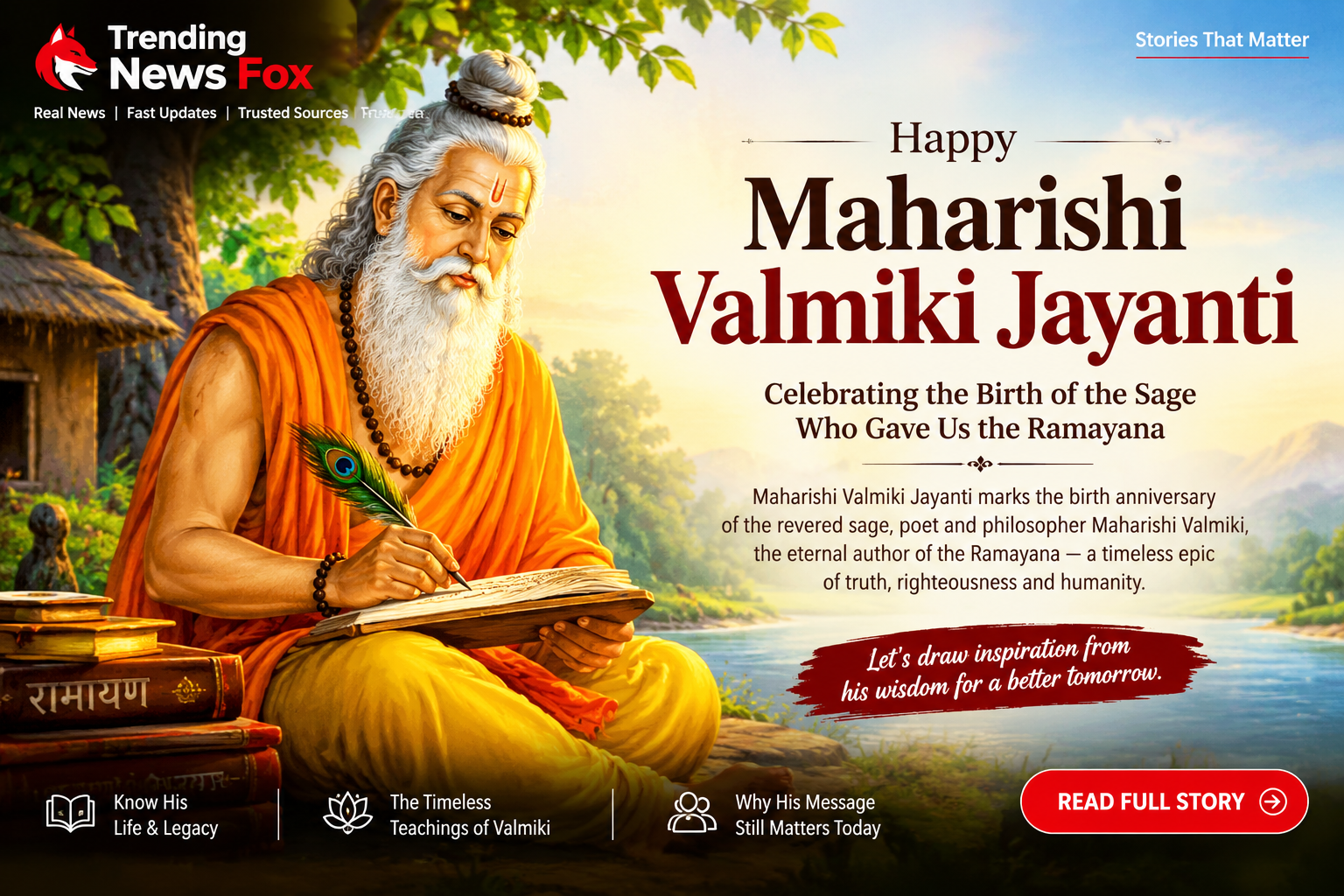
Maharishi Valmiki Jayanti 2026 falls on October 26. Explore its date, history, Ramayana significance, celebrations, wishes and timeless teachings.
By Trending News Fox, Kolkata, October 23, 2026
Maharishi Valmiki Jayanti 2026: Date, Significance, History, Celebrations and Timeless Lessons from the Ramayana
Maharishi Valmiki Jayanti 2026: India will celebrate Maharishi Valmiki Jayanti on Monday, October 26, 2026, honouring the revered sage traditionally known as the Adi Kavi, or the first poet of Sanskrit literature. The occasion celebrates his contribution to the epic Ramayana, his spiritual legacy and the timeless values of truth, compassion, justice and righteousness. As devotees prepare for the sacred occasion, Valmiki Jayanti offers an opportunity to revisit the teachings that continue to inspire millions of people across generations.
Trending News Fox brings you everything you need to know about Valmiki Jayanti 2026, including its date, religious significance, legendary history, traditional celebrations and important life lessons.
Maharishi Valmiki Jayanti 2026: Date and Important Details
Maharishi Valmiki Jayanti is observed annually on the full moon day, known as Purnima, of the Hindu lunar month of Ashwin. The festival usually falls in September or October according to the Gregorian calendar.
In 2026, the celebration will take place on October 26, Monday. The date is associated with Ashwin Purnima, an important occasion in the Hindu religious calendar. Traditional panchang calculations place the beginning of Purnima Tithi on October 25 and its conclusion on October 26, although exact timings can vary by location.
The day honours Maharishi Valmiki as a spiritual teacher, poet and revered figure in India’s literary and cultural heritage.
For devotees, the occasion is not merely a birth anniversary. It is also a reminder that wisdom, self-discipline and a commitment to positive change can transform human life.
Who Was Maharishi Valmiki?
Maharishi Valmiki occupies a distinguished place in Indian spiritual and literary traditions. He is widely revered as the author of the Sanskrit Ramayana, one of the most influential epics in Indian civilisation.
The Ramayana narrates the life of Lord Rama, his exile, the abduction of Sita, the search for her, the battle against Ravana and the restoration of righteousness. Beyond its religious importance, the epic explores family relationships, leadership, loyalty, sacrifice, duty and the consequences of human decisions.
Valmiki is known as the Adi Kavi because of his association with the beginnings of Sanskrit poetic tradition. His contribution has influenced Indian literature, theatre, music, dance, storytelling and religious practices for centuries.
The Ramayana has been retold in numerous Indian languages and adapted into different cultural traditions across South and Southeast Asia. These adaptations demonstrate the enduring influence of the epic and the continued relevance of its central themes.
Although many details of Valmiki’s historical life belong to traditional accounts rather than independently established historical records, his literary and cultural legacy remains profoundly significant.
The Inspiring Story of Maharishi Valmiki’s Transformation
One of the most widely narrated traditions associated with Valmiki describes his transformation from Ratnakar, a man believed to have lived by robbery, into a respected sage.
According to the traditional story, Ratnakar encountered the sage Narada, who encouraged him to reflect on his actions and the consequences of the life he was leading. The encounter prompted him to question whether the people for whom he committed wrongdoing would share responsibility for his actions.
The story describes Ratnakar beginning a period of deep meditation and spiritual discipline. Through sustained devotion and inner transformation, he eventually became Maharishi Valmiki.
His name is traditionally connected with the Sanskrit word for an anthill, reflecting the story that anthills formed around him during his prolonged meditation.
While this account belongs to religious tradition, its message remains powerful: people are not necessarily defined forever by their past mistakes. Self-reflection, determination and a willingness to change can lead to a better path.
For modern readers, the story offers a reminder that personal growth begins when individuals take responsibility for their choices and commit themselves to improvement.
Why Is Maharishi Valmiki Jayanti Celebrated?
Valmiki Jayanti celebrates the life and teachings of a sage whose influence extends far beyond the pages of a religious text.
The occasion carries several important messages.
1. Honouring the Ramayana
The festival recognises the literary, spiritual and cultural importance of the Ramayana. Its stories continue to influence discussions about family, leadership, courage, duty and moral responsibility.
2. Celebrating knowledge and wisdom
Valmiki’s legacy highlights the importance of literature, learning, reflection and the transmission of knowledge from one generation to another.
3. Promoting compassion and humanity
The traditional account of his transformation encourages people to look beyond a person’s past and recognise the possibility of positive change.
4. Encouraging righteousness
The Ramayana explores the challenges of choosing the right course of action, particularly when duty, personal relationships and difficult circumstances come into conflict.
5. Inspiring social harmony
Valmiki Jayanti is also an opportunity to promote dignity, equality, mutual respect and inclusion. Its message can encourage communities to reject prejudice and build a society in which every individual is treated with humanity.
Maharishi Valmiki Jayanti 2026: Rituals and Celebrations
Valmiki Jayanti is observed with devotion in different parts of India. The scale and style of celebrations vary between regions, temples and local communities.
1. Temple Visits and Prayers
Devotees visit temples dedicated to Maharishi Valmiki and other religious sites associated with the Ramayana tradition. People offer prayers and seek inspiration from the sage’s teachings.
2. Shobha Yatras and Processions
Organised religious processions, commonly known as Shobha Yatras, form an important part of celebrations in many places. Participants may carry portraits or representations of Maharishi Valmiki while devotional songs and religious chants accompany the procession.
These gatherings bring communities together in a shared expression of faith and cultural identity.
3. Ramayana Recitation
Some temples and community organisations arrange readings or recitations from the Ramayana. Devotees listen to episodes from the epic and reflect on the values represented by its characters.
4. Community Service and Charity
The festival provides an opportunity for charitable activities, including food distribution, support for disadvantaged families and community welfare initiatives. Such activities reflect the importance of compassion and responsibility towards others.
5. Cultural and Educational Programmes
Schools, cultural organisations and community groups may organise speeches, discussions, devotional programmes and performances based on the Ramayana.
These activities help younger generations understand the importance of India’s literary and spiritual traditions.
Travellers planning to attend local celebrations should confirm event schedules with the relevant temple or organising committee before visiting.
Five Timeless Life Lessons from Maharishi Valmiki
The legacy of Maharishi Valmiki offers lessons that remain relevant in today’s fast-changing world.
1. Change is always possible. The traditional story of Ratnakar’s transformation reminds us that people can learn from mistakes and work towards becoming better human beings.
2. Knowledge can transform society. Literature and education help people understand different perspectives, question assumptions and develop sound judgement.
3. Actions carry consequences. The Ramayana repeatedly explores the importance of personal responsibility and the long-term effects of decisions.
4. Compassion strengthens relationships. Respect, empathy and kindness can help individuals and communities overcome conflict and misunderstanding.
5. Integrity matters in leadership. The epic raises enduring questions about duty, justice and ethical conduct, making it a valuable starting point for discussions about responsible leadership.
These lessons can be applied at home, in schools, workplaces and public life.
Maharishi Valmiki Jayanti 2026: Relevance for the Younger Generation
In an age dominated by digital communication, rapid technological change and constant online information, the teachings associated with Valmiki remain relevant.
Young people can explore the Ramayana as a source of cultural knowledge, literary appreciation and ethical discussion. Reading different versions of the epic can also help them understand how stories evolve across languages, regions and generations.
Parents and teachers can use the occasion to encourage children to read, ask questions and discuss themes such as honesty, responsibility, courage and empathy.
The festival also offers an opportunity to examine the importance of respectful dialogue in a diverse society. Cultural traditions can become meaningful bridges between generations when they are shared through education, discussion and mutual understanding.
Valmiki Jayanti should therefore be viewed not only as an occasion for religious observance but also as a celebration of learning, reflection and cultural continuity.
Maharishi Valmiki Jayanti Wishes 2026
Here are some meaningful wishes that readers can share with family and friends:
- Happy Maharishi Valmiki Jayanti 2026! May the wisdom of the great sage inspire us to follow the path of truth, compassion and righteousness.
- On this sacred occasion, may the teachings of Maharishi Valmiki bring peace, knowledge and positivity into your life.
- Let us celebrate Maharishi Valmiki Jayanti by embracing kindness, respecting every individual and learning from the timeless wisdom of the Ramayana.
- May this Valmiki Jayanti inspire us to learn from our mistakes, improve ourselves and contribute to a more compassionate society.
- Warm wishes to everyone celebrating Maharishi Valmiki Jayanti 2026. May the spirit of knowledge and humanity guide us towards a brighter future.
Frequently Asked Questions (FAQs)
Q1. When is Maharishi Valmiki Jayanti in 2026?
Maharishi Valmiki Jayanti will be celebrated on Monday, October 26, 2026, according to commonly used Hindu calendar listings.
Q2. Why is Maharishi Valmiki called the Adi Kavi?
He is traditionally honoured as the Adi Kavi, meaning the first poet, because of his association with the Sanskrit poetic tradition and the Ramayana.
Q3. Which epic is Maharishi Valmiki associated with?
He is traditionally credited with composing the Sanskrit Ramayana, an influential epic narrating the life and journey of Lord Rama.
Q4. How is Valmiki Jayanti celebrated?
Common observances include temple visits, prayers, Shobha Yatras, Ramayana recitations, cultural programmes and charitable activities.
Q5. What is the main message of Valmiki Jayanti?
The occasion encourages learning, self-improvement, compassion, integrity and the pursuit of righteousness.
Q6. Is Maharishi Valmiki Jayanti a public holiday?
Holiday status varies by state, institution and workplace. It is listed as a restricted holiday in some Indian holiday calendars, so people should check the applicable government notification or their employer’s holiday list.
Conclusion: Celebrate the Legacy of Maharishi Valmiki
Maharishi Valmiki Jayanti 2026 is an opportunity to honour a revered sage whose association with the Ramayana has shaped India’s spiritual, literary and cultural traditions.
His enduring legacy encourages people to value knowledge, reflect on their actions, practise compassion and recognise the possibility of positive transformation. The festival also reminds us that cultural heritage becomes most meaningful when its lessons are reflected in everyday behaviour.
As India celebrates Valmiki Jayanti on October 26, let us renew our commitment to truth, respect, learning and social harmony.
Stay connected with Trending News Fox for more festival updates, important dates, cultural stories, religious observances and the latest news from India.
Share this article with your family and friends to spread awareness about Maharishi Valmiki Jayanti 2026. Leave a comment below: Which teaching associated with Maharishi Valmiki inspires you the most?
Trending News Fox — Your source for news, knowledge and meaningful stories.