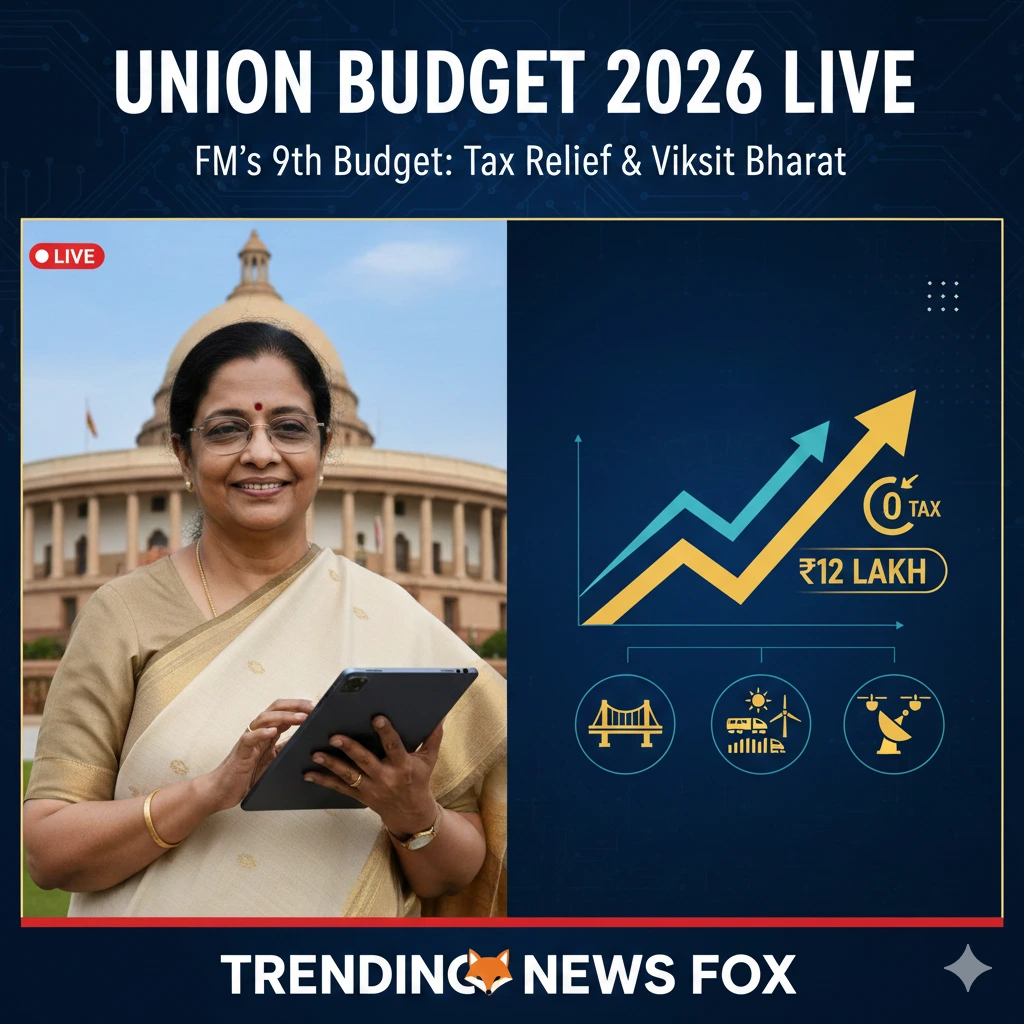
Budget Live: Finance Minister Nirmala Sitharaman shatters records with her 9th Budget. Get real-time updates on Income Tax changes, 80C hikes, gold prices, and big announcements for the middle class. Stay tuned to Trending News Fox for the latest!
Budget Live Audio Podcast Below:
Finance Minister Nirmala Sitharaman presented the Union Budget 2026–27 today, February 1, 2026. This was a landmark session as it was the first time a Budget was presented on a Sunday, and it marked the Minister’s record-breaking ninth consecutive Budget speech.
The overarching theme is “Viksit Bharat,” focusing on manufacturing, infrastructure, and simplifying the tax framework.
1. Key Income Tax Updates
- New Income Tax Act 2025: A massive overhaul was announced. The new framework will take effect from April 1, 2026, with simplified rules and redesigned forms intended to make compliance easier for the average citizen.
- No Slab Changes: Contrary to some expectations, there were no changes made to the existing income tax rates or slabs for FY 2026-27.
- Staggered Filing: Deadlines for ITR filing have been staggered. Individual taxpayers (ITR-1 and ITR-2) remain at July 31, but non-audit business cases now have until August 31.
- TCS/TDS Reductions: The Tax Collected at Source (TCS) on overseas tour packages and LRS remittances for education and medical purposes has been reduced from 5–20% down to 2%.
- Relief for Accident Victims: Interest awarded by the Motor Accident Claims Tribunal to individuals is now exempt from income tax.
2. Economy & Finance
- Fiscal Deficit: Targeted at 4.3% of GDP for FY27, continuing the path of fiscal consolidation.
- Growth Projections: The Economic Survey projects India’s growth at 7.4% for FY26 and between 6.8–7.2% for FY27.
- Capital Expenditure: Raised to ₹12.2 lakh crore, a significant jump to drive infrastructure and jobs.
3. Major Sectoral Announcements
| Sector | Key Initiative |
| Manufacturing | Launch of ISM 2.0 for semiconductors and a ₹40,000 crore outlay for electronics. |
| Healthcare | Customs duty waived for 17 cancer drugs; 75,000 new medical seats over 5 years. |
| Education | “She MARTS” (girls’ hostels) in every district; AVGC labs in 15,000 schools. |
| Pharma | “Biopharma Shakti” launched with a ₹10,000 crore outlay over 5 years. |
| Technology | Tax holiday until 2047 for foreign cloud companies using Indian data centers. |
4. What Gets Costlier/Cheaper?
- Cheaper: Imported goods for personal use (customs duty cut from 20% to 10%), cancer medicines, and seafood inputs.
- Costlier: Stock market trading (STT on Futures raised to 0.05% and Options to 0.15%). Misreporting income now carries a 100% penalty.
Note: The “Orange Economy” (creative industries like gaming and comics) received a major nod today, with the government aiming to create 2 million jobs in this sector by 2030.
Budget Live Video Below:
Finance Minister Nirmala Sitharaman has just concluded her speech for the Union Budget 2026-27. As of 12:10 PM IST, the focus has shifted from the podium to the detailed fine print of the New Income Tax Act, 2025.
Here are the definitive live updates and key announcements:
💰 Direct Tax & Personal Finance
This budget marks the official transition to the New Income Tax Act, 2025, which replaces the 64-year-old 1961 Act.
- Tax Slabs (New Regime): While major slab shifts were avoided, the government has focused on deepening the “New Regime” adoption.
- Standard Deduction: Increased from ₹75,000 to ₹1,00,000 for salaried individuals under the new regime.
- TCS Relief: The government has slashed the TCS rate on the sale of overseas tour programme packages, providing relief to international travelers.
- Capital Gains: Proposals include raising the exemption limit for Long Term Capital Gains (LTCG) to ₹2 lakh (up from ₹1.25 lakh).
🏗️ Infrastructure & Railways
- Capex Outlay: Proposed at ₹12.2 lakh crore for FY27, a 9% increase to maintain the momentum of “Viksit Bharat.”
- High-Speed Corridors: 7 new high-speed rail corridors announced, including the Mumbai–Pune route.
- New Freight Corridors: A new dedicated freight corridor will connect Dankuni (East) to Surat (West).
- Logistics: The Coastal Cargo Promotion Scheme aims to double the share of inland waterways and coastal shipping from 6% to 12% by 2047.
🔬 Manufacturing & Technology
- India Semiconductor Mission (ISM) 2.0: Launched with a massive outlay of ₹40,000 crore.
- Biopharma SHAKTI: A new ₹10,000 crore scheme to boost domestic production of biologics and biosimilars to tackle diseases like cancer and diabetes.
- Rare Earth Corridors: Dedicated corridors in Odisha, Kerala, Andhra Pradesh, and Tamil Nadu to secure critical mineral supply chains.
- SME Growth Fund: A ₹10,000 crore fund established to provide risk capital to job-creating micro and small enterprises.
🌍 Energy & Sustainability
- Carbon Capture: A ₹20,000 crore outlay for Carbon Capture, Utilization, and Storage (CCUS) technologies targeting the steel and cement sectors.
- City Economic Regions (CER): Allocation of ₹5,000 crore per city over 5 years to develop Tier-2 and Tier-3 cities as growth hubs.
📊 Fiscal Indicators
- Fiscal Deficit: Target set at 4.3% of GDP for FY27 (down from 4.4% in FY26).
- GDP Growth: The budget is built on a nominal GDP growth assumption of 10.1%.
📉 Market Watch
- Nifty Pharma & Healthcare: Up nearly 2% following the Biopharma SHAKTI announcement.
- Sin Goods: Cigarette prices are set to rise as the new excise duty (up to ₹8.50 per stick) takes effect immediately.
Finance Minister Nirmala Sitharaman is currently presenting the Union Budget 2026-27 in Parliament. This is a historic session, being the first time a budget is presented on a Sunday and the first since the transition to the New Income Tax Act, 2025.
Here are the key announcements as of 11:40 AM IST:
🏗️ Infrastructure & Railways
- Capex Boost: The government has proposed increasing capital expenditure to ₹12.2 lakh crore for FY27 (up from ₹11.2 lakh crore).
- High-Speed Rail: Plans for 7 new high-speed rail corridors have been announced, including routes like Mumbai–Pune, Hyderabad–Bengaluru, and Delhi–Varanasi.
- Infrastructure Risk Guarantee Fund: A new fund will be established to provide credit guarantees to lenders, reducing risks for private developers during the construction phase.
💻 Technology & Manufacturing
- ISM 2.0: The launch of India Semiconductor Mission 2.0 was announced with a focus on indigenous equipment, materials, and IP. The outlay for electronics manufacturing has been hiked to ₹40,000 crore.
- Rare Earth Corridors: Dedicated corridors for mining and processing rare earth minerals will be set up in Odisha, Kerala, Andhra Pradesh, and Tamil Nadu.
- Container Manufacturing: A new scheme with an allocation of ₹10,000 crore over five years aims to make India a global hub for container production.
🏥 Health & Social Sector
- Biopharma SHAKTI: A new scheme with a ₹10,000 crore outlay over 5 years to boost the domestic production of biologics and biosimilars.
- Textile Sector: An integrated program including the National Fiber Scheme and SAMARTH 2.0 was proposed to modernize the labor-intensive textile industry.
- Mahatma Gandhi Gram Swaraj: An initiative to strengthen handloom and handicrafts with global market linkages.
💰 Income Tax (Live Updates)
While the FM is currently moving through Part B of the speech, the focus is on the implementation of the New Income Tax Act, 2025 (replacing the 1961 Act).
- Status: Markets and taxpayers are waiting for the specific final word on the Standard Deduction and any changes to the tax slabs for the upcoming fiscal year.
- Current Framework: Under the existing new regime, income up to ₹12 lakh is practically tax-free (due to rebates), and up to ₹12.75 lakh for salaried individuals (including the ₹75,000 standard deduction).
📈 Market Reaction
- Nifty 50: Trading slightly lower at 25,362 (-0.22%) as the speech progresses.
- Sectors in Green: Defense, Railways, and Semiconductor-related stocks are seeing positive momentum following the specific allocation news.
Today, February 1, 2026, Finance Minister Nirmala Sitharaman is presenting her record-breaking 9th consecutive Union Budget (FY 2026-27). This is a historic moment as it’s the first time a budget is being presented on a Sunday.
The speech began at 11:00 AM IST. Here are the latest live updates and key highlights:
📢 Budget 2026: Live Highlights
- Infrastructure & Capex: The government is expected to allocate approximately ₹12.04 lakh crore for capital expenditure (nearly 3% of GDP), continuing the push for long-term growth.
- Income Tax (New Tax Act 2025): A major focus is the transition to the New Income Tax Act, 2025, set to replace the 1961 Act from April 1, 2026. The middle class is watching closely for a possible hike in the Standard Deduction (currently ₹75,000 in the new regime).
- Railway Budget: Key priorities include the rollout of Vande Bharat Sleeper trains, the Kavach 4.0 safety system, and an increase in non-AC coaches to manage overcrowding.
- Economic Outlook: The Economic Survey (tabled on Jan 29) projected a real GDP growth of 7.4% for FY26, with a slight moderation to 6.8–7.2% expected for FY27.
- GST & Revenue: January 2026 GST collections hit a strong ₹1.93 lakh crore, a 6.2% year-on-year increase.
💰 Tax Expectations & Changes: Budget Live
While the full details of the speech are unfolding, these are the primary areas of focus for taxpayers:
| Category | Key Anticipation / Update |
| New Tax Regime | Possible expansion of the 87A rebate to provide a zero-tax window for higher income levels. |
| Standard Deduction | Industry experts have urged an increase to ₹1 lakh to combat inflation. |
| Corporate Tax | Potential relief for manufacturers to boost the “Make in India” initiative. |
| “Sin Goods” | New excise duties have kicked in today for cigarettes and pan masala, making them costlier. |
🚀 Sector Watch: Budget Live
- Defence: Production has crossed ₹1.3 lakh crore annually; higher outlays for domestic procurement are expected.
- AI & Tech: A “bottom-up” strategy for AI adoption and incentives for semiconductor manufacturing are high on the agenda.
- Agriculture: Focus on climate-resilient seeds and the Prime Minister Dhan-Dhaanya Krishi Yojana.
Budget Live: FM Sitharaman Shatters Records with 9th Budget; Tax Relief and “Viksit Bharat” Take Center Stage
By Trending News Fox Editorial Team Published: February 1, 2026 | 11:30 AM IST
New Delhi — History was made today in the Central Hall of Parliament as Finance Minister Nirmala Sitharaman presented the Union Budget 2026-27. Marking her ninth consecutive budget—surpassing all previous records—Sitharaman delivered a fiscal roadmap focused on aggressive infrastructure growth, middle-class tax relief, and a “Viksit Bharat” (Developed India) 2047 vision.
In a rare move, the Budget was presented on a Sunday, only the second time in India’s history (the first being in 1999). As the Finance Minister opened her digital “Bahi Khata” (tablet), the nation tuned in to see how the government would balance fiscal discipline with the rising cost of living and global trade headwinds.
1. Income Tax Revolution: The ₹12 Lakh “Zero Tax” Milestone
The biggest headline for the common man is the massive overhaul of the New Tax Regime. In a bid to put more money into the pockets of the salaried class, the government has further sweetened the deal for those opting for the default tax system.
Budget Live: New Income Tax Slabs for FY 2026-27 (AY 2027-28)
The standard deduction has been hiked from ₹75,000 to ₹1,00,000, and the rebate under Section 87A ensures that individuals earning up to ₹12 lakh per annum will effectively pay zero tax under the New Tax Regime.
| Income Slab | Tax Rate (New Regime) |
| Up to ₹4,00,000 | Nil |
| ₹4,00,001 – ₹8,00,000 | 5% |
| ₹8,00,001 – ₹12,00,000 | 10% |
| ₹12,00,001 – ₹16,00,000 | 15% |
| ₹16,00,001 – ₹20,00,000 | 20% |
| ₹20,00,001 – ₹24,00,000 | 25% |
| Above ₹24,00,000 | 30% |
Analyst Note: The reduction of the highest surcharge rate from 37% to 25% remains in effect, making the New Regime significantly more attractive for high-net-worth individuals as well.
2. Infrastructure & Capex: The ₹12.04 Lakh Crore Push
The government continues its “build-mode” strategy. The capital expenditure (Capex) outlay for 2026-27 has been pegged at a staggering ₹12.04 lakh crore, roughly 3% of India’s GDP.
Key Infrastructure Highlights: Budget Live
- Railways: A record allocation for the “Vande Bharat” expansion, with 100 new routes and the introduction of “Vande Metro” for inter-city travel.
- Nuclear Energy Mission: A new mission aiming for 100 GW of nuclear power by 2047, with an initial ₹20,000 crore investment into Small Modular Reactors (SMRs).
- Bharat Net Initiative: Aiming to provide 100% broadband connectivity to all rural government schools and health centers by the end of the fiscal year.
3. Defense: Strengthening the “Atmanirbhar” Shield
Defense spending is projected to rise significantly, with the outlay crossing ₹7 lakh crore for the first time.
- Domestic Procurement: Over 65% of the defense budget is now earmarked for domestic suppliers to boost “Make in India.”
- Defense Exports: Having crossed ₹21,000 crore in FY25, the government has set a target of ₹35,000 crore for FY27.
4. Agriculture 2.0: Tech-Smart Farming
The Finance Minister emphasized “Climate-Smart Agriculture.” To combat unpredictable weather patterns, the government announced:
- Digital Public Infrastructure (AGRISTACK): A centralized database to provide farmers with real-time weather, crop insurance, and market price data.
- Drones & AI: Subsidies for “Agri-Drones” have been extended to individual farmers, not just cooperatives.
- Critical Minerals: Basic Customs Duty has been fully exempted on 15 critical minerals including cobalt and lithium, aiming to lower the cost of EV batteries and solar panels for rural use.
5. Fiscal Deficit & Economic Outlook
Despite the heavy spending, the government remains committed to fiscal consolidation.
- Fiscal Deficit Target: Targeted at 4.2% of GDP for FY27, down from the 4.4% achieved in FY26.
- GDP Growth: The Economic Survey projects a real GDP growth of 6.8%–7.2% for the upcoming year, positioning India as the fastest-growing major economy.
“Our focus is on the four pillars: the Poor, the Women, the Youth, and the Farmers (Gyan),” Sitharaman noted during her 95-minute speech.
6. Sectoral Winners and Losers
Budget Live Winners:
- Electronics & Manufacturing: Simplified tax systems for non-residents and duty cuts on raw materials.
- Renewable Energy: Focus on Small Modular Reactors and Solar “Surya Ghar” schemes.
- Real Estate: While the indexation benefit debate continues, the push for affordable housing under PMAY-Urban 2.0 provides a boost.
Budget Live Losers/Challenges:
- Global Importers: While customs slabs were rationalized from 8 to 4, certain “non-essential” luxury imports may see a hike.
- LTCG Investors: The market remains cautious as there was no rollback of the 12.5% Long-Term Capital Gains tax introduced in previous years.
7. The “Trump Factor”: Navigating Global Trade
Subtly woven into the budget was a strategy to insulate India from external shocks, specifically referring to the shifting trade dynamics with the US. By lowering import duties on critical materials and incentivizing local manufacturing, the Budget aims to make India a resilient global supply chain hub, regardless of geopolitical volatility.
Conclusion: A Budget for the “Amrit Kaal”
The Union Budget 2026-27 is a clear attempt to marry populist relief with long-term industrial ambition. By providing significant income tax relief to the middle class, the government hopes to spur domestic consumption, which has been the “twin engine” of growth alongside public investment.
As the markets react to these announcements—with the Sensex showing early gains of 450 points—the focus now shifts to the implementation of these mega-projects and the actual “take-home” impact on the average Indian citizen.
Trending News Fox will continue to bring you live updates and deep-dive analysis of the Finance Bill 2026. Stay tuned!
Budget Live: Frequently Asked Questions (FAQs)
1. What are the new Income Tax slabs for 2026-27?
Under the New Tax Regime for FY 2026-27, the slabs have been rationalized to provide relief to the middle class. Individuals earning up to ₹12 lakh now pay zero tax (after the Section 87A rebate). The new slabs are:
- Up to ₹4 Lakh: Nil
- ₹4L – ₹8L: 5%
- ₹8L – ₹12L: 10%
- ₹12L – ₹16L: 15%
- ₹16L – ₹20L: 20%
- ₹20L – ₹24L: 25%
- Above ₹24 Lakh: 30%
2. Has the Standard Deduction been increased in Budget 2026?
Yes. In a major win for salaried employees, the Standard Deduction has been hiked from ₹75,000 to ₹1,00,000 under the New Tax Regime. This move is expected to save salaried individuals an additional ₹7,500 to ₹10,000 in taxes annually.
3. What is the impact of Budget 2026 on the Stock Market?
The market has reacted positively to the ₹12.04 lakh crore Capex outlay, specifically boosting defense, railway, and infrastructure stocks. However, investors are closely monitoring any updates to Long-Term Capital Gains (LTCG) and Securities Transaction Tax (STT) for F&O trading.
4. Which items became cheaper or costlier after the 2026 Budget?
- Cheaper: Mobile phones, lithium-ion batteries (EVs), solar panels, and 15 critical minerals (due to customs duty exemptions).
- Costlier: Certain luxury imported goods and non-essential electronic imports where basic customs duty was hiked to protect “Make in India.”
5. What are the big announcements for Farmers?
The government launched AgriStack, a digital public infrastructure for farmers, and extended subsidies for Agri-Drones. A new mission for “Climate-Resilient Seeds” was also announced to tackle unpredictable weather patterns.
6. Is the Old Tax Regime still available?
Yes, the Old Tax Regime remains available, but the Finance Minister did not announce any new changes to its slabs or Section 80C limits (which stay at ₹1.5 lakh). The government continues to nudge taxpayers toward the New Tax Regime as the default and more “simplified” option.
7. Why was the Budget 2026 presented on a Sunday?
In a rare historical move, the Union Budget was presented on February 1, 2026 (Sunday) to ensure that the markets and businesses have a full day to process the announcements before the trading week begins on Monday.