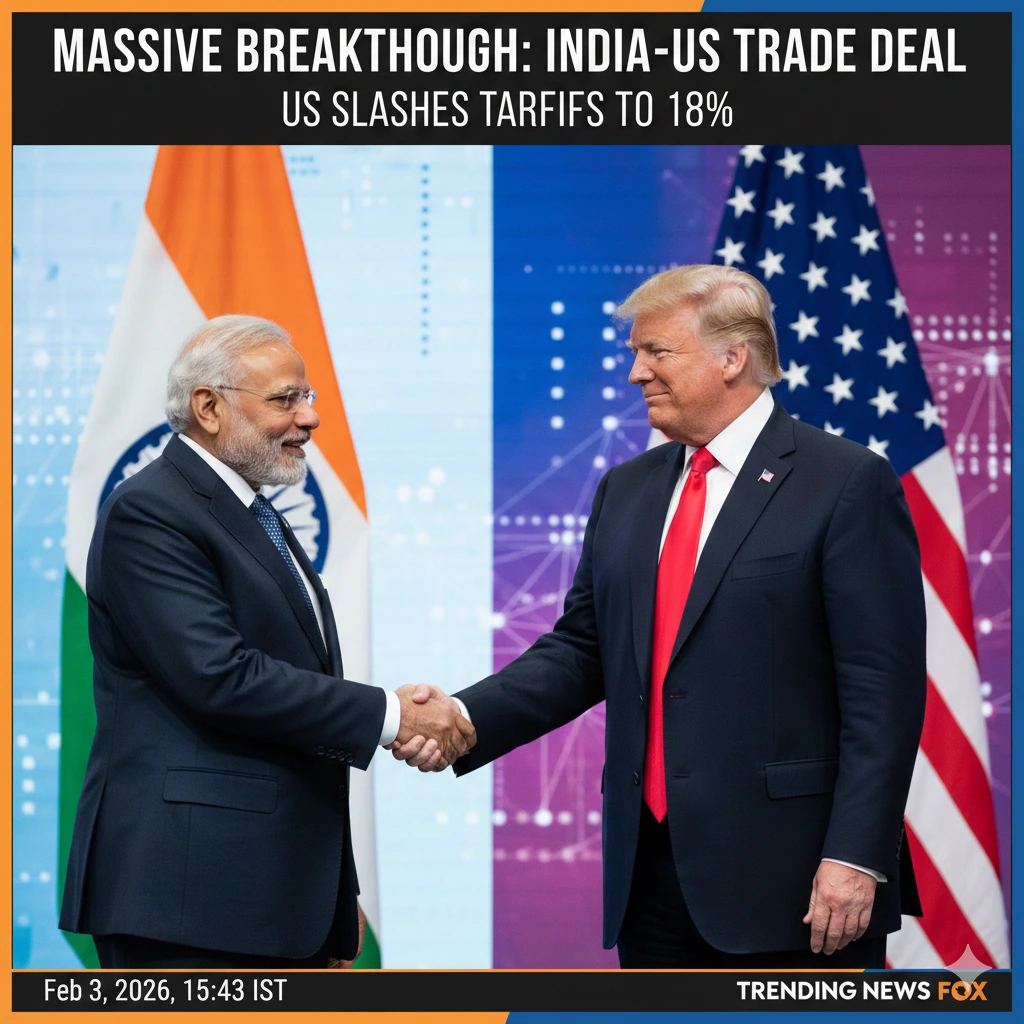
The US and India have signed a massive India US Trade Deal, cutting tariffs to 18%. India agrees to halt Russian oil purchases in a $500B energy shift. Read the full breakdown.
By Trending News Fox Editorial Team Published: February 3, 2026 | 3:30 PM IST
Massive Breakthrough: India and U.S. Seal Historic Trade Deal, Slashes Tariffs to 18%
NEW DELHI / WASHINGTON D.C. — In a monumental shift for global commerce, India and the United States have officially inked a “historic” trade agreement, effectively ending months of escalating tariff wars and diplomatic tension. Announced late Monday, February 2, 2026, by U.S. President Donald Trump and Prime Minister Narendra Modi, the deal marks a strategic “reset” that positions India as a primary economic alternative to China in the Indo-Pacific region.
The agreement, which saw immediate implementation, centers on a significant reduction of U.S. reciprocal tariffs on Indian goods—dropping from a staggering 50% (including punitive levies) to a streamlined 18%. In exchange, New Delhi has committed to a massive $500 billion purchase of American energy, technology, and defense equipment, alongside a controversial but decisive pivot away from Russian energy.
The Grand Bargain: Energy for Market Access
The cornerstone of this deal rests on a “quid pro quo” that reshapes India’s geopolitical alignment. For over a year, Washington had imposed a 25% “reciprocal tariff” plus an additional 25% penalty on Indian imports, citing New Delhi’s continued purchase of Russian oil amid the ongoing conflict in Ukraine.
Key Provisions of the 2026 Deal:
- Tariff Reduction: U.S. tariffs on “Made in India” products are slashed to 18%.
- Russian Oil Exit: India has agreed to halt its imports of Russian crude oil, which recently accounted for over one-third of its total oil intake.
- The $500 Billion Commitment: India will significantly scale up imports of U.S. liquefied natural gas (LNG), crude oil, coal, and “trusted” technology.
- Agricultural Access: India will lower barriers for U.S. farm products, a move hailed by U.S. Secretary of Agriculture Brooke Rollins as a “cash pump for rural America.”
President Trump, speaking via Truth Social following a phone call with PM Modi, described the pact as the “Father of All Deals,” emphasizing that it would help “end the war in Ukraine” by cutting off a major source of revenue for Moscow.
Winners and Losers: A Sector-Wise Breakdown
The news sent Indian markets into a frenzy on Tuesday, with the Sensex and Nifty 50 rallying nearly 3%. The deal provides a critical “competitive edge” for Indian exporters against regional rivals.
1. Textiles and Apparels
This sector is perhaps the biggest winner. With the U.S. accounting for 28% of India’s textile exports, the 18% tariff provides a vital lifeline. Stocks like Indo Count, Kitex, and Welspun India saw double-digit surges.
2. Gems and Jewelry
The Gem & Jewellery Export Promotion Council (GJEPC) hailed the deal as “vital relief.” Indian jewelry had been under severe pressure from high U.S. duties, and the reduction is expected to restore buyer confidence in New York and Los Angeles.
3. The Energy Pivot
While Indian refiners must now navigate the logistical shift away from Russian Urals, the deal secures long-term energy security through U.S. shale oil and LNG. American energy now accounts for nearly 10% of India’s crude imports, a figure set to double.
4. The China Factor
Strategically, the 18% tariff puts India in a superior position compared to China (which faces 34% tariffs) and even neighbors like Vietnam (20%) and Indonesia (19%).
| Country | 2026 U.S. Tariff Rate |
| India | 18% |
| Indonesia | 19% |
| Vietnam | 20% |
| China | 34% |
Economic Impact: GDP and the Rupee
Financial analysts are already adjusting their forecasts. Goldman Sachs raised India’s CY2026 real GDP growth forecast to 6.9%, citing a reduction in “trade-policy uncertainty.”
“This agreement unlocks unprecedented opportunities for farmers, MSMEs, and entrepreneurs to ‘Make in India’ for the world,” stated Commerce Minister Piyush Goyal.
The Indian Rupee also saw a sharp appreciation against the dollar, as the deal is expected to stem capital outflows and attract fresh Foreign Direct Investment (FDI) into India’s manufacturing hubs.
Political Friction: “Historic Leap” vs. “Capitulation”
Despite the economic optimism, the deal has sparked a fierce political debate within India.
- The Government: Union Ministers and State Leaders, including Haryana CM Nayab Singh Saini, called it a “historic leap” that fuels inclusive growth.
- The Opposition: Congress leader Rahul Gandhi slammed the move, alleging that PM Modi has “sold out” Indian farmers to appease Washington. The primary concern lies in the “Zero Tariff” access promised to U.S. agricultural giants, which critics fear could undercut local produce prices.
India US Trade Deal: What’s Next?
While the immediate tariff cuts are in effect, “comprehensive talks” are still underway to finalize the fine print on intellectual property, data localization, and specific dairy market access.
For the global economy, this deal signals that the U.S. is doubling down on its “friend-shoring” strategy, firmly placing India at the center of its non-China supply chain. As 2026 unfolds, the success of this deal will depend on how quickly Indian industry can scale up to meet the renewed American demand.
Stay tuned to Trending News Fox for live updates on the India-U.S. trade implementation and market reactions.
Also, read 15 Best Dress Shoes for Men in 2026: Top Comfort & Style Picks
India US Trade Deal: Frequently Asked Questions (FAQ)
1. What is the new India US Trade Deal tariff rate for Indian goods in the U.S.?
As per the February 2026 agreement, the U.S. has reduced the reciprocal tariff on Indian goods to 18%. This is a major reduction from the previous 50% total levy, which included a 25% base tariff and an additional 25% punitive duty related to India’s Russian oil imports.
2. Did India agree to stop buying Russian oil?
Yes. A key condition for the U.S. dropping its additional 25% penal duty was India’s commitment to halt crude oil imports from Russia. President Trump confirmed that India will pivot its energy sourcing to the United States and potentially other partners like Venezuela to fill the gap.
3. What is the $500 billion commitment mentioned in the India US Trade Deal?
U.S. President Donald Trump stated that Prime Minister Modi committed to purchasing over $500 billion in American energy, technology, agricultural products, and coal. While seen as a long-term strategic ambition rather than an immediate contractual obligation, it signals a massive shift in India’s import priorities.
4. Which Indian sectors will benefit most from the India US Trade Deal?
The 18% tariff rate provides immediate relief to labor-intensive and high-volume export sectors, including:
- Textiles and Apparels: (The U.S. is India’s largest market, taking 28% of exports).
- Gems and Jewelry: Restoring competitive pricing in the American luxury market.
- Auto Ancillaries: Boosting India’s role in the global EV and automotive supply chain.
- Seafood: Particularly frozen shrimp exporters who rely heavily on U.S. demand.
5. How does this deal affect India’s standing compared to China?
The deal gives India a significant competitive advantage. With an 18% tariff, India now faces lower barriers than China (34%), Vietnam (20%), and Bangladesh (20%). This makes “Made in India” products more attractive to U.S. retailers looking to diversify away from Chinese manufacturing.
6. Why did the U.S. and India sign this deal now?
The deal serves as a strategic “reset” to stabilize global supply chains and counter China’s economic influence. For the U.S., it secures a massive market for its energy and farm goods; for India, it removes “tariff uncertainty” that had been hampering GDP growth and capital inflows since 2025.
Also, read 10 Best Dress Shirts for Men in 2026: Top Brands for Every Budget