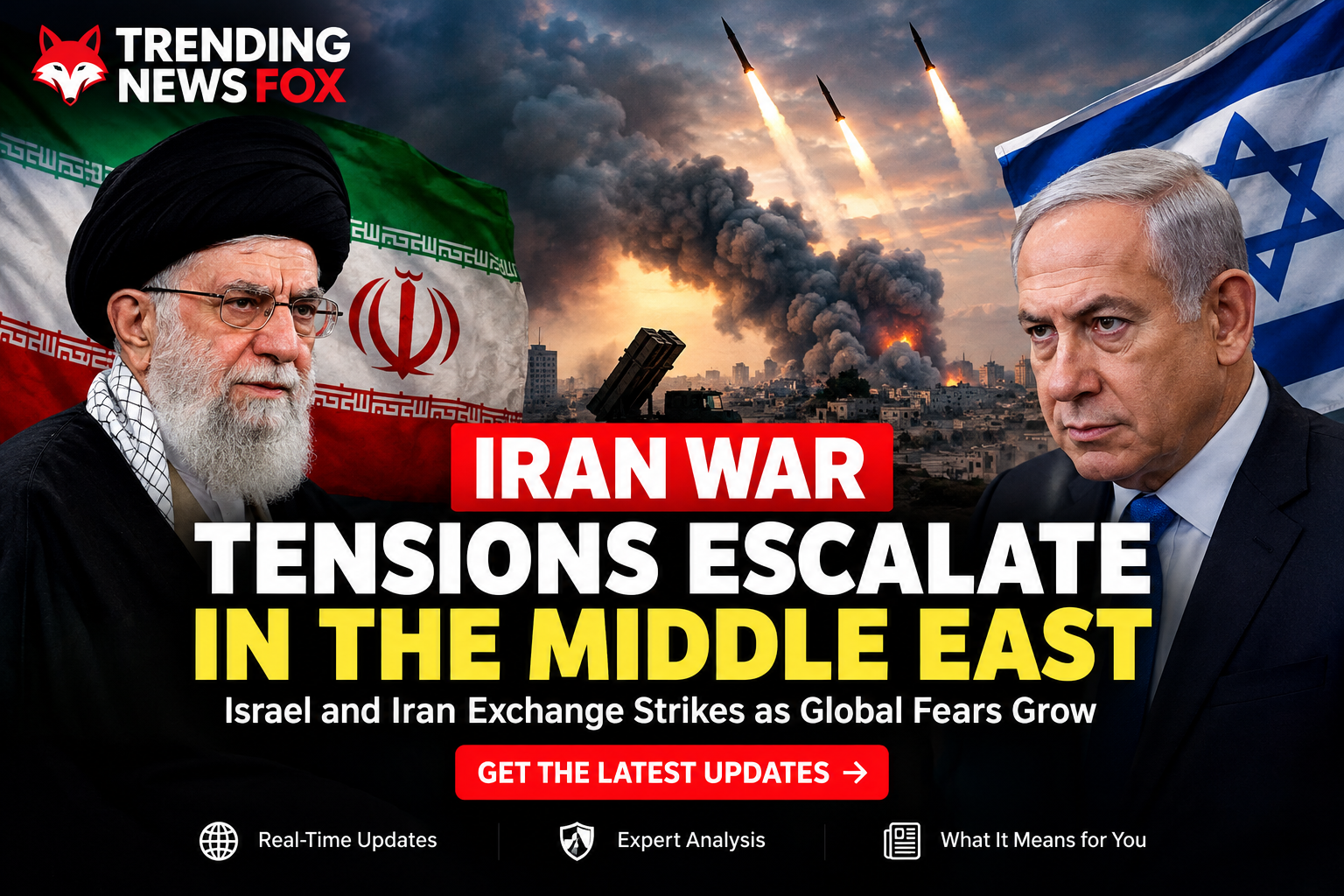
Iran war latest news on October 18, 2026: Strait of Hormuz tensions, shipping attacks, stalled peace talks, global oil prices and possible impacts on India.
By Trending News Fox, News & Media Team, Kolkata, October 18, 2026
Iran War Latest News Today: Shipping Attacks Raise Fears of Wider Middle East Conflict
Strait of Hormuz Becomes the Centre of the Crisis
The Strait of Hormuz has emerged as one of the most important flashpoints in the ongoing conflict. This narrow maritime passage connects the Persian Gulf with the Gulf of Oman and is a vital route for international energy supplies.
Before the war, roughly one-fifth of global oil and liquefied natural gas trade passed through the strait. Restrictions, attacks on commercial vessels and uncertainty over safe passage have disrupted shipping and increased concerns among energy traders, shipping companies and governments. Reuters reported on October 14 that maritime attacks had intensified and that Iran was changing its tactics against vessels it considered to be violating its restrictions.
The United States has maintained pressure on Iran through military operations and restrictions on Iranian maritime trade. Tehran, meanwhile, has sought leverage over the waterway as part of its broader strategy. Both sides have made competing claims about control of the strait, leaving commercial operators facing an unpredictable security environment.
Recent reports have also described attacks on vessels near Saudi Arabia and incidents involving shipping in the Arabian Sea. The United Kingdom Maritime Trade Operations agency has been monitoring reported maritime security incidents in the region. Responsibility for individual attacks must be established carefully, as some incidents have not been publicly attributed to a specific party.
These developments make the Strait of Hormuz a critical factor in determining whether the conflict escalates further or moves towards a negotiated settlement.
Iran War Latest News Today: Peace Talks Remain Uncertain as Washington and Tehran Disagree
Diplomatic efforts to end the war have continued, but major differences remain between Iran and the United States.
Iran has argued that reopening the Strait of Hormuz must be linked to guarantees that hostilities will end. Its proposals have included demands concerning sanctions, frozen assets and the US naval blockade. Washington, in turn, has sought concessions from Tehran, including on nuclear-related issues and regional security.
According to the Associated Press, mediators have continued exploring possible arrangements despite repeated setbacks. Negotiations have involved regional intermediaries, including Qatar and Pakistan, while proposals have attempted to address maritime access and the conditions needed to halt the fighting.
However, the two sides have not reached a durable agreement that resolves their central disagreements. A diplomatic proposal, an exchange of messages or a statement expressing willingness to negotiate should not be mistaken for a confirmed ceasefire.
The situation remains fragile because military incidents can quickly undermine diplomatic progress. Even if negotiators make progress on shipping arrangements, disagreements over sanctions, security guarantees and Iran’s nuclear programme could complicate a broader settlement.
The coming days will therefore be important for determining whether diplomatic contacts produce concrete commitments or whether the confrontation enters another dangerous phase.
Iran War Latest News Today: Oil Prices and the Global Economy Face Fresh Risks
The Iran war is not simply a regional security crisis. It also has the potential to affect the cost of energy, transportation, manufacturing and everyday goods across the world.
When commercial shipping becomes more dangerous, tanker operators and insurers may demand higher premiums. Longer routes, delayed deliveries and reduced vessel availability can add to transportation expenses. Oil markets also respond to expectations about future supply, meaning prices can rise when traders fear a disruption even before shortages become widespread.
Reuters reported on October 13 that Brent crude remained above $100 per barrel amid persistent regional security concerns and elevated transportation costs. The precise price changes over time depend on market conditions, production decisions, inventories and expectations about the duration of the conflict.
Higher energy costs can eventually feed into inflation. Businesses that depend on fuel, freight and petrochemical products may face increased expenses, some of which can be passed on to consumers.
However, the impact is not uniform. Countries with diversified energy supplies, adequate reserves or alternative transportation arrangements may be better positioned to manage disruptions. Prices can also move downward if shipping conditions improve or credible diplomatic progress reduces the risk premium.
For households, the most important issue is whether elevated costs persist long enough to affect transport fares, household budgets, food distribution and other essential expenses.
Iran War Latest News Today: What the Iran War Means for India
India has significant reasons to monitor developments in the Persian Gulf. The country imports a substantial share of its crude oil requirements, and international energy prices influence domestic fuel costs, the current account and inflation.
A prolonged disruption around the Strait of Hormuz could create challenges for Indian energy buyers and shipping companies. Higher crude prices may increase import expenditure, while more expensive freight and insurance can raise the overall cost of transporting commodities.
The consequences could extend to aviation, logistics, manufacturing and agriculture. Fuel and transportation expenses influence the movement of goods, while some agricultural inputs are linked to global energy and fertiliser markets.
For consumers, the possible effects include pressure on household spending and the cost of transporting essential products. Businesses with thin profit margins may also find it harder to absorb higher input costs.
Nevertheless, it would be premature to assume that every international oil-price increase will immediately result in a corresponding increase in Indian retail fuel prices. Domestic prices depend on several factors, including government policy, taxation, currency movements, refining costs and decisions by fuel retailers.
India also has strategic interests in regional stability, the safety of Indian nationals abroad and uninterrupted commercial links with Gulf countries. Continued monitoring of maritime security, energy supplies and diplomatic developments is therefore essential.
Iran War Latest News Today: Humanitarian Concerns Extend Beyond the Battlefield
Behind the military and economic headlines are civilians facing uncertainty, displacement and the possibility of losing access to essential services.
Escalating conflict can damage homes and infrastructure, disrupt medical care and force families to leave affected areas. People who depend on stable electricity, clean water, food supplies and regular healthcare are particularly vulnerable when fighting intensifies.
The wider Middle East remains affected by multiple interconnected conflicts. Recent Associated Press reporting has described renewed violence in Gaza and Yemen, as well as incidents involving commercial vessels in regional waters. These developments illustrate how insecurity in one area can interact with existing political and humanitarian crises elsewhere.
Protecting civilians, enabling humanitarian assistance and safeguarding medical facilities must remain priorities. International humanitarian law places obligations on parties to armed conflict, including requirements concerning the protection of civilians.
Accurate reporting is equally important. Unverified casualty figures, misleading videos and claims circulated without reliable evidence can deepen public anxiety and inflame tensions. Readers should distinguish confirmed facts from allegations and avoid sharing material whose origin cannot be established.
What Could Happen Next?
Several developments could shape the next phase of the Iran war.
First, renewed diplomatic progress: If Washington and Tehran agree on credible security arrangements, a halt to hostilities and a workable framework for reopening the Strait of Hormuz, tensions could begin to ease. Such an outcome would depend on implementation, not merely announcements.
Second, continued maritime confrontation: Further attacks, threats or restrictions affecting commercial vessels could keep shipping costs elevated and increase pressure on global energy markets. Miscalculations involving military forces or civilian shipping could also widen the conflict.
Third, a broader regional escalation: Continued hostilities involving other regional actors could create additional security challenges, especially if attacks spread to more shipping routes or energy infrastructure.
Fourth, a prolonged stalemate: Even without a dramatic new offensive, an extended conflict could maintain uncertainty, delay investment and increase the economic burden on businesses and households.
None of these scenarios is guaranteed. The most reliable assessment will depend on verified developments, official statements, independent reporting and evidence of actual changes in military activity or maritime traffic.
Key Developments Readers Should Watch
For anyone following Iran war latest news, five indicators deserve particular attention:
- Whether the United States and Iran announce a verifiable ceasefire or reach a substantive diplomatic agreement.
- Whether commercial shipping through the Strait of Hormuz becomes safer and more predictable.
- Whether attacks on tankers, cargo ships or energy infrastructure continue.
- How global crude oil prices, freight costs and insurance premiums respond to developments.
- Whether regional governments and international mediators make measurable progress towards de-escalation.
These indicators provide a more useful picture than relying on isolated headlines or unconfirmed claims circulating on social media.
Conclusion: Can Diplomacy Prevent Another Escalation?
The Iran war remains a serious international concern, with maritime security, energy supplies and diplomatic negotiations closely connected. The Strait of Hormuz continues to be a critical pressure point, while disagreements over sanctions, security guarantees and nuclear issues complicate efforts to achieve a lasting settlement.
For India, the crisis highlights the importance of energy security, stable trade routes and careful monitoring of international developments. For the wider world, the central challenge is to prevent a regional confrontation from creating deeper economic disruption and further humanitarian suffering.
A sustainable resolution will require credible negotiations, practical security arrangements and commitments that all parties are prepared to honour. Until then, developments in the Persian Gulf will remain important for governments, markets, businesses and ordinary families.
Stay informed with Trending News Fox: Follow our latest international news coverage for verified updates on the Iran war, Strait of Hormuz developments, global oil prices and the diplomatic efforts shaping the Middle East.
What do you think should be the priority now — an immediate ceasefire, reopening the Strait of Hormuz or a comprehensive peace agreement? Share your views respectfully in the comments, share this report with others who want to stay informed, and follow Trending News Fox for more news and analysis.
Editorial note: This article reflects reporting available as of October 18, 2026. The conflict is developing rapidly; verify breaking claims, casualty figures, ceasefire announcements and market prices against current, reliable sources before publication or later updates.