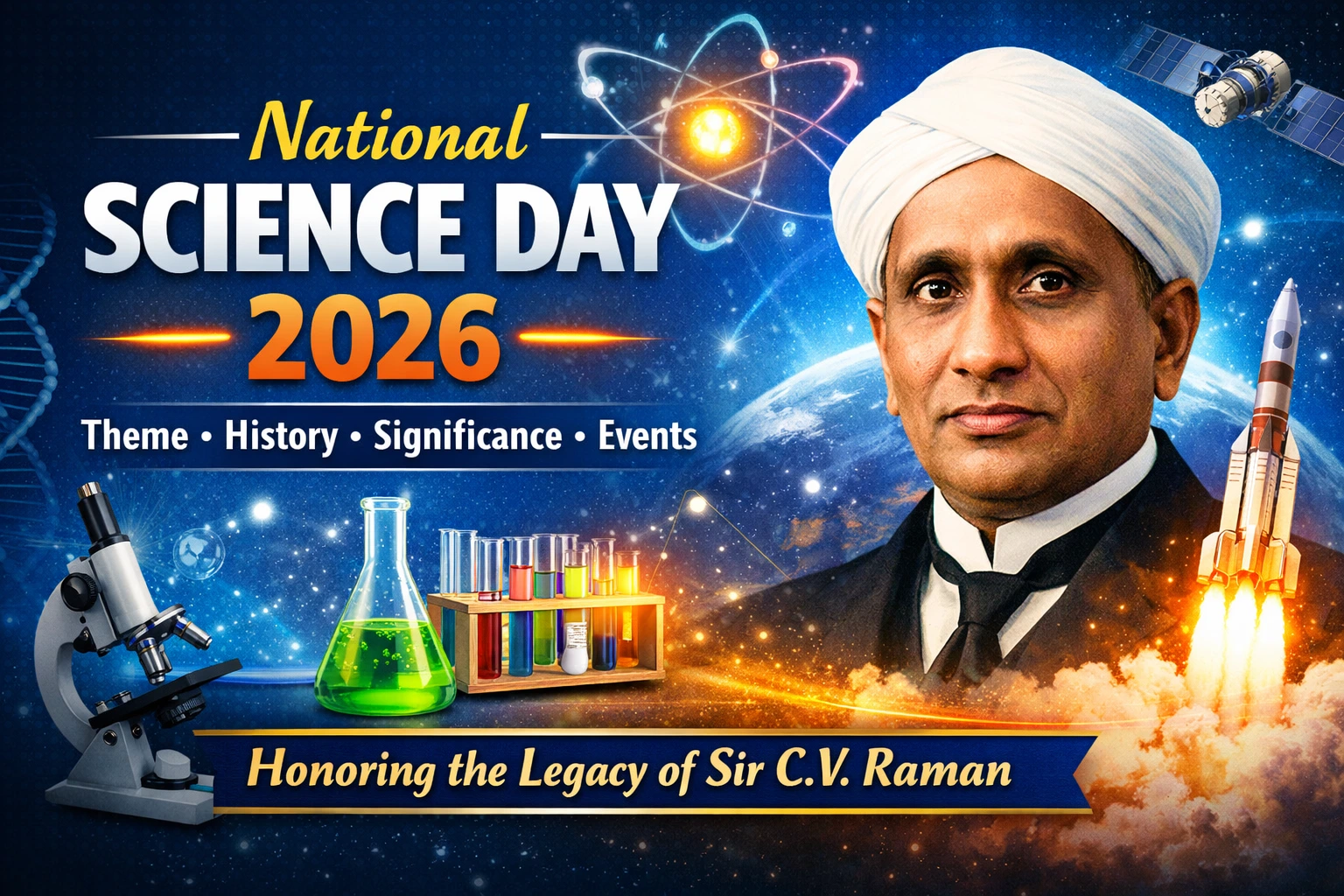
National Science Day 2026 celebrates India’s scientific achievements and commemorates the discovery of the Raman Effect by Sir C.V. Raman. Explore the theme, history, importance, events, and latest educational initiatives happening across the country. Perfect for students, teachers, and science enthusiasts looking for updated insights.
By Trending News Fox Editorial Team Published: February 24, 2026
National Science Day 2026: History, Theme, Significance, Events & Celebrations Across India
National Science Day is one of India’s most important scientific observances, celebrated every year on 28 February to honor the remarkable discovery of the Raman Effect by legendary physicist C. V. Raman. More than just a tribute to a scientist, the day serves as a nationwide reminder of India’s scientific heritage, technological progress, and the importance of promoting a scientific mindset among young learners.



As India steps into an era of rapid innovation—AI, space exploration, biotechnology, digital transformation—National Science Day 2026 carries even greater relevance. Schools, colleges, research institutes, and government bodies use this day to celebrate knowledge, inspire curiosity, and encourage scientific thinking across all age groups.
History of National Science Day
The roots of National Science Day trace back to 1928, when Sir C.V. Raman announced his groundbreaking discovery—an optical phenomenon that would later be known worldwide as the Raman Effect. This scientific breakthrough earned him the Nobel Prize in Physics (1930), making him the first Asian to receive a Nobel in the sciences.
Recognizing the national importance of this achievement, the Department of Science and Technology (DST) proposed dedicating February 28 as National Science Day. The Government of India officially accepted the proposal in 1986, and since then, the day has been celebrated with increasing enthusiasm across the country.
What Is the Raman Effect?
The Raman Effect explains how light changes its wavelength and energy when it passes through a transparent medium. This discovery revolutionized the fields of:
- Spectroscopy
- Chemical analysis
- Material science
- Medical diagnostics
- Astronomy and planetary exploration
Today, Raman spectroscopy plays a crucial role in industries such as pharmaceuticals, forensics, nanotechnology, archaeology, and even space research by organizations like Indian Space Research Organisation.
Theme of National Science Day 2026
The official theme for National Science Day 2026 is expected to focus on innovation, future technologies, and science education. (If you want, I can update this instantly once the official theme is released by the DST.)
Every year, the theme is chosen to highlight a relevant scientific area. Previous themes included:
- “Scientific Research and Innovation”
- “Science and Technology for a Sustainable Future”
- “Global Science for Global Well-being”
The 2026 theme will likely emphasize the growing role of AI, robotics, space science, and biotechnology in shaping India’s future.
Importance of National Science Day
National Science Day plays a vital role in India’s academic and scientific ecosystem. Its importance lies in:
1. Honoring Scientific Pioneers
It recognizes the extraordinary contributions of scientists like Sir C.V. Raman, whose work continues to influence modern research.
2. Promoting a Scientific Temper
The day encourages critical thinking, logical reasoning, curiosity, and evidence-based decision-making—values promoted under National Council for Science and Technology Communication (NCSTC).
3. Inspiring Future Innovators
From school students to university scholars, millions participate in activities that fuel interest in STEM (Science, Technology, Engineering, Mathematics).
4. Highlighting India’s Research Capabilities
India’s strides in space missions, quantum tech, green energy, AI, nanoscience, and healthcare innovations are showcased across various platforms.
5. Strengthening Public Engagement With Science
National Science Day promotes interactive learning through exhibitions, science fairs, workshops, public lectures, and live demonstrations.
How India Celebrates National Science Day
National Science Day is celebrated throughout schools, colleges, and research institutions with great enthusiasm. Typical activities include:
1. Science Exhibitions & Fairs
Students showcase working models, experiments, and innovative ideas—often focusing on sustainable development, robotics, renewable energy, and digital technologies.
2. Workshops and Seminars
Experts from research fields conduct interactive sessions on new-age technologies such as AI, machine learning, quantum computing, biotechnology, and astrophysics.
3. Quiz Competitions & Debates
These activities encourage children to develop scientific thinking, creativity, and problem-solving skills.
4. Public Science Lectures
Events led by scientists, academicians, and innovators help bridge the gap between advanced research and public understanding.
5. Awards and Recognitions
Research institutions and universities honor outstanding contributions to science communication, innovation, and community outreach.
6. Visits to Scientific Institutions
Schools organize visits to museums, laboratories, space centers, and technology parks, enhancing real-world scientific exposure.
National Science Day and India’s Future
National Science Day is not just a tradition but a strategic investment in the future. India is rapidly expanding its scientific footprint in areas like:
- Space missions by Indian Space Research Organisation
- Healthcare innovations in vaccines, genomics, and medical technologies
- Digital transformation through AI, IoT, and smart systems
- Sustainable solutions in green energy and climate-focused research
- Deep-tech startups driving robotics, EVs, and semiconductor advancement
Celebrating science ensures that India continues to nurture the next generation of innovators, thinkers, researchers, and problem-solvers.
The Legacy of C.V. Raman
The story of Sir Chandrasekhara Venkata Raman continues to inspire millions across India. His dedication, curiosity, and passion for scientific research set an example for young learners who aspire to contribute to society through science.
His discovery of the Raman Effect proved that groundbreaking innovations can arise from simple curiosity and unwavering perseverance—a message that remains timeless.
Conclusion
National Science Day is more than a date on the calendar—it is a celebration of curiosity, innovation, and India’s vibrant scientific spirit. As the country heads into a future shaped by advanced technologies, the day emphasizes the crucial role of research, education, and innovation in nation-building.
It reminds us that science is not confined to laboratories; it is a way of thinking, questioning, and discovering the world around us.
FAQs on National Science Day
1. What is National Science Day and why is it celebrated?
National Science Day is celebrated every year on 28 February to commemorate the discovery of the Raman Effect by renowned physicist C. V. Raman. The day promotes scientific awareness, innovation, and the importance of scientific thinking among students and the public.
2. When was National Science Day first celebrated?
National Science Day was first celebrated in 1987, after the Government of India officially designated February 28 as the day of observance in 1986 following a proposal by the Department of Science and Technology.
3. What is the theme of National Science Day 2026?
The official theme for National Science Day 2026 has not yet been announced. Typically, the Department of Science and Technology releases the theme closer to the event. The theme usually focuses on innovation, sustainability, technology, or scientific well-being.
4. What is the Raman Effect?
The Raman Effect explains how the wavelength of light changes when it interacts with a transparent substance. This discovery earned Sir C.V. Raman the Nobel Prize in Physics in 1930 and is widely used today in fields like spectroscopy, forensics, chemistry, medicine, and space research by organizations such as the Indian Space Research Organisation.
5. How do schools celebrate National Science Day?
Schools across India celebrate with:
- Science exhibitions and fairs
- Experiments and model demonstrations
- Quizzes, debates, and essay competitions
- Guest lectures by scientists and educators
- Visits to science museums and laboratories
These activities help students develop curiosity, critical thinking, and scientific temper.
6. Who organizes National Science Day events in India?
Most events are coordinated by schools, colleges, and research institutes, along with support from government bodies like the National Council for Science and Technology Communication (NCSTC) under the DST.
7. Why is National Science Day important for students?
It encourages students to think scientifically, explore innovation, participate in STEM activities, and get inspired by the contributions of scientists such as C.V. Raman. It also exposes them to real-world scientific applications through events, demonstrations, and competitions.
8. How does National Science Day contribute to India’s scientific progress?
The observance promotes public engagement with science, motivates young innovators, and highlights India’s achievements in fields like space exploration, biotechnology, quantum tech, AI, and green energy. It strengthens the overall scientific culture of the nation.
9. Is National Science Day a public holiday?
No, National Science Day is not a public holiday. However, it is widely celebrated across educational and scientific institutions nationwide.
10. Who was the first Asian to win a Nobel Prize in Science?
Sir C.V. Raman, for his discovery of the Raman Effect, became the first Asian to receive a Nobel Prize in any branch of science in 1930.
Disclaimer
The information provided in this article is for general awareness and educational purposes related to National Science Day. While efforts have been made to ensure accuracy, event themes, dates, and details may vary based on official announcements from relevant authorities. Readers are advised to verify information from official sources before use.
saibal.bose.how36@gmail.com, saibal.bose.how36@gmail.com, saibal.bose.how36@gmail.com, & saibal.bose.how36@gmail.com. (2026x, February 24). National Science Day 2026: Theme, History, Significance & Update. Trending News Fox. https://trendingnewsfox.com/national-science-day-2026-theme-history-significance-update/