Explore the New Geological Discoveries that are reshaping our understanding of Earth. Stay informed about groundbreaking research and findings in geology.
Beneath the Surface: The Groundbreaking New Geological Discoveries Rewriting Earth’s History in 2026
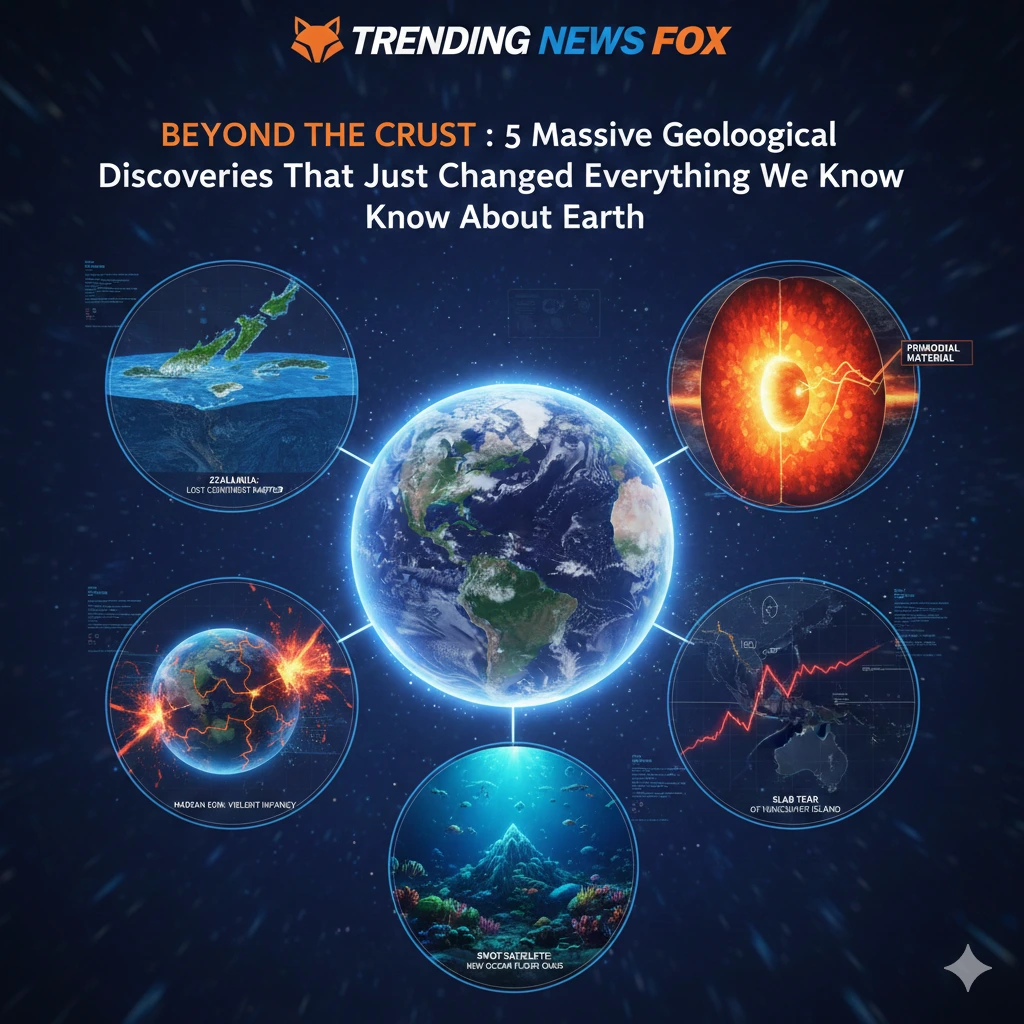
Beyond the Crust: 5 Massive New Geological Discoveries That Just Changed Everything We Know About Earth
Also, read What Are the Best Tips for Step Aerobics Success?
From the full mapping of a “lost” eighth continent to evidence of a leaking core, 2025 and early 2026 have delivered a golden age of geological discovery. Explore the five breakthroughs reshaping our understanding of the planet we call home.
How Do New Geological Discoveries Impact Us?
For decades, we viewed the Earth as a relatively settled puzzle. We knew the continents, understood the basics of plate tectonics, and had a firm grasp on the planet’s internal layers. But as we move into 2026, the scientific community is reeling from a series of “earth-shattering” discoveries that prove our home planet is far more dynamic—and mysterious—than we ever imagined.
Also, read Pradosh Vrat Katha: A Path to Inner Peace and Blessings
From the depths of the Pacific to the very center of the Earth’s core, here are the most significant geological breakthroughs that are trending right now.
1. Zealandia: The “Lost” Eighth Continent is Finally Mapped
Perhaps the most headline-grabbing news in recent months is the complete mapping of Zealandia (or Te Riu-a-Māui). While geologists have long suspected a hidden landmass in the South Pacific, 2025 marked the first time the entire 1.9 million square mile continent was fully charted.
Spanning an area nearly half the size of Australia, 94% of Zealandia remains submerged beneath the ocean. By using advanced dredging tools and magnetic anomaly mapping, researchers from GNS Science have confirmed that this is not just a collection of volcanic fragments but a distinct, independent continent with its own unique crustal thickness and geological history.
Why it matters: Zealandia offers a “time capsule” of the supercontinent Gondwana. Understanding how it thinned and sank helps scientists predict how modern coastlines might react to future tectonic shifts and rising sea levels.
2. The Leaking Core: Primordial Material is Escaping
For a century, the boundary between Earth’s liquid outer core and the rocky mantle was thought to be an impenetrable wall. New research published in Quanta and Nature Geoscience has turned that theory upside down.
Scientists have detected high levels of Helium-3 and Ruthenium—elements typically sequestered in the metal-rich core—leaking into the mantle and reaching the surface via volcanic “hotspots” like Hawaii. This suggests that the “abyssal wall” at the core-mantle boundary has “doorways,” allowing material from the planet’s birth to seep out after 4.5 billion years.
“The idea that the core is actively ‘bleeding’ into the mantle changes our entire model of Earth’s internal heat engine,” says one lead researcher. “It means the planet is cooling and evolving in ways we didn’t account for.”
3. A More Violent Infancy: The Hadean Eon Breakthrough
We used to believe that the early Earth (the Hadean Eon, 4.6 to 4.0 billion years ago) was a “stagnant lid”—a rigid, unmoving shell of rock. However, the discovery of 3.3-billion-year-old olivine crystals containing ancient melt inclusions has proven otherwise.
Geochemical analysis from the GFZ Helmholtz Centre reveals that subduction—the process where one tectonic plate dives beneath another—was active and “shockingly vigorous” hundreds of millions of years earlier than previously thought. This means the engine of plate tectonics, which recycles carbon and regulates our climate, has been running almost since the planet’s inception.
4. The “Slab Tear” Beneath the Pacific Northwest
Closer to home, geologists have identified a rare and terrifying phenomenon off the coast of Vancouver Island. Utilizing high-resolution seismic imaging, a team led by Brandon Shuck discovered that the Explorer Plate is physically tearing apart from the Juan de Fuca plate.
This “plate collapse” or “slab tearing” is happening in real-time. As the plate breaks, it creates “microplates,” which can change the stress distribution along the Cascadia Subduction Zone. This discovery is vital for earthquake forecasting, as these tears can act as pathways for magma to rise, potentially explaining mysterious volcanic activity in the Cascade Mountains and Yellowstone.
5. Deep-Sea “Oases” and the SWOT Satellite Revolution
Finally, our understanding of the ocean floor has been revolutionized by NASA’s SWOT (Surface Water and Ocean Topography) satellite. In just one year of operation, SWOT has mapped thousands of previously undiscovered underwater volcanoes (seamounts) and “abyssal hills.”
These aren’t just rocks; they are biological engines. These seamounts deflect deep-sea currents, bringing nutrients to the surface and creating massive ecosystems in the “barren” deep ocean. SWOT has increased the number of known seamounts from 44,000 to an estimated 100,000, providing a new roadmap for both marine biology and underwater navigation.
The Bottom Line: We are Living on a “New” Earth
These discoveries represent more than just academic updates; they are a fundamental shift in how we perceive our planet’s stability. The Earth is not a static rock; it is a leaking, tearing, shifting, and growing entity that still hides 95% of its secrets beneath the waves and the crust.
As technology like the SWOT satellite and high-precision geochemistry continues to evolve, 2026 promises to be the year we finally “look under the hood” of the world we thought we knew.
Also, read Nationwide Pet Insurance: Peace of Mind for Pet Owners
What Methods Uncover New Geological Discoveries?
Uncovering new geological discoveries is a complex process that combines traditional “boots-on-the-ground” fieldwork with cutting-edge space and sub-atomic technology. As seen in the recent breakthroughs regarding Zealandia and Earth’s leaking core, geologists now use a multi-layered approach to “see” through solid rock and deep ocean water.
Here are the primary methods used to uncover these discoveries:
1. Seismic Imaging and Tomography
This is essentially an “ultrasound” for the Earth.
- How it works: Geologists record the waves of energy generated by earthquakes or man-made explosions. As these waves travel through the Earth, they speed up or slow down depending on the density and temperature of the rock.
- Discovery impact: This method was used to identify the “slab tear” beneath the Pacific Northwest. By analyzing seismic data, scientists can create 3D models of the mantle and core-mantle boundary.
2. Remote Sensing and Satellite Imagery (SWOT)
Modern geology relies heavily on data from space to map the surface and the sea floor.
- How it works: Satellites like NASA’s SWOT (Surface Water and Ocean Topography) use radar interferometry to measure the height of the ocean surface with incredible precision. Because large underwater mountains (seamounts) have gravity that pulls water toward them, they create small “bumps” on the ocean surface that satellites can detect.
- Discovery impact: This led to the discovery of thousands of previously unknown underwater volcanoes and helped complete the mapping of the submerged continent of Zealandia.
3. Geochemical Analysis and Isotope Fingerprinting
To understand what is happening in the core or the ancient past, scientists look at the “DNA” of rocks.
- How it works: Researchers analyze the chemical composition of volcanic rocks and crystals (like zircons). By looking at specific isotopes—such as Helium-3 or Ruthenium—they can determine if a rock originated in the crust, the mantle, or even the core.
- Discovery impact: This is how the “leaking core” was discovered. Finding primordial helium in surface lava proved that material from the center of the Earth is escaping to the surface.
4. Deep-Sea Dredging and Core Sampling
Sometimes, there is no substitute for a physical sample.
- How it works: Specialized ships use heavy-duty drills or dredges to pull up rock samples from the ocean floor or deep within the crust. These samples are then dated using radiometric dating to determine their age.
- Discovery impact: Core samples from the South Pacific provided the final proof that Zealandia was made of continental crust (granite and metamorphic rock) rather than oceanic crust (basalt).
5. Magnetic Anomaly Mapping
The Earth’s magnetic field has flipped many times throughout history, and rocks “remember” these flips.
- How it works: Magnetometers towed behind ships or attached to planes measure the magnetic pull of the seafloor. This creates a “striped” pattern that acts like a barcode, telling geologists how old the seafloor is and how fast the tectonic plates are moving.
- Discovery impact: This was instrumental in understanding how Zealandia separated from Gondwana and why it eventually sank.
6. High-Pressure Lab Experiments
To understand the Earth’s core without actually going there, scientists recreate it in a lab.
- How it works: Using Diamond Anvil Cells, researchers squeeze tiny samples of minerals between two diamonds to simulate the extreme pressure of the Earth’s interior, while hitting them with lasers to simulate the heat.
- Discovery impact: These experiments allow geologists to predict how minerals behave 2,000 miles below our feet, helping them interpret seismic data more accurately.
By combining these methods, modern geology has moved from simply describing the Earth’s surface to understanding the planet as a living, breathing chemical engine.