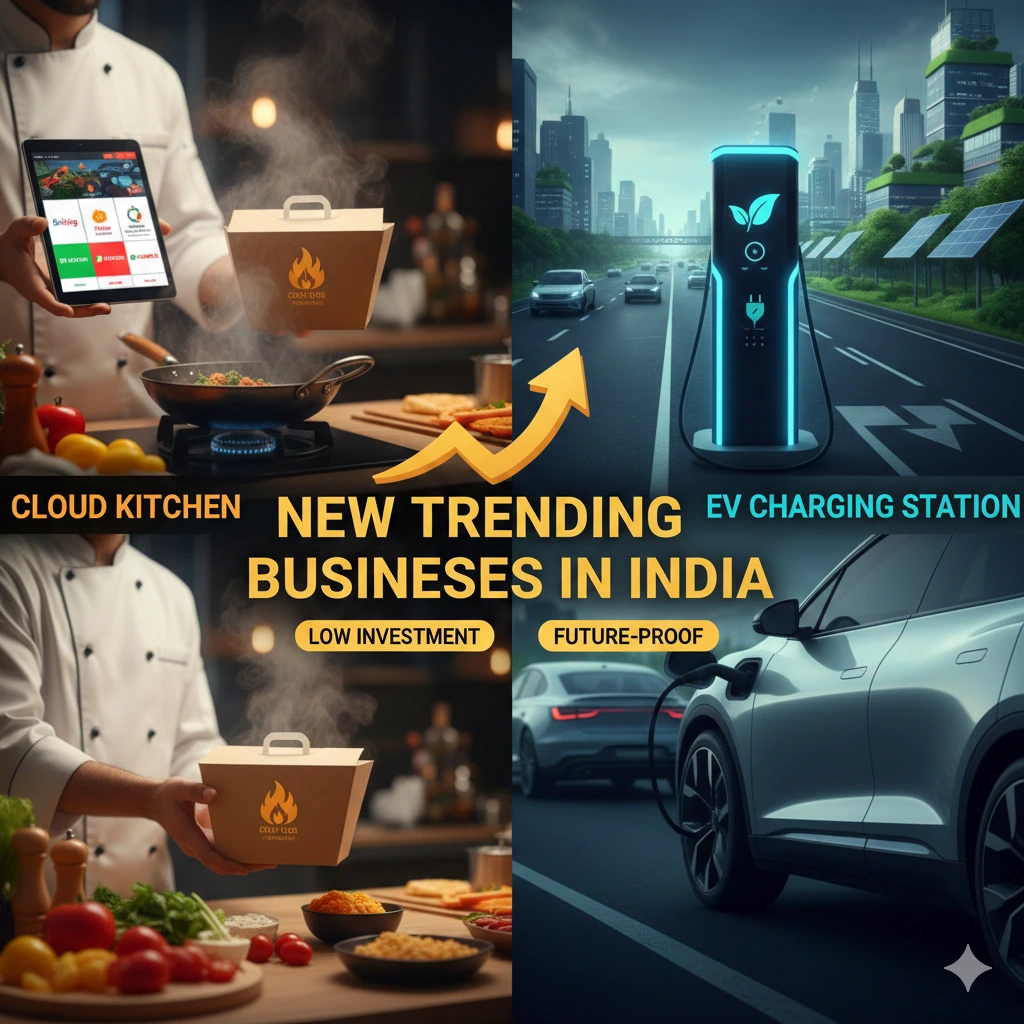
Explore new trending business in India. Uncover valuable insights and strategies to capitalize on the latest market opportunities.
🚀 India’s Entrepreneurial Boom: The Latest New Trending Business in India Opportunities
India’s economy is undergoing a massive transformation, driven by rapid digitalization, government support, and evolving consumer preferences. For aspiring entrepreneurs and investors, this dynamic environment presents a wealth of high-growth business opportunities.
Here are the latest trending business sectors and key updates defining India’s new entrepreneurial landscape.
1. Deep Tech and Digitalization: The AI-Driven Future
The most significant wave of new business is firmly rooted in technology, particularly in “deep tech” and advanced digital services.
- Artificial Intelligence (AI) and Deep Tech: Startups focusing on advanced engineering, scientific breakthroughs, and AI are seeing a massive surge. This includes applications in:
- Quantum Computing: Emerging as a crucial frontier with potential in accelerating complex AI models, drug discovery, materials science, and developing quantum-safe cybersecurity.
- Cybersecurity: With the rollout of the new Digital Personal Data Protection (DPDP) Rules, 2025, there is an estimated ₹10,000 crore investment expected in privacy automation and compliance services. Cybersecurity for individuals, schools, and small businesses is a major growth area.
- Semiconductors and Electronics Manufacturing: Government initiatives like the Semicon India Programme and Production Linked Incentive (PLI) schemes are attracting large-scale investments. India aims to become a significant global hub for manufacturing, with approvals for chip and display units gaining momentum.
- Digital Marketing and Online Services: As more businesses, especially SMEs in Tier 2 and Tier 3 cities, move online, the demand for affordable and local-language digital marketing, SEO, content creation, and e-commerce support is soaring.
2. Green Economy and Sustainability: The Net-Zero Transition
India’s commitment to achieving net-zero emissions by 2070 is powering a Green Revolution in business.
- Renewable Energy Solutions: The target of 500 GW of renewable energy capacity by 2030 is driving massive investment. Opportunities include:
- Solar Products and Installation: Residential and commercial solar panel installation and energy-efficient appliances.
- Electric Vehicle (EV) Ecosystem: Setting up EV charging stations, battery swapping/replacement centres, and EV repair services.
- Sustainable Packaging and Waste Management: Businesses offering biodegradable, eco-friendly packaging alternatives to plastic are in high demand, driven by environmental awareness and regulatory changes.
- Agritech and Vertical Farming: Innovations leveraging drones, IoT, and AI to improve crop yields, monitor soil health, and manage supply chains are key. Vertical farming is emerging as a solution to land constraints in urban areas.
3. Hyper-Local & Convenience Economy: Serving the Evolving Consumer
Modern Indian consumers, especially in urban areas, prioritize convenience, speed, and personalized experiences, fueling several booming small-to-medium-scale businesses.
- Cloud Kitchens: This remains a top trend, offering a low-capital way to launch a food business. By focusing purely on delivery (through apps like Swiggy/Zomato) without high overheads for seating/interiors, entrepreneurs can experiment with multiple cuisines.
- Quick Commerce Logistics: The demand for fast delivery (including food, groceries, and medicines) requires a sophisticated and rapidly expanding logistics and micro-warehousing network, particularly in non-metro cities.
- Personalised Services:
- Custom Gifting: The trend for unique, personal presents is boosting small luxury businesses offering curated gift hampers.
- Pet Care Services: The rise in pet ownership has created a market for grooming, walking, pet-sitting, and specialised pet food/supplies.
4. New Trending Business in India: Health, Wellness, and Education (EdTech)
The post-pandemic landscape has solidified the importance of digital access to healthcare and education.
- Digital Health and Telemedicine: Platforms offering virtual doctor consultations, online mental health therapy, and digital prescriptions are breaking down geographical barriers, especially for remote patients.
- EdTech/Online Coaching: Virtual tutoring, online courses for upskilling (coding, digital skills), and exam preparation remain highly lucrative, offering flexible timings and lower costs than traditional classes.
- Elderly Care Services: With changing family structures, there’s a growing need for professional, in-home care for seniors, often on a part-time basis.
5. New Trending Business in India: Government-Backed & Manufacturing Sectors
Central government policies are actively creating ecosystems for growth in specific industrial and agricultural sectors.
- Production Linked Incentive (PLI) Schemes: These schemes are driving investment in manufacturing across sectors like:
- Pharmaceuticals and Medical Devices
- Electronics and Telecom Equipment
- Automotive (especially EV components)
- Agricultural Value Chains: Recent government approval of a multi-year development program for the Makhana (Fox Nut) sector highlights a focus on modernizing specific, high-potential agricultural ecosystems for both domestic and export markets.
New Trending Business in India: Summary for Entrepreneurs
The current business landscape in India favors ventures that:
- Leverage Technology: Whether through an app, a digital marketing strategy, or AI-based solutions.
- Address Sustainability: Focus on environmental impact, renewable energy, or responsible consumption.
- Prioritize Convenience: Cater to the time-poor, modern urban consumer with quick, easy, and personalized services.
Also, read GOAT India Tour: What to Expect?
💰 Deep Dive: Cloud Kitchen vs. EV Charging Station Business in India
You’re looking at two of the most dynamic and future-forward business trends in India: the low-capex Cloud Kitchen and the infrastructure-heavy, future-proof EV Charging Station.
Here is a detailed comparison of the initial investment, operational scope, and profitability of each.
1. Cloud Kitchen: Low Investment, High Competition
The Cloud Kitchen (or Ghost Kitchen) model capitalizes on India’s massive online food delivery market (Swiggy, Zomato).
| Feature | Details | Estimated Investment (INR) |
| Initial Capital | Low. No expensive dining area, furniture, or front-of-house staff. Ideal for first-time entrepreneurs. | ₹3 Lakh to ₹10 Lakh |
| Key Expenses | Kitchen equipment (stoves, ovens, refrigeration), initial inventory, licensing, packaging, and marketing/branding. | Equipment: ₹1.5–3 Lakh. Rent: ₹25,000–₹60,000/month. |
| Scope & Scalability | High. Can run multiple “brands” or cuisines from a single kitchen location, known as a multi-brand cloud kitchen. | Easily scalable by renting a larger space or adding satellite kitchens in new delivery zones. |
| Revenue Model | Primarily driven by order volume through food aggregators (Swiggy, Zomato) and direct channels (WhatsApp, own website/app). | Earns per order, often with aggregator commissions of 20–30% which impact margins. |
| Profitability & ROI | High-Margin Potential. Low overheads allow for higher profit margins (potentially 15–25% net profit). | Faster break-even (often within 6–12 months) due to low initial investment. |
| Challenges | Intense Competition and high dependency on aggregator platforms, whose commissions are a major cost factor. Requires continuous digital marketing and branding efforts to stand out. |
2. EV Charging Station: High Investment, Future-Proof Potential
The EV Charging Station business is an infrastructure play, supported heavily by government policy (FAME scheme, state subsidies) and the massive growth in EV sales (aiming for 30% EV penetration by 2030).
| Feature | Details | Estimated Investment (INR) |
| Initial Capital | High. Investment is heavily in high-capacity equipment and electricity grid infrastructure. | ₹12 Lakh to ₹2 Crore |
| Key Expenses | DC Fast Chargers (costlier, for highways/malls) vs. AC Chargers (cheaper, for long-stay/offices), land lease/rent, transformer/grid connectivity, and software management system. | DC Fast Charger: ₹5 Lakh–₹20 Lakh (per unit). Land/Infrastructure: Significant variable cost. |
| Scope & Scalability | Network-Driven. Scalable by expanding the network of stations (geographical growth) or increasing charger density at a location. | Focus is on long-term infrastructure ownership and network development. |
| Revenue Model | Primary revenue is from charging fees (per kWh or per minute). Additional revenue from value-added services (coffee shops, retail) and advertising/brand partnerships. | Revenue is recurring and stable, driven by vehicle utilization rate and consistent energy costs. |
| Profitability & ROI | Longer-Term ROI. Higher upfront costs mean a longer break-even period (e.g., a DC Fast Charger might take ~20 months at 50% utilization). | Future-Proof. The profit potential skyrockets as EV adoption increases, making it a sustainable asset. |
| Challenges | High Upfront Cost and the need for reliable, high-load electricity connections (negotiating with DISCOMs is crucial). Site selection (high traffic/footfall) is critical for maximizing utilization. |
⚖️ Conclusion: Which One is Right for You?
| Factor | Cloud Kitchen | EV Charging Station |
| Risk Profile | Lower (smaller capital loss) | Higher (large initial capital) |
| Entry Barrier | Low (easy to start from home/small space) | High (land, heavy equipment, power infra) |
| Time to Profit | Short (6-12 months) | Longer (1.5 – 3 years, but higher long-term stability) |
| Long-Term Asset | Relies on brand value/customer loyalty. | Owns physical infrastructure and a crucial utility asset. |
- If you seek a fast-moving, low-capital entry into the market with passion for food and marketing, choose the Cloud Kitchen.
- If you have significant capital and are looking for a future-proof, long-term infrastructure business with government backing, the EV Charging Station is a highly strategic investment.
This video provides an overview of the financial model for an EV charging station, covering investment, profit, and business planning. EV Charging Station Business India: Investment, profit, and business plan
Also, read Messi in Kolkata: A Dream Come True for Fans