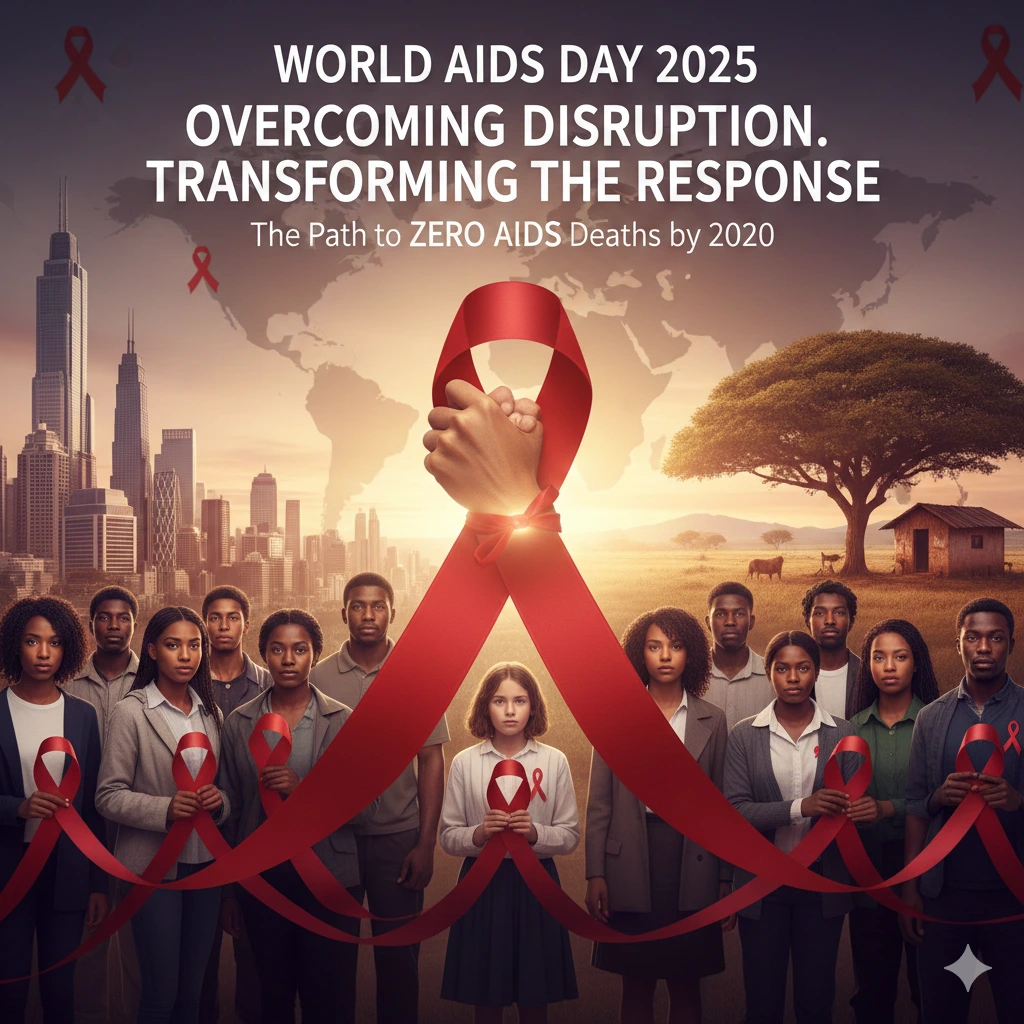
Join us in observing World AIDS Day 2025. Discover events, resources, and ways to support the fight against HIV/AIDS in your community.
🌍 World AIDS Day 2025: Overcoming Disruption and Transforming the Response
On December 1, 2025, the world once again unites to observe World AIDS Day. This year’s global theme, “Overcoming disruption, transforming the AIDS response,” serves as a stark reminder of the progress achieved and the immediate, critical threats that risk undoing decades of hard-won gains.
The focus is squarely on addressing the growing challenges—particularly declining international funding, geopolitical instability, and rising structural inequalities—that have severely disrupted HIV prevention, treatment, and community-led services worldwide.
The Urgency of Transformation: Key Global Challenges
The UNAIDS and WHO have sounded a clear alarm: the global AIDS response is at a dangerous crossroads. The central message for 2025 is a dual call to action: mitigate immediate disruptions and enact transformative shifts to get the world back on track to end AIDS as a public health threat by the 2030 Sustainable Development Goal (SDG) target.
- The Funding Crisis: A historic drop in international donor funding is directly impacting low- and middle-income countries. This has led to cuts in essential services, with community-led organizations—the frontline of the response—being hit the hardest.
- Growing Inequity: The impact of these disruptions is disproportionately felt by marginalized groups, including key populations (men who have sex with men, transgender people, sex workers, and people who use drugs) and vulnerable populations (adolescent girls and young women). Punitive laws and rampant stigma further restrict their access to life-saving prevention and care.
- Stagnant Prevention Efforts: Significant reductions in essential prevention programs, such as Pre-Exposure Prophylaxis (PrEP) and voluntary medical male circumcision, are leaving millions without adequate protection, raising the risk of new infections.
✨ Hope on the Horizon: Advances in Prevention and Treatment
Despite the headwinds in funding and policy, remarkable scientific and systemic innovations continue to redefine HIV care and prevention. The commitment to Scale Innovation is a key focus for World AIDS Day 2025.
- Long-Acting Injectables (LAIs): This represents one of the most significant breakthroughs. Medications like Lenacapavir, a twice-yearly injection for prevention (PrEP), have shown near-100% efficacy in clinical trials. The global challenge now is overcoming regulatory and intellectual property barriers to ensure affordable generic versions are rapidly accessible, especially in high-burden regions like Africa.
- Simplified Treatment Regimens: Ongoing research is delivering simpler, more patient-friendly Antiretroviral Therapy (ART) options, including long-acting injectable treatments administered every few months, and even new chewable or dissolvable tablets, which are particularly beneficial for children and those with swallowing difficulties.
- Integrated Care: There is a renewed push to integrate HIV services—including testing, treatment, and management of co-infections like tuberculosis and Hepatitis—within a comprehensive primary health care approach, supported by strong community networks.
- Focus on Advanced HIV Disease (AHD): Initiatives like the Pan American Health Organization’s (PAHO) call for “Zero AIDS Deaths by 2030” highlight the need for early diagnosis and timely initiation of ART to prevent patients from reaching AHD, which is still a major cause of AIDS-related deaths.
🤝 The Call to Action: Defending Progress
World AIDS Day 2025 demands a collective re-commitment built on the principles of equity, human rights, and community leadership. Global health organizations are urging action on several key fronts:
- Sustained and Increased Financing: International partners must bridge the financing gap to protect essential services and support countries transitioning to self-reliant national HIV responses.
- Addressing Inequity and Discrimination: Countries must uphold human rights, repeal punitive laws that criminalize key populations, and eliminate the stigma and discrimination that keeps people from seeking testing and care.
- Empowering Communities: Community-led organizations, which are essential for reaching the most vulnerable, must be prioritized and empowered. Their leadership is the backbone of the AIDS response.
- Accelerating Innovation Access: Policymakers must streamline regulatory processes and remove barriers to make breakthrough innovations, such as long-acting injectables, widely and affordably available for those who need them most.
World AIDS Day is a moment of remembrance for the millions lost and a renewed vow to those living with HIV: the fight is not over. Transformation is the only path forward to ensure that the promise of ending AIDS by 2030 is not just a dream, but a reality grounded in resilient, equitable, and compassionate care for all.
Also, read India vs South Africa 1st ODI: India Won by 17 Runs