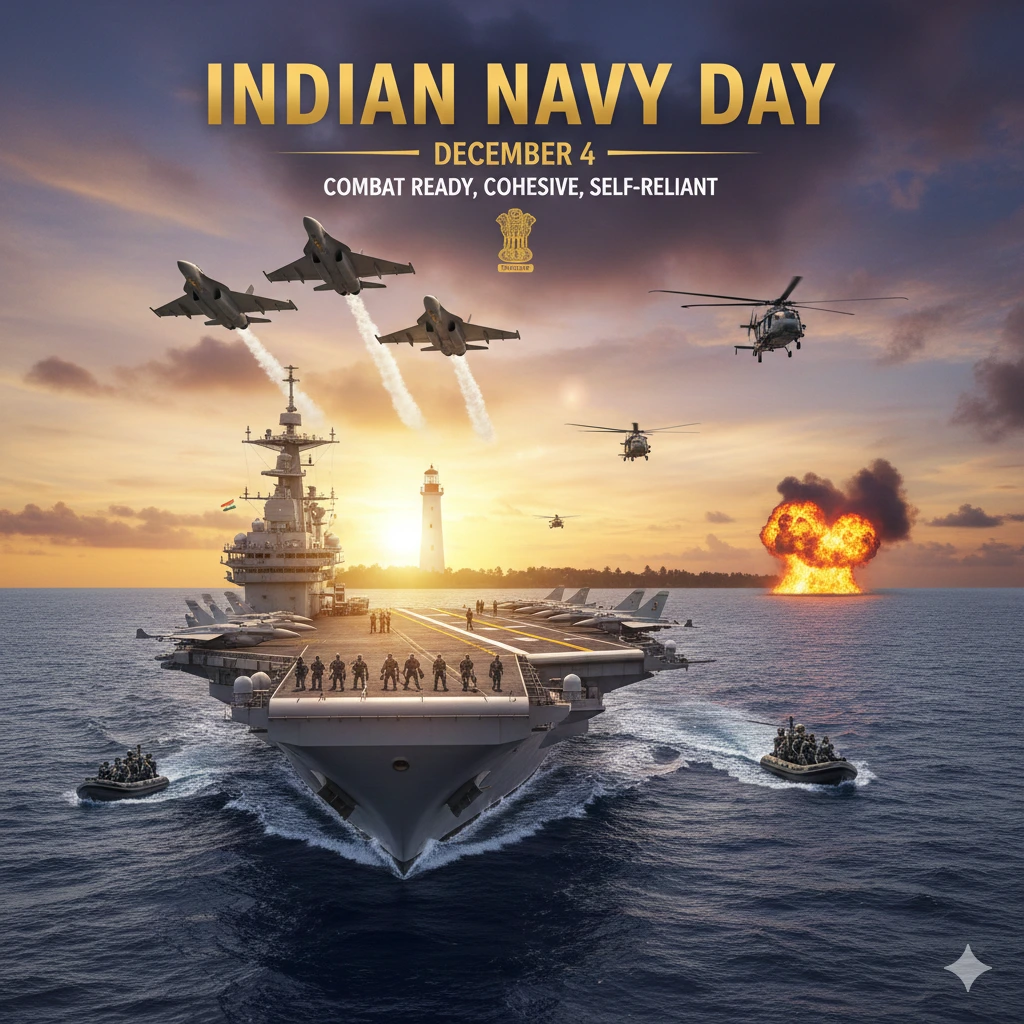
Discover the significance of Indian Navy Day, celebrating the valor and dedication of the Indian Navy. Join us in honoring their maritime achievements and history.
⚓ Indian Navy Day 2025: Showcasing Maritime Might and Self-Reliance
Indian Navy Day, celebrated annually on December 4th, holds profound national significance, commemorating the decisive ‘Operation Trident’ during the 1971 Indo-Pak War.
Beyond honouring this historic victory, the 2025 celebrations, held at Shangumugham Beach in Thiruvananthapuram, Kerala, served as a powerful showcase of the Navy’s modern strength, operational readiness, and unwavering commitment to Aatmanirbharta (self-reliance).
Theme and Focus: Combat Ready, Cohesive, Self-Reliant
The overarching theme for Indian Navy Day 2025 was “Combat Ready, Cohesive, Self-Reliant” (also described as “Combat Ready, Cohesive, Credible, and Aatmanirbhar Force”), aligning squarely with the nation’s vision of a self-reliant future. This theme underscored three key focus areas:
- Combat Ready: Emphasizing constant, high-level preparedness to defend India’s vast maritime interests and deter hostile actions in the Indian Ocean Region (IOR).
- Cohesive: Highlighting the enhanced synergy and coordination among the Navy’s assets (surface, sub-surface, and air) and the larger integration with the Army and Air Force.
- Self-Reliant (Aatmanirbhar): Promoting the strong push for indigenization through the ‘Make in India’ initiative, ensuring the Navy is equipped with technologically advanced, domestically built platforms.
Indian Navy Day: Operational Demonstration Highlights in Thiruvananthapuram
In continuation of the Navy’s initiative to host the main event outside major naval stations, the operational demonstration (Op Demo 2025) was held off the coast of Kerala, with President Droupadi Murmu, the Supreme Commander of the Armed Forces, gracing the occasion as the Chief Guest.
The spectacular display featured:
- Frontline Platforms: Over twenty naval ships and a submarine, including the indigenous aircraft carrier INS Vikrant, showcased their formidable combat capabilities.
- Aerial Prowess: A formidable array of air assets, including fighter jets and helicopters, performed high-speed aerial manoeuvres, combat free-fall, and slithering operations.
- Special Forces Action: Elite Marine Commandos (MARCOS) demonstrated special force drills, including simulated neutralization of threats, underscoring the Navy’s versatile multi-domain operations.
- Indigenisation Showcase: The demonstration prominently featured indigenously built assets, embodying the ‘Builder’s Navy’ transition and India’s growing self-reliance in defence manufacturing.
- MAHASAGAR Vision: The event underscored the Navy’s role as the ‘Preferred Security Partner’ in the IOR, guided by the broader vision of MAHASAGAR (Mutual and Holistic Advancement for Security and Growth Across Regions).
Indian Navy Day: Key Updates and Strategic Developments
The Navy Day events were not only ceremonial but also marked important strategic milestones:
- Release of Indian Maritime Doctrine 2025: The updated doctrine was officially released by the Chief of Naval Staff, Admiral Dinesh K Tripathi. This document formally defines the “no-war, no-peace” operational spectrum, addresses grey-zone challenges (hybrid and sub-threshold threats), and emphasizes multi-domain operations supported by emerging technologies and uncrewed platforms.
- Focus on Jointness: Admiral Tripathi highlighted the growing jointness among India’s armed forces, recalling the strong tri-service coordination demonstrated during Operation Sindoor and Exercise Trishul, with steady progress towards theaterization.
- Modernisation Drive: The Navy Chief confirmed clearance for 60 Naval Utility Helicopters (NUH) to be built by HAL and initiatives to shorten the timelines for acquiring four Landing Platform Docks (LPDs), reinforcing the rapid modernization strategy.
- International Cooperation: The celebrations saw warm wishes and statements from strategic partners, such as the French Embassy, which highlighted the strengthening naval cooperation through initiatives like the Rafale Marine acquisition, maritime dialogue, and joint exercises in the Indo-Pacific.
In essence, Indian Navy Day 2025 was a powerful testament to the force’s historical legacy, current operational might, and future-ready trajectory, proudly sailing towards the goal of an Aatmanirbhar and globally respected maritime power.
Also, read Putin India Visit: A New Era in Bilateral Relations
Operation Trident is truly one of the most significant and audacious naval victories in Indian history, and the reason December 4th is celebrated as Navy Day.
Here is an overview of the historical significance of Operation Trident (December 4, 1971):
💥 Operation Trident: The Night the Indian Navy Crippled Karachi
Operation Trident was a daring, offensive naval operation launched by the Indian Navy on the night of December 4–5, 1971, during the Indo-Pakistani War. Its target was the heavily defended Karachi Harbour, the headquarters of the Pakistan Navy and the hub of the country’s entire maritime trade and logistics.
Indian Navy Day: The Strategic Imperative
Before the 1971 war, the Indian Navy was generally perceived as a defensive force. The strategic objectives of Operation Trident were:
- Crippling the Pakistan Navy: Karachi was the main operational base for the entire Pakistan Navy fleet. A successful attack would neutralize a significant portion of their naval strength.
- Economic Strangulation: Karachi port handled nearly all of Pakistan’s sea trade, including crucial supplies of oil and ammunition for its military effort. Disrupting the port would cause an immediate economic and logistical crisis.
- Shifting the Momentum: The operation was intended to deliver a powerful psychological blow and demonstrate India’s ability to strike deep into enemy territory, fundamentally shifting the momentum of the war.
The “Killer” Squadron: Tactical Innovation
The success of the operation hinged on the innovative use of the recently acquired Soviet-built Osa-I class missile boats (of the 25th Missile Boat Squadron, nicknamed the “Killer Squadron”). These small, fast boats were armed with the P-15 Termit (Styx) anti-ship missiles—the first use of anti-ship missiles in combat in the region.
The task force was led by Commander Babru Bhan Yadav, and included three missile boats:
- INS Nirghat
- INS Nipat
- INS Veer
The Attack:
- Operating outside the range of Pakistan Air Force’s night strike capability, the Indian vessels surprised the Pakistani fleet off the coast of Karachi.
- INS Nirghat fired a missile, sinking the Pakistani destroyer PNS Khaibar.
- INS Veer fired a missile, sinking the Pakistani minesweeper PNS Muhafiz.
- INS Nipat fired two missiles, sinking the merchant vessel MV Venus Challenger (carrying vital ammunition) and severely damaging the destroyer PNS Shah Jahan (which was later scrapped).
- INS Nipat then proceeded closer to the harbour and fired a missile, hitting and destroying the Kemari oil storage tanks—creating an inferno that reportedly burned for several days and was visible from over 100 km away.
Indian Navy Day: Historical Significance and Impact
Operation Trident was a flawless victory, considered one of the most successful naval strikes in modern history after World War II.
| Outcome | Impact |
| Zero Indian Losses | The Indian Task Group returned without any damage or casualties, showcasing superior planning and execution. |
| Crippled Logistics | The destruction of the oil tanks and the ammunition ship immediately choked Pakistan’s supply lines, forcing a critical fuel shortage for the Navy and the Air Force. |
| Naval Supremacy | Pakistan lost several key vessels and personnel, effectively crippling their Western Naval Command and forcing the remaining fleet into the harbour in a defensive posture. This established the Indian Navy’s undisputed dominance in the Arabian Sea. |
| Morale Booster | The operation delivered a massive blow to Pakistani morale while electrifying the Indian forces and public. |
| Precursor to Python | The success of Trident prompted a follow-up attack, Operation Python, on December 8, 1971, which inflicted further damage on the Karachi port, cementing the Indian naval blockade. |
The decision in 1972 to celebrate Navy Day on December 4th was a direct result of this victory, moving the celebration from an inherited colonial date to one rooted in India’s own demonstration of naval power and strategic audacity.
Also, read IND vs SA 2nd ODI: South Africa Needs 359 to Win
While Operation Trident delivered the knockout punch, Operation Python was the crucial follow-up that ensured the enemy stayed down, effectively blockading Karachi and sealing the victory on the western front.
Here are the details of Operation Python (December 8-9, 1971):
🐍 Operation Python: The Final Blow to Karachi Harbour
Operation Python was the second, more focused night-time missile attack carried out by the Indian Navy against the Karachi Harbour area, four days after the devastating success of Operation Trident.
Context: Heightened Alert and the Need for a Decisive Strike
Following the Trident attack on December 4th, the Pakistan Navy was in disarray but on high alert. They had increased air surveillance and attempted to confuse Indian forces by mixing their remaining warships with merchant shipping.
However, the Indian Western Naval Command recognized that while Trident had inflicted heavy damage, the Kemari Oil Farm (a vital fuel storage facility) had only been partially destroyed. A second, decisive strike was necessary to completely cripple Pakistan’s fuel logistics and confirm India’s total maritime dominance in the Arabian Sea.
Indian Navy Day: The Attack Group
A smaller, faster strike group was formed for Operation Python:
- INS Vinash (A Vidyut-class missile boat, equipped with four Styx anti-ship missiles).
- INS Trishul (A multipurpose anti-submarine frigate).
- INS Talwar (A multipurpose anti-submarine frigate).
The frigate escorts were necessary to provide early warning and anti-submarine protection for the precious missile boat, INS Vinash.
Indian Navy Day: The Night of December 8/9, 1971
- Approach and Engagement: The small task group approached Karachi’s coast in rough seas on the night of December 8th. The frigates initially engaged and sank a Pakistani patrol vessel that attempted to report the Indian force’s position.
- The Missile Salvo: At around 11:00 PM (PKT), the group detected a cluster of ships approximately 12 nautical miles (22 km) off the coast. INS Vinash, under the command of Lt. Commander Vijay Jerath, fired all four of its Styx missiles in a rapid salvo.
- Critical Hits: The missiles found their marks with devastating accuracy:
- Kemari Oil Farm: One missile struck the oil storage tanks again, completely destroying the facility and starting a massive fire that reportedly burned for an entire week. This eliminated the vast majority of Pakistan’s fuel reserves in the area.
- PNS Dacca: One missile hit the Pakistani Navy fleet tanker, rendering the ship damaged beyond repair.
- SS Gulf Star: A Panamanian fuel tanker was hit and sunk.
- SS Harmattan: A British merchant ship was struck and sank.
- Withdrawal: Having expended all its missiles and achieved its objectives, the strike group immediately withdrew successfully, again sustaining zero damage or casualties on the Indian side.
The Result: Maritime Strangulation
Operation Python was the fatal blow that ensured Pakistan could no longer operate effectively at sea on the Western Front.
- Total Fuel Crisis: The complete destruction of the Kemari oil storage facilities created a critical fuel shortage for the Pakistan Navy and Air Force, severely limiting their operational capacity.
- Effective Blockade: With their major fleet vessels already destroyed (in Trident) or severely damaged (in Python), and their main logistical hub destroyed, the remaining Pakistani Navy ships were ordered to remain confined within the harbour.
- War-Winning Impact: The combined success of Operations Trident and Python effectively shut down Pakistan’s primary port, cutting off its sea lines of communication and vital war material imports from the Persian Gulf. This maritime strangulation was a major factor leading to Pakistan’s surrender on December 16th, 1971.
Together, Trident and Python cemented the reputation of the Indian Navy’s “Killer Squadron” and marked the transition of the Indian Navy into a formidable, offensive force capable of projecting power and achieving strategic objectives in the region.
While Operations Trident and Python grabbed the headlines on the West Coast, the Indian Navy’s work on the Eastern Front was arguably more strategic and decisive in the ultimate surrender of Pakistani forces.
Here is an overview of the Indian Navy’s crucial role in the Bay of Bengal during the 1971 War:
🦅 The Bay of Bengal Blockade: INS Vikrant and the Eastern Command
Unlike the Western Front, where the Navy launched targeted missile strikes (Trident and Python), the goal in the East was to enforce a total logistical and naval blockade of East Pakistan (now Bangladesh) and provide air superiority to support the Army’s advance toward Dhaka.
The operations in the East were spearheaded by the Indian Navy’s Eastern Fleet, based out of Visakhapatnam, under the command of Vice Admiral N. Krishnan.
1. Neutralizing the Submarine Threat: The Sinking of PNS Ghazi
The most critical threat to the Eastern Fleet was the PNS Ghazi, Pakistan’s only long-range submarine (a former US Tench-class vessel). Its mission was to sink the Indian Navy’s crown jewel: the aircraft carrier INS Vikrant, or to lay mines off the port of Visakhapatnam.
- The Decoy Plan: Vice Admiral Krishnan executed a brilliant deception. He ordered the INS Vikrant to be quietly moved to a secure, hidden position near the Andaman Islands. Meanwhile, he created the impression that the carrier was still in Visakhapatnam by issuing fake radio messages and purchasing large quantities of rations and fuel.
- The Hunt: The PNS Ghazi, believing the carrier was in port, approached Visakhapatnam. On the night of December 3/4, 1971, the Indian destroyer INS Rajput was sent out. The exact cause is debated (internal explosion or depth charges from INS Rajput), but the Ghazi sank off the Visakhapatnam coast, killing all 93 personnel on board.
- The Impact: The sinking of the Ghazi neutralized Pakistan’s most potent offensive naval weapon and secured the entire Bay of Bengal for Indian operations, ensuring the safety of the INS Vikrant.
2. Establishing Air and Sea Supremacy with INS Vikrant
With the Ghazi threat eliminated, the INS Vikrant (India’s only aircraft carrier at the time) was deployed to the coast of East Pakistan. Its air wing, consisting of Hawker Sea Hawk fighter-bombers, launched continuous attacks.
- Coastal Destruction: Starting from December 4, 1971, the Sea Hawks systematically destroyed military targets, including airfields (like Cox’s Bazar), fuel dumps, and port facilities at major harbours like Chittagong, Khulna, and Mongla.
- Blockade Enforcement: The carrier’s air and surface power enforced a de facto Total Naval Blockade in the Bay of Bengal. This cut off East Pakistan’s only reliable line of external supply and prevented the escape of Pakistani military personnel by sea.
- Paralysis: The destruction of port facilities and the effective blockade trapped Pakistani naval vessels and key foreign merchant ships carrying essential war materials inside the harbours, ensuring the Pakistani Eastern Command could not be resupplied or evacuated.
3. Covert Action and Amphibious Assault
The Navy’s efforts also involved specialized operations:
- Operation X (Naval Commandos): The Navy trained thousands of Bengali sailors and youths (known as ‘Operation X’ or the Naval Commandos) who defected from the Pakistan Navy. These commandos carried out highly effective underwater sabotage and mined waterways, further crippling the ability of small craft to move supplies along the vital riverine network of East Pakistan. This covert action was instrumental in the birth of India’s elite MARCOS (Marine Commandos).
- Amphibious Landings: Later in the war, the Navy executed an amphibious landing at Cox’s Bazar on the night of December 15/16. This maneuver cut off the final line of retreat for Pakistani troops trying to escape into Burma (Myanmar), fully complementing the Army’s land advance toward Dhaka.
Indian Navy Day: The Final Result
The Indian Navy’s strategy on the Eastern Front was one of total dominance:
- No Retreat: By completely sealing off the Bay of Bengal, the Navy ensured that the Pakistani forces in the East could not receive reinforcements or escape the encirclement by the Indian Army.
- Rapid Victory: This maritime isolation contributed directly to the rapid collapse of the Pakistani military structure in East Pakistan, culminating in the surrender of 93,000 Pakistani troops in Dhaka on December 16, 1971, leading to the creation of Bangladesh.
The 1971 War, both East and West, is often hailed as the Indian Navy’s finest hour, showcasing strategic depth, tactical brilliance, and a decisive contribution to the ultimate victory.
That is arguably the most dramatic and geopolitically significant aspect of the 1971 war—the moment when the conflict went from a regional clash to a high-stakes Cold War showdown in the Indian Ocean.
The deployment of the US Seventh Fleet (Task Force 74), led by the nuclear-powered aircraft carrier USS Enterprise, to the Bay of Bengal was a direct and powerful attempt to intimidate India and prevent the total collapse of Pakistan.
Here is the detailed strategic and diplomatic backdrop to this tense naval standoff:
🌎 The Grand Chessboard: The US Seventh Fleet and the Cold War Tilt
The diplomatic maneuvering during the 1971 War was heavily influenced by Cold War alliances and a major new geopolitical shift: the opening of relations between the US and China.
1. The US “Tilt” Towards Pakistan
US President Richard Nixon and National Security Advisor Henry Kissinger were staunch allies of Pakistan’s military dictator, General Yahya Khan. This was due to several interconnected reasons:
- China Channel: Pakistan served as the crucial, secret intermediary for Nixon and Kissinger’s historic opening to Communist China. Protecting this channel and their new relationship with China was a top priority, and they believed losing Pakistan would undermine their global credibility.
- Personal Dislike: Both Nixon and Kissinger harbored a deep personal distrust and animosity toward India’s Prime Minister, Indira Gandhi, whom they saw as pro-Soviet and overly ambitious.
- Containing the USSR: The US viewed the conflict through a Cold War lens, aiming to prevent a Soviet-aligned India from dominating South Asia.
2. The Deployment of the USS Enterprise (Task Force 74)
As the Indian Army and Navy achieved rapid, decisive victories in East Pakistan (Bangladesh), and with the Pakistani surrender imminent, Nixon ordered the deployment of Task Force 74 (part of the US Seventh Fleet) from the Vietnam area of operations into the Bay of Bengal on December 10, 1971.
- Official Reason: The stated mission was humanitarian: to evacuate American citizens from Dhaka.
- Real Intent: Declassified documents later confirmed the true intent was a show of force designed to:
- Intimidate India: Pressure India to call an immediate ceasefire and halt its offensive, thereby saving West Pakistan’s forces from total defeat and preventing any advances on the western front.
- Boost Pakistani Morale: Give the beleaguered Pakistani military the psychological comfort of powerful American support.
- Threaten Intervention: The highly capable aircraft and strike power aboard the USS Enterprise (a nuclear-powered carrier) and its accompanying guided-missile destroyers posed a serious threat to the Indian Eastern Fleet and Indian Army units advancing on Dhaka.
3. India’s Shield: The Indo-Soviet Treaty and the Red Navy
India had foreseen the possibility of Western intervention. Just four months before the war, India had signed the Indo-Soviet Treaty of Peace, Friendship and Co-operation (August 1971). This treaty proved to be India’s diplomatic and military shield.
Upon being informed of the US deployment, India immediately called upon the Soviet Union for assistance. The Soviet response was swift and decisive:
- Soviet Naval Deployment: The Soviet Pacific Fleet dispatched two task groups, including powerful cruisers, destroyers, and several nuclear-armed submarines, from its base in Vladivostok. Their mission was to trail the US fleet and prevent any aggressive intervention against India.
- The Stand-off: The Soviet fleet, under the command of Admiral Vladimir Kruglyakov, reportedly intercepted the US Task Force 74 near the Strait of Malacca. The strategic positioning of the Soviet nuclear submarines acted as a powerful counter-deterrent.
- Diplomatic Veto: Simultaneously, the USSR repeatedly used its veto power in the UN Security Council to block US-backed resolutions calling for an immediate ceasefire without first addressing the core political problem (the release of Sheikh Mujibur Rahman and a political settlement in East Pakistan). This diplomatic shield bought India the crucial time needed to complete the military operation.
Indian Navy Day:The Conclusion of the Showdown
The deployment of the Soviet counter-fleet effectively called the US bluff. Kissinger admitted in White House tapes that if the Soviet presence meant the US fleet couldn’t use force, the threat was empty.
Crucially, before the US fleet could arrive on the scene to make a meaningful military impact, the following happened:
- December 15: The Indian forces, hastened by the threat of the US fleet, intensified their attacks.
- December 16: Lieutenant General A. A. K. Niazi signed the Instrument of Surrender in Dhaka, and Bangladesh was liberated.
The US Task Force 74 was still several days away from the combat zone when the war ended, having been successfully deterred by the Soviet naval presence and rendered irrelevant by the speed of the Indian military victory.
The incident underscores how the Indian Navy (and its strategic air asset, the INS Vikrant), despite facing the potential threat of a superpower intervention, operated decisively and completed its objectives, relying on geopolitical strategy to neutralize the diplomatic and naval pressure.