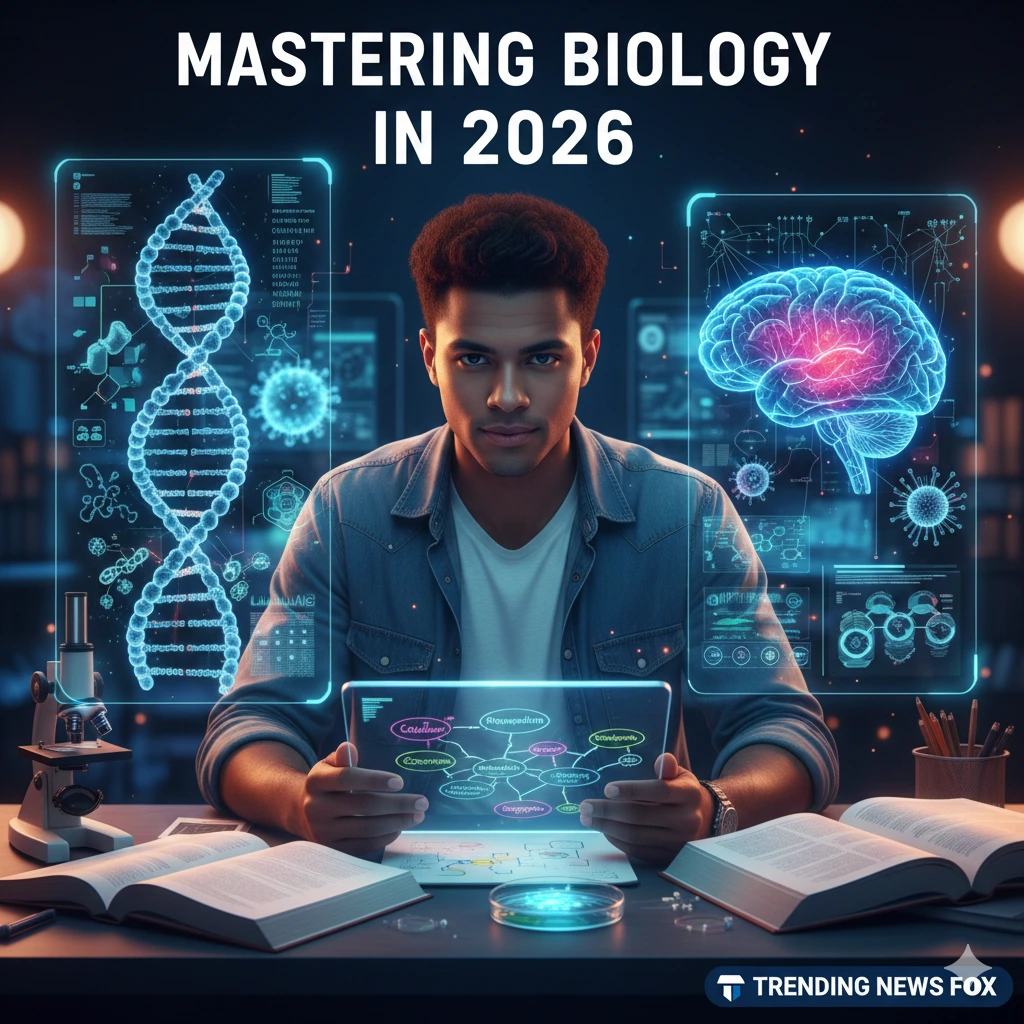
Unlock the secrets to mastering biology with our comprehensive 2026 guide. From active recall techniques to CRISPR and AI trends, learn how to ace your exams and laboratory work.
By The Trending News Fox, Web News & Media Team, Monday 19th January, 2026
Mastering Biology in 2026: The Ultimate Guide to Acing the Life Sciences
In the rapidly evolving landscape of 2026, biology is no longer just a subject of memorizing plant parts and skeletal structures. From CRISPR gene-editing breakthroughs to the integration of AI in personalized medicine, the field has become the frontier of human innovation. Whether you are a high school student aiming for top marks or a college biology major navigating complex molecular pathways, mastering this “visual science” requires a strategic, modern approach.
Also, read Recent Biology Discoveries in 2026 That Are Changing the World
This comprehensive guide breaks down the essential study habits, active learning techniques, and laboratory strategies you need to dominate your biology exams and stay ahead in the trending world of life sciences.
1. Shift from Memorization to Conceptual Mastery
The most common mistake students make is treating biology like a history class—memorizing dates and names without understanding the “why.” In 2026, exams are increasingly focused on application and critical thinking.
- The “Forest vs. Trees” Approach: Before diving into the microscopic details of a cell, understand the “forest”—the big-picture function of the system. For example, don’t just memorize the steps of the Krebs Cycle; understand that its primary goal is to harvest high-energy electrons for ATP production.
- Logical Chains: Practice explaining biological processes as a cause-and-effect chain. If a specific enzyme is inhibited, what happens to the subsequent product? How does that affect the organism’s homeostasis? Building these logical links ensures you can answer “what if” questions on exams.
2. Leverage Visual Learning Strategies
Biology is inherently visual. Your brain is wired to process images 60,000 times faster than text, making diagrams your greatest ally.
- The “Blank Sheet” Method: Don’t just look at a diagram in your textbook. Take a blank sheet of paper and try to draw the process—be it mitosis, the nitrogen cycle, or the structure of a nephron—from memory. If you can’t draw it and label the parts, you don’t know it yet.
- Color-Coding: Use consistent colors in your notes. For example, always use red for oxygenated blood and blue for deoxygenated blood in circulatory diagrams, or specific colors for different types of neurotransmitters.
- Mind Mapping: Create “concept maps” that connect disparate topics. How does the process of photosynthesis in a plant cell relate to the carbon cycle in an ecosystem? Mind maps help bridge the gap between micro-biology and macro-ecology.
3. Adopt the “Active Recall” and “Spaced Repetition” Duo
Passive reading is the enemy of retention. To move information from short-term to long-term memory, you must use evidence-based study techniques.
- Active Recall: Instead of re-reading your notes, close the book and ask yourself, “What are the three main stages of cellular respiration?” This “retrieval practice” strengthens neural pathways.
- Spaced Repetition: Don’t cram for 10 hours the night before. Research shows that spacing your study sessions (e.g., 1 hour every other day) is twice as effective. Use digital tools like Anki or Brainscape to automate this process with flashcards.
- The Feynman Technique: Try to explain a complex concept, like epigenetics or signal transduction, to someone with no science background. If you hit a snag in your explanation, that is exactly where your knowledge gap lies.
4. Excellence in the Laboratory: Beyond the Petri Dish
In 2026, laboratory work accounts for a significant portion of biology grades. Success in the lab requires preparation that starts long before you put on your lab coat.
| Lab Skill | Importance | Pro Tip |
| Pre-Lab Prep | Understanding the theory behind the experiment. | Always read the manual 24 hours prior; visualize each step. |
| Data Interpretation | Translating results into meaning. | Practice drawing graphs from raw data sets manually. |
| Safety & Etiquette | Preventing accidents and contamination. | Know the location of the eye-wash station and disposal bins. |
| Equipment Mastery | Accurate measurements. | Spend “open lab” time practicing with pipettes and microscopes. |
5. Stay Updated with 2026 Biology Trends
To truly master biology, you must see its relevance in the real world. Trending news in 2026 highlights several key areas that are frequently appearing in modern curricula:
- CRISPR & Synthetic Biology: The ability to “program” living organisms is a top-tier topic. Familiarize yourself with how gene-editing works at a molecular level.
- Epidemiology & Vaccine Tech: Post-pandemic biology focuses heavily on mRNA technology and how pathogens evolve to resist treatments.
- Climate Resilience: Understanding how species adapt (or fail to adapt) to rapidly changing environments is a staple of contemporary ecology exams.
- The Gut Microbiome: The link between the “second brain” (your gut) and mental health is a burgeoning field of study in human physiology.
6. Optimization for Exam Day
When the test paper is in front of you, your strategy is just as important as your knowledge.
- Read the Verb: Does the question ask you to Identify, Describe, Explain, or Evaluate? An “Explain” answer requires a “because,” whereas an “Identify” answer only needs a name.
- Annotate Diagrams First: If there is a diagram provided, label everything you recognize immediately before reading the questions. This prevents “brain freeze.”
- Check Your Units: In biology, a number without a unit (like mg/dL or μm) is usually a wrong answer.
Expert Tip: “Osmosis may work for water, but it doesn’t work for biology exams. You cannot learn the material by simply sleeping with the textbook under your pillow. You must engage, draw, and question.”
Mastering Biology: Summary Checklist for Success
To ensure you are on the path to becoming a biology expert, follow this weekly routine:
- [ ] Preview: Read the lecture outline before class.
- [ ] Engage: Take handwritten notes and draw rough sketches during the lecture.
- [ ] Review: Within 24 hours, “massage” your notes into a clean, organized format.
- [ ] Self-Test: Use flashcards for terminology and blank-page drawing for processes.
- [ ] Apply: Relate the topic to a 2026 news headline.
Mastering biology is a marathon, not a sprint. By treating it as a visual, logical, and interconnected system rather than a list of facts, you will not only ace your exams but also gain a profound understanding of the living world around you.
Frequently Asked Questions: Mastering Biology
Q1: What are the hardest topics to master in biology?
In 2026, students consistently rank Cellular Energetics (Photosynthesis and Respiration) and Gene Expression/Regulation as the most challenging. These topics are difficult because they involve microscopic, multi-step chemical pathways that are hard to visualize. Other “stumpers” include Population Genetics (Hardy-Weinberg) and Signal Transduction Pathways.
Q2: Is biology mostly just memorization?
No. While there is significant terminology, modern biology exams focus on application and data analysis. You might memorize what a mitochondria is, but the exam will likely ask how a specific toxin affecting the electron transport chain would impact a cell’s pH levels. Understanding the mechanism is more important than the definition.
Q3: How do I use “Active Recall” for biology?
Stop re-reading your textbook. Instead, try “Blurting”: read a page, close the book, and write down everything you remember on a blank sheet. Then, check what you missed and write those parts in a different color. Repeat this weekly to strengthen your neural pathways.
Q4: What are the best career paths for biology majors in 2026?
The “Biotech Boom” of 2026 has created high demand in:
- Bioinformatics: Combining coding with biology to analyze genomic data.
- Genetic Counseling: Helping patients understand their DNA risk factors.
- Epidemiology: Tracking and preventing new pathogen outbreaks.
- Sustainability Science: Using synthetic biology to create carbon-capturing materials.
Q5: How important are diagrams in biology exams?
Crucial. In most grading rubrics, a well-labeled diagram can earn you full marks even if your written explanation is brief. Practice drawing the Cell Cycle, DNA Replication, and Action Potentials until you can do them blindfolded.
saibal.bose.how36@gmail.com. (2026x, January 19). Mastering Biology in 2026: The Ultimate Study Guide & Trends. Trending News Fox. https://trendingnewsfox.com/mastering-biology-in-2026-the-ultimate-study-guide-trends/