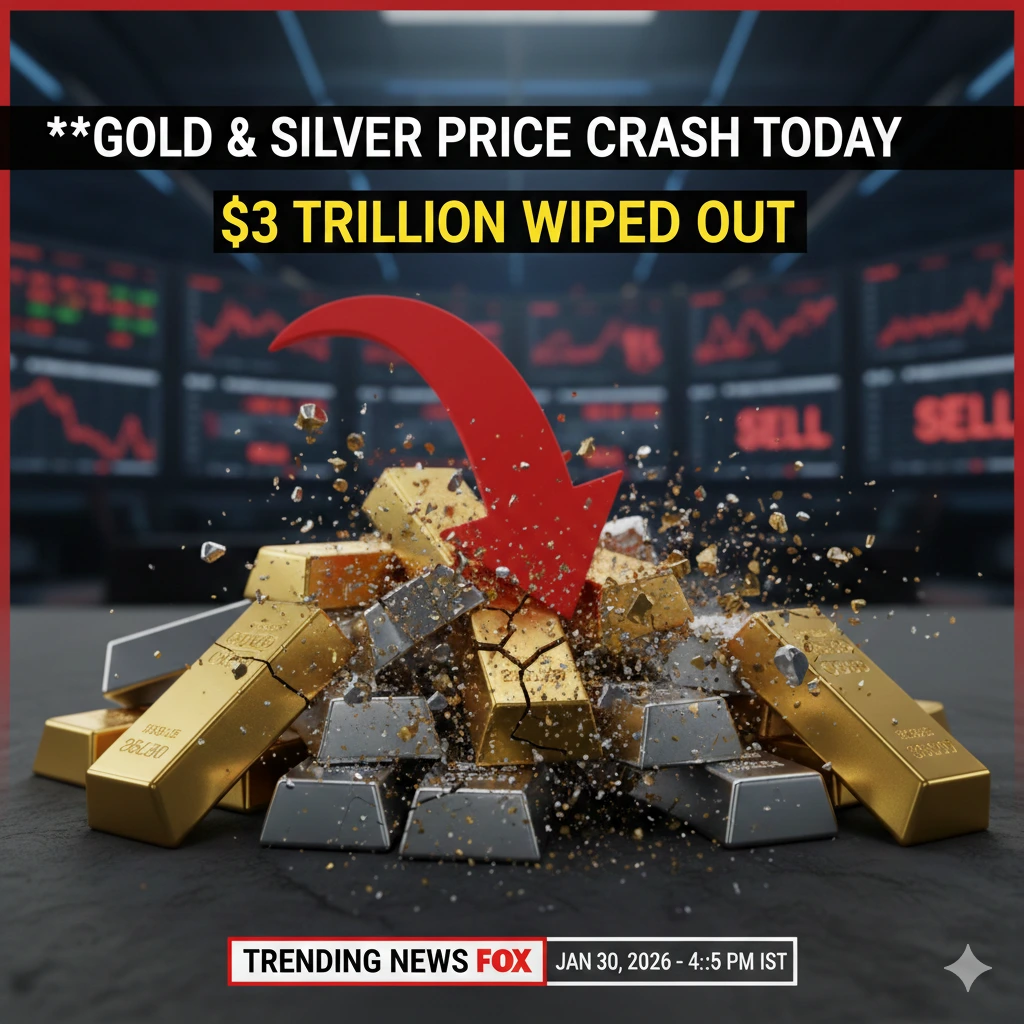
Gold Silver Crash Today, Jan 30, 2026, as a stronger US Dollar and Fed Chair rumors triggered a $3 trillion sell-off. Find out why gold fell to ₹1.67 lakh and silver plunged 11% from record highs. Is it a buying opportunity or a market bubble?
By Trending News Fox, Web News & Media Team, Published Friday 30th January, 2026
Gold Silver Crash Today: $3 Trillion Wipeout Shakes Global Markets
The “Everything Rally” in precious metals hit a massive brick wall today, Friday, January 30, 2026. In what traders are calling one of the most volatile sessions in history, gold and silver prices crashed sharply, wiping out over $3 trillion in market value within a matter of minutes. This dramatic reversal comes just 24 hours after both metals scaled unprecedented all-time highs, leaving investors wondering if the historic January bull run has finally run out of steam.
By mid-day trading, gold futures on the MCX dropped by over 1.28% to roughly ₹1,67,241 per 10 grams, a steep fall from yesterday’s peak of over ₹1,80,000. Silver took an even harder hit, plunging more than 3% (approx. ₹12,000) to trade near ₹3,87,700 per kg after briefly touching a staggering ₹4,20,000 on Thursday.
Why are Gold and Silver Falling Today?
The sudden carnage in the bullion market wasn’t a random occurrence. A “perfect storm” of macroeconomic shifts and speculative profit-booking triggered the sell-off.
1. The “Warsh Effect”: A Hawkish Fed Looming?
The primary catalyst for today’s crash was a major announcement from the White House. President Donald Trump indicated he would reveal his pick for the next Federal Reserve Chair today. Rumors have intensified that Kevin Warsh, known for a more “hawkish” stance on interest rates, is the front-runner to replace Jerome Powell.
The prospect of a Fed leader who might keep interest rates higher for longer—or even consider hikes to combat sticky inflation—sent the US Dollar Index (DXY) rebounding from its 4-year lows of 96. Since gold is denominated in dollars, a stronger greenback makes the metal more expensive for international buyers, leading to immediate downward pressure.
2. Massive Profit-Taking After Record Highs
January 2026 has been a month for the history books. Before today’s dip, gold was on track for its best monthly performance since the 1980s, and silver had surged over 50% in a single month.
“When you see vertical moves like we did on Thursday, a correction isn’t just likely; it’s necessary,” says Jigar Trivedi, Senior Research Analyst at IndusInd Securities. “Traders moved en masse to lock in life-changing profits, and that high-volume selling triggered a domino effect.”
3. ETF Liquidation
The crash was amplified by Gold and Silver ETFs, which saw some of their largest single-day outflows in years. In the Indian market, silver-focused ETFs from Zerodha and SBI reportedly fell by as much as 14% in early trade as retail and institutional investors scrambled for the exit.
The Market Data: Gold and Silver Price Today (Jan 30, 2026)
| Metal | Current Price (Approx.) | 24-Hour Change | Yesterday’s Peak (All-Time High) |
| Gold (24K/10g – MCX) | ₹1,67,241 | -1.28% | ₹1,80,779 |
| Silver (Per Kg – MCX) | ₹3,87,724 | -3.04% | ₹4,20,048 |
| Spot Gold (Intl.) | $5,236/oz | -2.20% | $5,626/oz |
| Spot Silver (Intl.) | $110/oz | -4.00% | $121/oz |
Is This a Market Manipulation or a Natural Correction?
Social media has been abuzz with claims of market manipulation, with the phrase “$3 trillion wiped out in minutes” trending on X (formerly Twitter). Some retail traders pointed to the “flash crash” nature of the decline, noting that gold lost market cap at a rate of nearly $58 billion per minute during the peak of the sell-off.
However, institutional analysts view this as a liquidity event. When volatility spikes to this level, banks and market makers often widen their “spreads” (the difference between buy and sell prices) or pull back from quoting altogether. This thinning of liquidity means that even a standard sell order can cause a disproportionately large price drop, creating a “vacuum” effect.
The Impact on Physical Demand in India
In India, the world’s second-largest consumer of gold, the record-high prices of January had already begun to bite. The World Gold Council (WGC) recently warned that India’s gold imports are likely to decline in 2026 as jewelry demand cools under the weight of ₹1.8 lakh price tags.
Interestingly, today’s price drop is being viewed as a potential “entry point” for those who missed the initial rally. While the Economic Survey 2026 noted that precious metals are driving “sticky” core inflation in India, retail buyers in Delhi, Mumbai, and Chennai are closely watching to see if gold stabilizes around the ₹1.65 lakh mark before the upcoming wedding season.
Forecast: Where Do Gold and Silver Go From Here?
Despite the “brutal” nature of today’s sell-off, the long-term outlook remains surprisingly bullish among major global banks.
- J.P. Morgan & UBS: Analysts at these firms have recently raised their 2026 year-end targets. UBS is looking at $6,200 per ounce for gold by late 2026, citing ongoing geopolitical tensions (specifically US-Iran friction) and the trend of central banks diversifying away from the dollar.
- The Silver Deficit: Silver continues to have a strong fundamental “floor” due to its industrial use. With the 2026 surge in AI data centers and green energy tech, silver is entering its fifth consecutive year of a structural supply deficit.
- Support Levels: Market experts like Manoj Kumar Jain of Prithvi Finmart suggest that as long as international gold holds above $4,980/oz and silver stays above $98/oz, the broader bull trend is intact.
Conclusion: Buying Opportunity or the Beginning of the End?
Today’s gold and silver crash is a stark reminder that what goes up vertically often comes down just as fast. For short-term speculators, the “wipeout” is a disaster; for long-term investors, it may be the healthy “cooldown” required for the next leg of the rally.
All eyes now turn to the U.S. Producer Price Index (PPI) data and the official naming of the new Fed Chair. If the new leadership signals a return to aggressive rate hikes, the “gold rush” of 2026 may face its first true bear market. But if geopolitical tensions remain high and the dollar’s rebound proves temporary, today’s crash might just be a footnote in a historic year for bullion.
Stay tuned to Trending News Fox for live updates on the bullion market and the latest on the 2026 Union Budget.
Also, read Australian Open Tennis 2026: Schedule, Results, Live Updates & Key Highlights
Frequently Asked Questions (FAQ) – Gold and Silver Crash
1. Why did gold and silver prices crash today, January 30, 2026?
The primary reasons for the crash include aggressive profit-taking after both metals hit record all-time highs on Thursday, a rebound in the US Dollar Index (DXY), and rumors that President Trump will appoint a more hawkish Federal Reserve Chair (such as Kevin Warsh), which could keep interest rates higher for longer.
2. How much did gold and silver prices fall?
In a single session, gold futures on the MCX dropped approximately 1.28% (₹2,162) to trade near ₹1,67,241 per 10 grams. Silver took a much larger hit, plunging over 3% to 8% in various markets, falling to roughly ₹3,87,700 per kg from its peak of over ₹4,20,000.+1
3. Was the $3 trillion wipeout caused by market manipulation?
While social media users have alleged manipulation due to the speed of the decline—gold lost market cap at a rate of $58 billion per minute—analysts suggest it was a “liquidity event.” Massive sell orders triggered stop-losses, and a lack of buyers at record-high levels created a price vacuum.
4. Is it a good time to buy gold after today’s price drop?
Many market experts view this as a healthy correction in a long-term bull market. While short-term volatility is expected to continue, long-term investors often see such 5–10% dips as an entry point, especially with the 2026 Union Budget approaching and ongoing geopolitical tensions.
5. What are the gold and silver price predictions for next week?
Analysts suggest that the trend will depend on the US Producer Price Index (PPI) data and the official Fed Chair announcement. If gold holds above $4,980/oz and silver stays above $95/oz internationally, the rally may resume. However, a break below these levels could signal further cooling.
6. How did today’s crash affect Gold and Silver ETFs?
ETFs were hit hardest by the volatility, with some domestic silver and gold ETFs crashing by as much as 14% in early trade. This was driven by retail investors rushing to liquidate their holdings after the previous day’s parabolic rise.
Also, read Happy Republic Day 2026: Celebrating India’s Pride, Unity & Constitution
Video Below:
Audio Podcast Below: