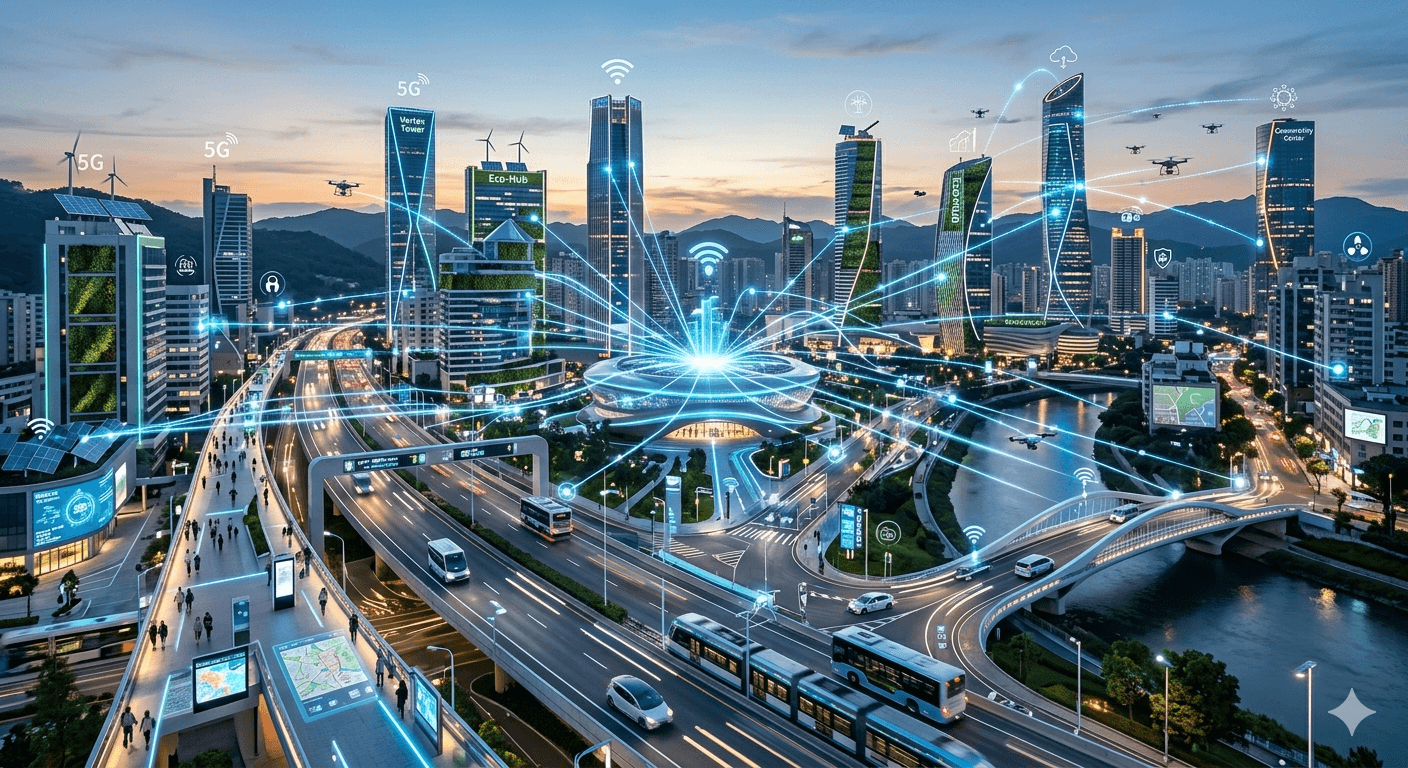
Discover the future of urban living with our insights on smart cities. Explore innovative technologies that enhance sustainability, efficiency, and quality of life.
By Trending News Fox, News & Media Team, Kolkata
The Blueprint of Tomorrow: How Smart Cities Are Redefining Urban Living
The traditional metropolis is reaching its breaking point. As global populations surge, cities now house over 55% of humanity—a figure the United Nations projects will skyrocket to nearly 70% by 2050. This unprecedented urban migration leaves municipalities facing a critical question: how can local governments manage exploding populations, crumbling infrastructure, and mounting climate anxieties without sacrificing quality of life?
The answer lies in the concept of the Smart City.
Far from a futuristic sci-fi trope, the smart city is a highly functional, data-driven framework changing urban planning in real time. By weaving artificial intelligence (AI), the Internet of Things (IoT), and high-speed connectivity directly into the physical landscape, modern cities are transforming from passive concrete jungles into living, adapting ecosystems.
1. Defining the Modern Smart City
At its core, a smart city is an urban area that utilizes technology, data collection, and digital infrastructure to optimize city services, improve environmental sustainability, and elevate the daily lives of its citizens.
Rather than viewing municipal elements—such as electricity, water, transit, and public safety—as separate silos, a smart city connects them. It functions via a continuous digital loop:
[Sensors Collect Data] ➔ [Networks Transmit Info] ➔ [AI Analyzes Inputs] ➔ [City Adjusts Infrastructure]
This structural evolution relies heavily on the Smart Golden Triangle: the integration of advanced technology, responsive public processes, and citizen-centric management. Without active community engagement and real-world utility, advanced technology amounts to little more than expensive corporate rebranding.
2. The Core Technology Powering Connected Cities
A city cannot be “smart” without a robust foundation of underlying technologies. To understand how these environments breathe, we have to look at the primary tech layers driving them:
Smart Cities: Internet of Things (IoT) and Sensor Networks
IoT devices act as the sensory organs of the modern landscape. Thousands of low-power, interconnected sensors are embedded into roads, water pipes, streetlights, and waste bins. These sensors monitor everything from air quality and moisture levels to acoustic anomalies and physical structural stress.
Smart Cities: High-Speed Connectivity (5G and Beyond)
Data is useless if it cannot travel. Secure, high-speed connectivity serves as the nervous system of urban infrastructure. The widespread deployment of 5G cellular networks provides the massive bandwidth and ultra-low latency required to transmit millions of data points simultaneously, allowing devices to communicate in milliseconds.
Smart Cities: Artificial Intelligence and Edge Computing
If sensors are the eyes and 5G is the nervous system, Artificial Intelligence is the brain. Machine learning algorithms analyze torrents of raw municipal data to identify patterns, flag maintenance issues, and automate responses. Edge computing—processing data directly on localized hardware rather than sending it all to a distant cloud server—ensures that critical systems like automated traffic signals react instantaneously.
3. Real-World Applications: Urban Operations Reimagined
The primary objective of a smart city strategy is turning data into measurable public benefits. When deployed correctly, these ecosystems dramatically streamline daily operations.
Smart Cities: Intelligent Transport Systems (ITS)
Traffic congestion costs billions of dollars in lost productivity and millions of tons of excess carbon emissions annually. Smart cities combat gridlock using adaptive traffic signals.
Instead of operating on rigid, pre-timed schedules, intelligent intersections utilize embedded cameras and road sensors to evaluate real-time traffic volume. If a major thoroughfare experiences a sudden bottleneck, an AI management system alters traffic light intervals on the fly to dissolve the jam.
Furthermore, digital parking infrastructure maps available spaces across the city. Drivers can view real-time parking availability via mobile applications, eliminating the traditional, high-emission cruise around block after block in search of a parking spot.
Smart Cities: Automated Waste Management
Traditional trash collection is notoriously inefficient, involving rigid schedules where trucks frequently empty half-empty bins while overflowing containers sit neglected.
Smart waste management programs utilize solar-powered compacting trash bins equipped with fill-level sensors. When a container reaches its capacity limit, it automatically alerts municipal sanitation crews via a cloud-based dashboard. This data ensures collection routes are dynamically optimized, saving city fuel costs, reducing truck emissions, and keeping public spaces cleaner.
Smart Cities: Smart Energy Grids and Eco-Friendly Architecture
Urban areas consume roughly 75% of global primary energy. Smart grids balance local power distribution by using real-time predictive analytics to forecast energy demand spikes.
These grids integrate clean, renewable energy sources—like localized solar arrays and wind power—while adjusting distribution seamlessly. At the street level, smart LED streetlights dim when roads are empty and brighten when motion sensors detect pedestrians or oncoming vehicles, reducing public energy consumption by up to 70%.
4. Case Studies: Global Leaders in Smart Integration
Cities across the globe are setting benchmarks for smart urban transformation, approaching modernization in unique ways.
| City | Core Strategy | Signature Program | Key Metric / Goal |
| Singapore | Comprehensive digitization across public and private sectors. | Smart Nation Initiative | Digital health tracking & localized video consults for aging populations. |
| Zurich | Energy optimization and high-tech utility tracking. | Smart Building & Streetlight Network | Achieved up to 70% energy savings on modernized street lighting. |
| Helsinki | Aggressive, data-driven climate action. | Carbon-Neutral Master Plan | Reduced local emissions by 27% compared to 1990 levels. |
| Seoul | Pervasive IoT sensory coverage and civic green initiatives. | Solar-Compacting Waste & IoT Net | City-wide tracking of traffic, air quality, and senior safety. |
5. The Critical Hurdles: Privacy, Security, and Equity
The growth of smart cities brings significant logistical and societal complications. No municipal overhaul can succeed without navigating these central risks:
Smart Cities: Data Privacy Concerns
Because smart cities thrive on a non-stop collection of data, they naturally provoke surveillance anxieties. When thousands of cameras, public Wi-Fi hubs, and localized sensors track pedestrian flows, drawing the boundary line between behavioral data analysis and an invasion of civil liberties becomes difficult. Municipal governments must implement rigorous data-anonymization protocols to guarantee public transparency.
Data Privacy Mandate: To maintain public trust, city leaders must adopt open-governance principles, ensuring collected data tracks institutional patterns and utility metrics rather than identifiable personal details.
Smart Cities: Cybersecurity Vulnerabilities
An interconnected city presents a massive attack surface for malicious hackers. If a municipality integrates its water networks, traffic grids, and emergency response pipelines into a single digital platform, a successful ransomware attack could paralyze entire populations. Securing these systems requires zero-trust network architectures and robust cryptographic defenses.
Smart Cities: The Digital Divide and Urban Inequality
Technology should bridge social divides, not expand them. If a city’s primary services—such as booking public transit, reporting municipal maintenance issues, or accessing emergency health portals—require a modern smartphone and high-speed internet, marginalized communities risk being cut off from essential care. True urban intelligence prioritizes social inclusion alongside engineering milestones.
6. The Horizon: Building an Inclusive Urban Future
The evolution of urban planning is shifting away from tech-for-the-sake-of-tech toward a human-centric model. The ultimate measure of a smart city’s success is not the volume of its sensors or the complexity of its AI models, but the health, safety, and happiness of its citizens.
By utilizing technology to reduce carbon footprints, maximize resource conservation, and optimize public space, smart cities provide a clear blueprint for sustainable living. Tomorrow’s cities will be highly connected, highly adaptive, and—above all else—built around the everyday needs of the people who call them home.