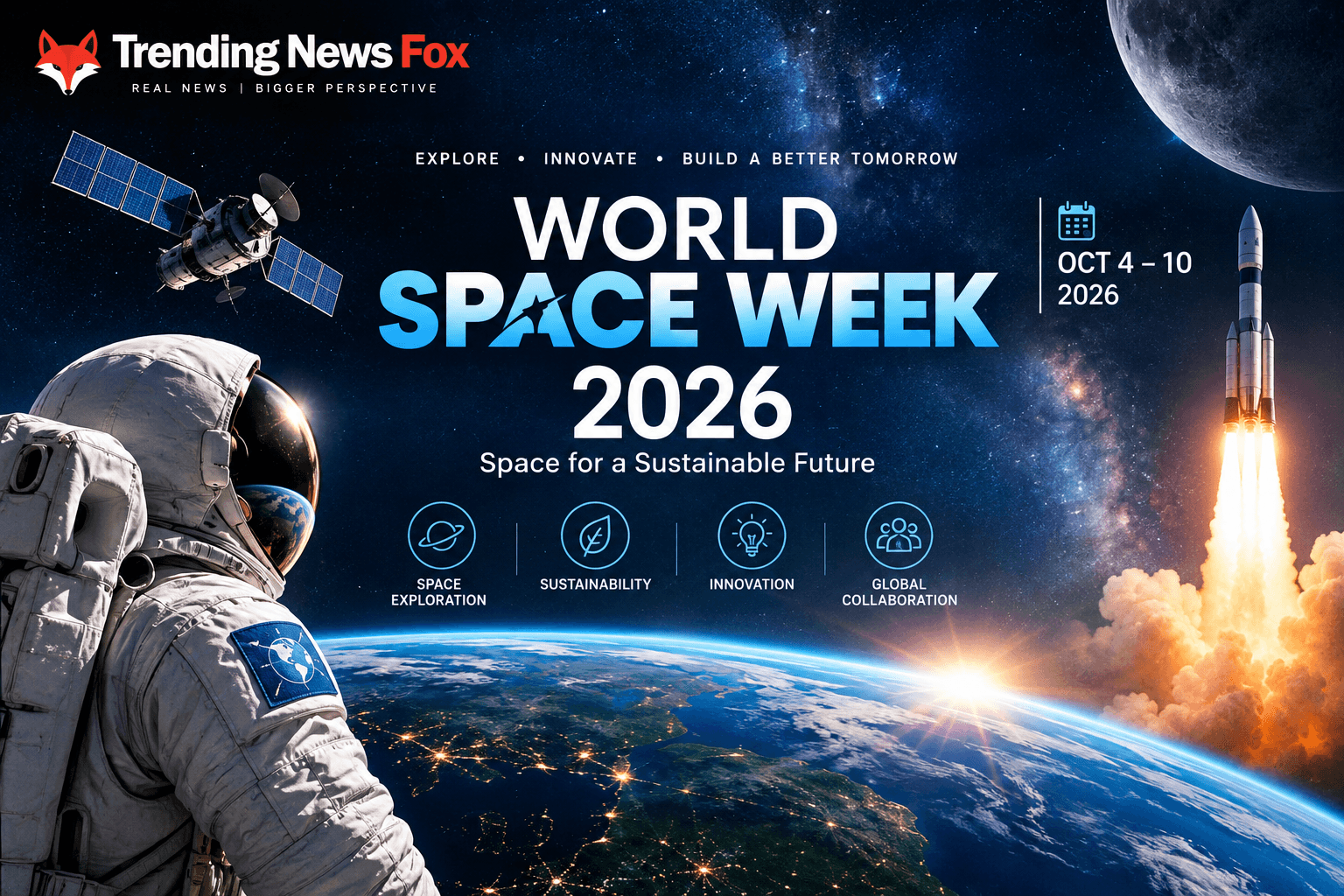
World Space Week 2026 runs October 4–10 with the theme “Rocket Revolution.” Explore its history, space technology, rockets, STEM, India and the future of space exploration.
Published by Trending News Fox | October 6, 2026
World Space Week 2026: Rocket Revolution and the Future of Space Exploration
World Space Week 2026 is being celebrated globally from October 4 to October 10, bringing attention to humanity’s remarkable achievements in space science, technology and exploration. This year’s theme, “Rocket Revolution,” highlights the rapid transformation taking place in the space-launch industry and the growing number of organizations and nations gaining access to space.
For millions of students, researchers, space enthusiasts and science communicators, World Space Week is an opportunity to look beyond Earth and understand how space technology is shaping life on our planet. From communication satellites and weather forecasting to navigation, disaster monitoring and scientific research, space technology has become an increasingly important part of modern society.
What Is World Space Week?
World Space Week is an annual international celebration established by the United Nations to recognize the contribution of space science and technology to improving the human condition.
The United Nations General Assembly proclaimed World Space Week through Resolution 54/68 on December 6, 1999. It is observed every year from October 4 to October 10.
The dates have major historical significance. On October 4, 1957, Sputnik 1 became the first human-made Earth satellite to be launched into space, marking the beginning of the Space Age. October 10 is also significant because the Outer Space Treaty entered into force on that date in 1967.
World Space Week now serves as a global platform for education, public awareness, science outreach and international cooperation.
World Space Week 2026 Theme: “Rocket Revolution”
The central theme of World Space Week 2026 is “Rocket Revolution.”
The theme reflects a major transformation in the way humanity reaches space. For decades, space launches were dominated primarily by national space agencies and government-backed programmes. Today, the space-launch ecosystem includes commercial companies, reusable rocket developers, startups, universities and emerging national space programmes.
This changing environment is making space increasingly accessible and is expanding the potential uses of orbital technology.
The rocket revolution is not simply about launching spacecraft faster. It represents a broader change in the economics, technology and availability of space access.
Why Rockets Matter to the Future of Space
Rockets remain the fundamental technology that carries satellites, spacecraft, scientific instruments and crewed vehicles beyond Earth’s atmosphere.
Advances in launch technology can influence the cost and frequency of missions. Reusable rocket systems, improved manufacturing techniques, advanced propulsion technologies and commercial launch services are contributing to a rapidly evolving industry.
More frequent launches can support the deployment of communication satellites, Earth-observation systems, scientific missions and other space-based infrastructure.
The result could be a more connected and technologically capable space ecosystem.
Space Technology Is Already Part of Everyday Life
Space exploration may seem distant, but many technologies developed for or supported by space activities have practical applications on Earth.
Satellites contribute to weather forecasting, navigation, telecommunications, environmental monitoring and disaster management. Earth-observation systems can help scientists monitor changes in forests, oceans, agriculture and urban areas.
Satellite-based information can also support emergency response by providing valuable data during floods, cyclones, wildfires and other disasters.
This makes World Space Week more than a celebration of rockets and astronauts. It is also a reminder of how space technology can contribute to everyday life and sustainable development.
World Space Week 2026 and the Next Generation
One of the most important objectives of World Space Week is inspiring young people to become interested in science, technology, engineering and mathematics.
Students can use the week to learn about astronomy, spacecraft, satellites, robotics, planetary science and rocket engineering.
Schools and educational institutions can organize activities such as:
- Space science exhibitions
- Rocket-model demonstrations
- Astronomy observation sessions
- Satellite and spacecraft projects
- STEM competitions
- Space quizzes
- Science presentations
- Planetarium visits
- Astronomy workshops
- Discussions about careers in space science
Such activities can transform curiosity about the night sky into an interest in scientific education and future careers.
The United Nations describes World Space Week as an opportunity to inspire students, educate the public about space activities, demonstrate public support for space programmes and foster international cooperation.
India and the Growing Space Economy
For India, the growing global interest in space technology creates significant opportunities.
India has developed a strong space programme and has increasingly attracted attention for satellite technology, launch capabilities, planetary exploration and commercial space activities.
The country’s space ecosystem includes government institutions, private companies, startups, researchers and educational organizations. The broader global shift toward commercial space activity also creates opportunities for Indian entrepreneurs and technology companies.
For young Indians interested in physics, engineering, computer science, mathematics or astronomy, the expanding space sector offers a wide range of potential career paths.
The future of space will not be limited to astronauts. Engineers, software developers, data scientists, robotics specialists, researchers, designers, medical professionals and policy experts can all contribute to the space industry.
The Commercial Space Revolution
Perhaps the biggest change represented by the Rocket Revolution is the increasing role of commercial organizations.
Private companies are developing launch vehicles, spacecraft, satellite systems and other technologies. This growing commercial participation can encourage competition and innovation.
The World Space Week Association describes the 2026 theme as a celebration of the transformation in space launch and the expansion of access through commercial launch providers, reusable rockets, university teams, startups and new national space actors.
As launch opportunities increase, new businesses may emerge around satellite communications, Earth observation, space data, research, tourism and other applications.
Challenges Behind the Rocket Revolution
Despite the excitement surrounding new space technologies, the expansion of space activity also brings challenges.
One important issue is space debris. As more spacecraft and satellites enter orbit, responsible management of orbital environments becomes increasingly important.
Another challenge is ensuring that space remains a peaceful environment and that the benefits of space technology are available to countries and communities around the world.
International cooperation, responsible behaviour and appropriate legal frameworks will therefore remain important as humanity expands its activities beyond Earth.
The United Nations Office for Outer Space Affairs works to promote international cooperation in the peaceful exploration and use of outer space and supports efforts to help countries benefit from space science and technology.
Space Exploration and Humanity’s Future
The history of space exploration demonstrates how quickly technological possibilities can change.
Sputnik 1 represented the beginning of the Space Age. Human spaceflight followed, and later came robotic exploration of the Moon, Mars and the wider solar system.
Today, spacecraft can study distant planets, observe galaxies billions of light-years away and monitor Earth’s changing environment.
The next phase could bring even more ambitious missions, including expanded lunar exploration, advanced space stations, new scientific observatories and eventually deeper human exploration.
The rocket revolution is therefore not only about today’s launches. It is about creating the infrastructure that could support tomorrow’s discoveries.
How People Can Celebrate World Space Week 2026
Anyone can participate in World Space Week.
Families can watch educational space documentaries, explore astronomy resources or observe the night sky. Students can build simple models or conduct space-related research projects.
Teachers can introduce lessons about rockets, satellites and planetary science. Science clubs can organize quizzes, exhibitions and astronomy nights.
Space enthusiasts can also follow official World Space Week activities and share educational content online.
The World Space Week Association reports that its global celebration has involved tens of thousands of events across more than 100 countries, demonstrating the worldwide reach of the observance.
World Space Week 2026: Looking Beyond Earth
World Space Week 2026 arrives at a fascinating moment for humanity’s relationship with space.
The “Rocket Revolution” theme captures a period when access to space is changing rapidly. New technologies, commercial launch providers, startups, universities and national programmes are contributing to a more diverse space ecosystem.
But the true significance of space exploration goes beyond rockets.
Space science can help us understand our planet, expand scientific knowledge, develop new technologies and inspire future generations. It can also remind humanity that many of our greatest challenges require cooperation across borders.
As World Space Week 2026 continues from October 4 to October 10, the message is clear: the future of space is being shaped not only by governments and astronauts, but by scientists, engineers, entrepreneurs, students and dreamers around the world.
The next great chapter of space exploration may already be beginning—and the rocket revolution could be the technology that takes humanity there.
Frequently Asked Questions
When is World Space Week 2026?
World Space Week 2026 is celebrated globally from October 4 to October 10, 2026.
What is the theme of World Space Week 2026?
The official 2026 theme is “Rocket Revolution.”
Why is World Space Week celebrated?
It celebrates the contribution of space science and technology to humanity and promotes education, public awareness and international cooperation in space activities.
Why does World Space Week start on October 4?
October 4 commemorates the launch of Sputnik 1 in 1957, the first human-made Earth satellite.
How can students participate in World Space Week?
Students can participate through astronomy observations, science projects, rocket-model activities, quizzes, exhibitions, STEM workshops and educational space events.
What does the Rocket Revolution mean?
It refers to the rapid transformation of space launch, including the growth of commercial launch providers, reusable rockets, startups, university teams and emerging national space programmes.
Final Word
World Space Week 2026 is more than a celebration of rockets and space exploration. It is an opportunity to understand how space technology affects life on Earth and to encourage the next generation to imagine what is possible beyond our planet.
For Trending News Fox, this year’s “Rocket Revolution” offers a powerful reminder that the future of space is being built today—one launch, one discovery and one ambitious idea at a time.
What do you think will be humanity’s next major achievement in space? Share your thoughts in the comments and follow Trending News Fox for more science, technology and trending news updates.