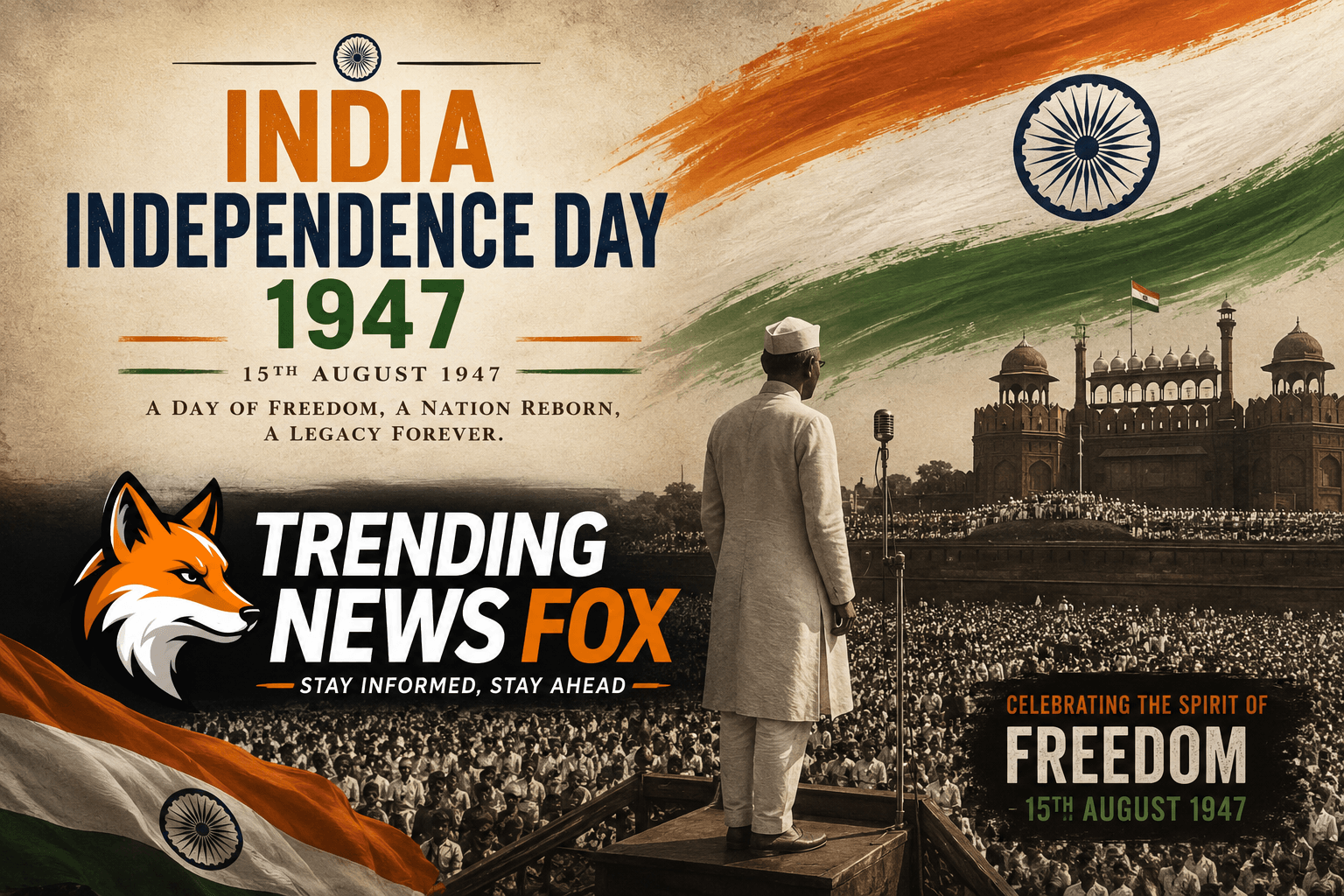
India Independence Day 1947 marked the historic end of British rule and the birth of an independent nation. Explore the history, significance, freedom struggle and legacy of August 15, 1947, on Trending News Fox.
Dawn of Freedom: How August 15, 1947, Reshaped India and the World
Trending News Fox Special Report | By History & Politics Desk
On the stroke of midnight on August 15, 1947, a nation of nearly 400 million people awoke to a new reality. After nearly two centuries under foreign rule—first under the commercial grip of the East India Company and later under the direct sovereignty of the British Crown—India officially declared itself an independent state.
The birth of independent India was not merely a localized political transfer of power. It marked the definitive beginning of global decolonization following World War II, shattering the aura of imperial hegemony and establishing the world’s largest democracy.
Here is the authoritative story of how India achieved its freedom on August 15, 1947, the pivotal movements that led to that momentous day, and the bittersweet legacy of Partition.
The Road to 1947: A Century of Resistance
The achievement of freedom in 1947 was the culmination of generations of sacrifice, strategic political organizing, and civilian movements across the Indian subcontinent.
┌─────────────────────────────────────────────────────────────────────────────┐
│                        CHRONOLOGY OF INDIAN FREEDOM                         │
├───────────────────┬─────────────────────────────────────────────────────────┤
│ 1857              │ First War of Independence (Sepoy Mutiny)                 │
│ 1885              │ Formation of the Indian National Congress               │
│ 1905              │ Swadeshi Movement launched against Partition of Bengal  │
│ 1919              │ Jallianwala Bagh Massacre sparks mass outrage           │
│ 1920–1922         │ Non-Cooperation Movement launched by Mahatma Gandhi     │
│ 1930              │ Salt March (Dandi March) challenges British monopolies  │
│ 1942              │ Quit India Movement demands immediate British exit      │
│ July 18, 1947     │ Indian Independence Act receives Royal Assent           │
│ August 15, 1947   │ Official Transfer of Power and Independence Day         │
└───────────────────┴─────────────────────────────────────────────────────────┘
India Independence Day 1947: Key Pillars of the Freedom Movement
- The Shift from Rebellion to Organized Politics: After the uprising of 1857, direct administration transferred from the East India Company to the British Crown. The founding of the Indian National Congress in 1885 laid the institutional foundation for constitutional reform and eventual self-governance.
- Gandhian Non-Violent Resistance: Mahatma Gandhi transformed the freedom movement from an elite political discussion into a mass popular revolution. Through Satyagraha (truth-force), civil disobedience, and economic boycotts, non-violent resistance exposed the moral vulnerability of colonial rule.
- Revolutionary Counter-Pressure: Alongside non-violent campaigns, revolutionary movements led by figures like Bhagat Singh, Chandrashekhar Azad, and Subhas Chandra Bose (who formed the Indian National Army) exerted immense physical and intelligence pressures on British administrative control.
- Post-WWII Geopolitics: World War II left Britain economically exhausted. With rising military disloyalty—evidenced by the Royal Indian Navy mutiny of 1946—the British government under Prime Minister Clement Attlee realized that holding India by force was no longer viable.
The Mountbatten Plan and the “Tryst with Destiny”
In March 1947, Lord Louis Mountbatten arrived in New Delhi as the last Viceroy of India.His mandate was to oversee a swift transfer of power.Originally scheduled for June 1948, Mountbatten drastically accelerated the timeline to August 1947, selecting August 15 to coincide with the second anniversary of Japan’s surrender in World War II.
India Independence Day 1947: The Historic Midnight Assembly
On the night of August 14, 1947, the Constituent Assembly gathered in New Delhi. As midnight struck, Jawaharlal Nehru, India’s first Prime Minister, delivered one of the 20th century’s most iconic speeches:
“Long years ago we made a tryst with destiny, and now the time comes when we shall redeem our pledge, not wholly or in full measure, but very substantially. At the stroke of the midnight hour, when the world sleeps, India will awake to life and freedom.”— Jawaharlal Nehru, August 14, 1947
The following morning, August 15, Nehru raised the Indian National Tricolor flag above the Lahori Gate of the historic Red Fort in Old Delhi.This ceremonial hoisting established a tradition that continues to this day.
The Bittersweet Victory: Partition and Its Aftermath
The triumph of August 15, 1947, was accompanied by profound tragedy.The passage of the Indian Independence Act 1947 partitioned British India into two independent dominions: India and Pakistan.
| Parameter | Dominion of India | Dominion of Pakistan |
| Date of Creation | August 15, 1947 | August 14, 1947 |
| First Head of State | Lord Mountbatten (Governor-General) | Muhammad Ali Jinnah (Governor-General) |
| First Prime Minister | Jawaharlal Nehru | Liaquat Ali Khan |
| Key Legislative Body | Constituent Assembly of India | Constituent Assembly of Pakistan |
| Territorial Scope | Central, Southern, Eastern India, & Princely States | West Pakistan (now Pakistan) & East Pakistan (now Bangladesh) |
India Independence Day 1947: The Human Cost of Division
The hasty drawing of borders by British barrister Sir Cyril Radcliffe divided Punjab and Bengal along religious lines.
- Mass Displacement: An estimated 14 to 15 million people were uprooted, marking one of the largest forced migrations in human history.
- Communal Violence: Widespread riots erupted across border regions. Hundreds of thousands lost their lives in the violence that accompanied the division.
- Gandhi’s Absence from Celebrations:Deeply saddened by the violent partition of the subcontinent, Mahatma Gandhi chose not to attend the official celebrations in New Delhi. Instead, he spent August 15 in Kolkata (Calcutta), fasting and praying for communal harmony.
India Independence Day 1947: Key Historical Figures of August 15, 1947
The structural foundation of independent India rested on several visionary leaders:
- Jawaharlal Nehru:As India’s first Prime Minister, he articulated the nation’s democratic vision, establishing secular governance and industrial development plans.
- Sardar Vallabhbhai Patel: Serving as the Deputy Prime Minister and Home Minister, Patel led the monumental diplomatic effort to integrate over 560 autonomous princely states into the Indian Union.
- Dr. B.R. Ambedkar: Appointed as the Chairman of the Drafting Committee for the Constitution, Ambedkar ensured that post-independence India would be anchored in equality, fundamental rights, and the abolition of untouchability.
- Sarojini Naidu & Hansa Mehta: Female leaders who championed women’s rights within the new legislative frameworks, ensuring universal adult suffrage from day one of the republic.
India Independence Day 1947: Legacy and Modern Significance
The events of August 15, 1947, altered the geopolitical landscape permanently. India’s transition to independence dismantled the foundational economics of European empire building and served as a blueprint for anti-colonial movements across Africa, Asia, and the Caribbean.
Today, Independence Day remains a national symbol of unity in diversity. From the grand military and cultural parades at the Red Fort to local celebrations in towns and villages across the nation, August 15 stands as a reminder of the resilience, democracy, and sovereign spirit of the Indian people.
Keep following Trending News Fox for in-depth historical features, political analyses, and breaking global updates.
India Independence Day 1947: History & Significance | Trending News Fox
Frequently Asked Questions: India Independence Day 1947
1. Why was August 15 chosen as India’s Independence Day?
Lord Louis Mountbatten, the last Viceroy of India, chose August 15, 1947. He selected this specific date because it coincided with the second anniversary of Japan’s surrender in World War II (August 15, 1945), which he considered a personally auspicious landmark in his military career.
2. Why did India gain independence at midnight?
When British authorities agreed to transfer power on August 15, Indian astrologers pointed out that August 15 was an inauspicious date according to the Hindu calendar. As a compromise between political urgency and traditional sentiments, the Constituent Assembly convened on the night of August 14, allowing the official transition to take place exactly as the clock struck midnight, marking the start of August 15.
3. Where was Mahatma Gandhi on August 15, 1947?
Mahatma Gandhi did not attend the official independence celebrations in New Delhi. Deeply anguished by the violent communal riots triggered by the Partition of Bengal and Punjab, he was in Kolkata (then Calcutta). He spent the day fasting, praying, and working to restore communal peace.
Key Historical Snapshot
| Detail | Fact |
| First Prime Minister | Jawaharlal Nehru |
| First Governor-General (Independent India) | Lord Louis Mountbatten |
| First Indian Governor-General | C. Rajagopalachari (1948–1950) |
| Legislation Passed | Indian Independence Act 1947 (UK Parliament) |
| Historic Speech | “Tryst with Destiny” by Jawaharlal Nehru |
4. What was the “Tryst with Destiny” speech?
“Tryst with Destiny” was the historic address delivered by Jawaharlal Nehru to the Indian Constituent Assembly on the eve of India’s independence, midnight on August 14–15, 1947. It is regarded as one of the greatest speeches of the 20th century, capturing the political culmination of India’s freedom struggle.
5. Why do India and Pakistan celebrate Independence Day on different dates?
Pakistan celebrates its Independence Day on August 14, while India celebrates on August 15. This occurred primarily for administrative convenience:
- Lord Mountbatten needed to attend the transfer of power ceremony in Karachi (Pakistan’s original capital) before heading to New Delhi for India’s midnight ceremony.
- Pakistan’s ceremony took place on the afternoon of August 14, 1947, leading them to adopt August 14 as their national day.
6. Was the Indian National Anthem played on August 15, 1947?
No. Jana Gana Mana (composed by Rabindranath Tagore) was sung during the Constituent Assembly session, but it was not yet the official national anthem. It was formally adopted as India’s National Anthem on January 24, 1950, two days before India became a Sovereign Democratic Republic.