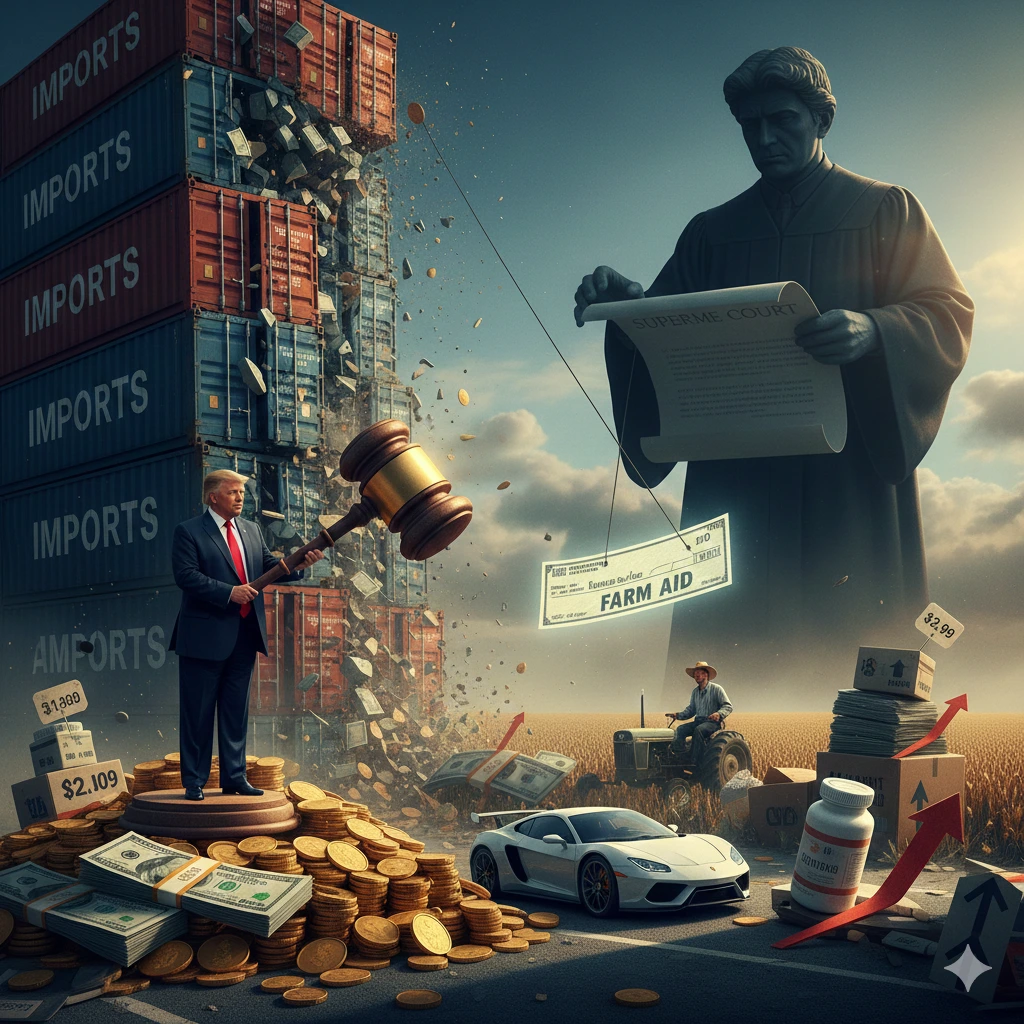
Stay updated on Donald Trump Tariffs policies, their economic impact, global reactions, and what they mean for trade and consumers. Get the latest news, analysis, and expert insights on Donald Trump Tariffs.
📰 The Donald Trump Tariffs Tide Rises: Latest Updates on President Trump’s ‘America First’ Trade Policy
The latest updates on President Donald Trump’s “America First” trade agenda show a dramatic escalation in US tariff policy, with sweeping new duties enacted, trade tensions flaring with key partners, and the entire program facing a major legal challenge. Since the beginning of the year, the administration has implemented a series of tariff hikes intended to protect domestic manufacturing and generate massive government revenue.
🚨 Record-High Donald Trump Tariffs and Major Policy Shifts
The core of the new policy, largely implemented under the controversial International Emergency Economic Powers Act (IEEPA), established a minimum 10% tariff on nearly all US imports, effective in April.3 This move pushed the US average applied tariff rate to levels not seen in over a century.
- Soaring Revenue: The duties have led to a historic surge in collections, with total duty revenue hitting $215.2 billion in Fiscal Year 2025 (ending September 30). Monthly tariff collections now routinely exceed $30 billion, compared to under $10 billion per month in the previous year.
- Targeted Hikes: Beyond the baseline, the administration has imposed significant, country-specific “reciprocal tariffs,” including a 50% tariff on a wide range of goods from countries like India, linked to allegations of fueling foreign war efforts and other trade barriers.
- End of De Minimis: In August, the widely used de minimis exemption, which allowed imports valued under $800 to enter duty-free, was suspended, subjecting a large volume of small shipments to the new tariffs.
- New Sectoral Duties: Tariffs have also been raised on specific sectors under Section 232 of the Trade Expansion Act, including a 50% tariff on steel, aluminum, and copper, and a 25% tariff on imported cars from most nations.
⚖️ Legal Battles and Supreme Court Review
The legality of the sweeping IEEPA tariffs remains in doubt and is currently at the center of a high-stakes legal battle.
- Court Challenges: Lower federal courts have ruled that the tariffs imposed under the IEEPA exceed the President’s authority.
- Supreme Court Hearing: The consolidated case is now before the US Supreme Court, with a decision expected in early 2026. A ruling against the administration could potentially revoke the IEEPA-based tariffs—which account for an estimated 61% of the year-to-date tariff increase—and possibly require the return of revenues already collected. Economists suggest alternative legal pathways exist, which could lead to a quick replacement of the lost duties, but this would cause short-term market volatility.
🌎 Global Impact and Trade Tensions
The aggressive new tariff regime has already triggered significant global trade disruption and retaliation.
- Impact on India: India’s exports to the US have reportedly fallen by 28.5% over a five-month period following a series of steep tariff hikes, particularly affecting labor-intensive sectors like garments, textiles, and gems and jewelry.
- China and Canada: Trade negotiations with China have led to temporary agreements and shifts in tariffs, while tensions with Canada remain high, with threats of additional duties on Canadian imports, including fertilizer.
- New Flashpoint: Rice: President Trump recently signaled the possibility of fresh Donald Trump Tariffs on Indian rice, claiming the country is “dumping” the product in the US market, a move aimed at appeasing American farmers facing price pressure.
🌾 Farm Aid and Economic Implications
In a move to offset the financial stress of the trade wars, the administration has announced an $11 billion relief assistance package for American farmers, arguing the aid is a necessary bridge during a period of trade adjustment.
Economists continue to debate the long-term economic effects:
- GDP & Prices: Many analyses project the cumulative effect of the tariffs will result in a reduction in long-run US GDP and an increase in consumer prices, disproportionately affecting lower-income households.
- Tax Replacement Theory: President Trump has repeatedly claimed that tariff revenues are rising fast enough to eventually allow for the replacement or elimination of federal income taxes. However, federal revenue data shows that individual income taxes remain the core pillar of government funding, generating far more revenue than current tariff collections.
Also, read Top Trending News Stories | Latest Breaking News & Updates
🚗💊 Sector Spotlight: The Economic Impact of Donald Trump Tariffs on Autos and Pharmaceuticals
President Trump’s sweeping tariff policy has had a profound, sector-specific impact, creating distinct challenges for the highly globalized Automotive Industry and the sensitive Pharmaceutical Supply Chain. While the tariffs aim to bolster domestic production, the immediate effects have been felt through rising input costs, supply chain disruption, and increased prices for consumers.
🚗 The Automotive Industry: Rising Sticker Prices and Squeezed Profits
The auto sector has been hit by a “double tariff whammy”—duties on both raw materials (steel and aluminum) and finished vehicles/parts. The centerpiece of this policy is the 25% tariff on imported cars and high duties on auto parts from most nations.
| Key Impact Area | Economic Effect | Latest Data / Response |
| Consumer Prices | Increased cost of vehicles, especially imports. | Average price increase on 2026 Model Year vehicles is nearly $2,000, a drastic jump compared to previous years. The average monthly car payment has risen to $766 (Edmunds). |
| Input Costs | Tariffs on steel, aluminum, copper, and auto parts raise manufacturing costs for all vehicles, including those assembled in the US. | Automakers like General Motors and Ford have cited tariff costs in the range of $3 billion to $5 billion annually. |
| Profit Margins | Automakers initially absorbed much of the cost to remain competitive, severely squeezing profitability. | Manufacturers are now increasingly passing on costs, leading to a rise in Manufacturer’s Suggested Retail Prices (MSRPs) even as profitability is still challenged. |
| Supply Chain/Production | Disruption and production halts for certain imported models. | Automakers like Audi and Infiniti have reportedly halted or paused imports of certain models to the US market in response to the 25% tariff. |
The key takeaway for the auto industry is that tariffs act as a tax on production, adding an estimated $2,500 to $3,000 in added costs per vehicle (imported or domestically assembled), which is now finally flowing through to the consumer.
💊 The Pharmaceutical Supply Chain: Cost Hikes and Shortage Risks
The pharmaceutical sector, which has historically enjoyed mostly tariff-free trade, is now facing duties on essential ingredients and products, threatening to destabilize an already fragile global supply chain.
| Key Impact Area | Economic Effect | Latest Data / Response |
| Drug Prices | Increased cost of Active Pharmaceutical Ingredients (APIs) and finished drugs. | A 25% tariff could increase annual US drug costs by up to $51 billion, translating to 12.9% price hikes if fully passed through. Some analyses project a cost increase of $600 per year per household. |
| Supply Chain Fragility | Heavy US reliance on imported APIs and generic drugs, particularly from India (which sources from China). | 90–95% of sterile injectable generics used in US hospitals rely on raw materials from China/India. Tariffs increase the risk of shortages for critical generic medicines like antibiotics and cancer treatments. |
| Generic Drug Market | Generic manufacturers operate on thin margins and cannot easily absorb cost increases. | Tariffs on imported components up to 25% force generic drug companies to re-evaluate sourcing, potentially leading them to discontinue low-margin drugs and exacerbate existing shortages. |
| Ancillary Costs | Tariffs on essential items beyond the drug itself. | 15% tariffs have been applied to sterile packaging materials, glass vials, and analytical testing instruments, adding pressure to overall drug manufacturing and distribution costs. |
The administration’s goal is to incentivize domestic drug production for national security, but experts warn that building new pharmaceutical manufacturing facilities takes 5 to 10 years or more, meaning the short-to-medium-term effect is simply higher prices and a greater risk of drug shortages.
Also, read