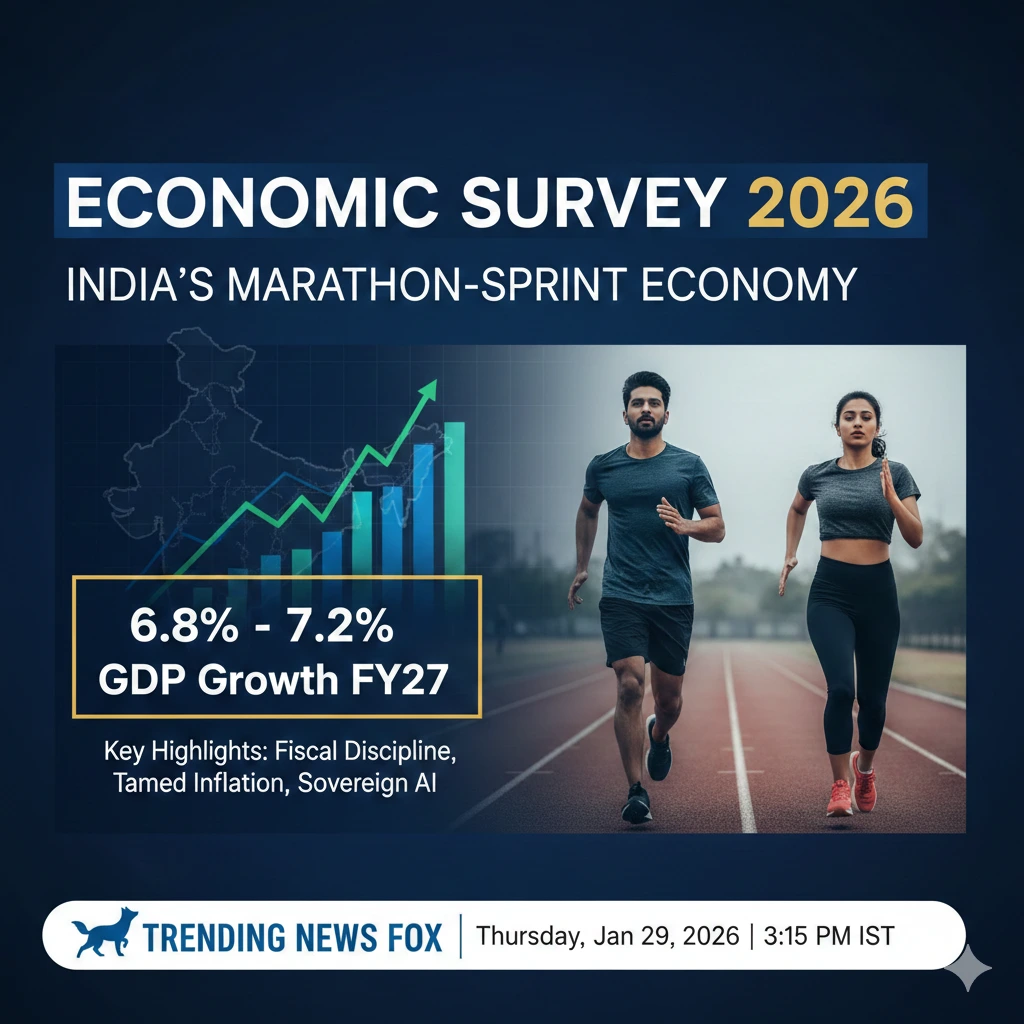
FM Nirmala Sitharaman tables Economic Survey 2026. India projects 6.8%-7.2% GDP growth for FY27. Read the key highlights, inflation outlook, and download the PDF.
By Trending News Fox News Desk Published: January 29, 2026
India’s “Marathon-Sprint” Economy: Key Takeaways from Economic Survey 2026
New Delhi, January 29, 2026 – Finance Minister Nirmala Sitharaman today tabled the Economic Survey 2025-26 in Parliament, painting a picture of an Indian economy that is remarkably resilient but operating in an increasingly “fragile” global environment. Authored by Chief Economic Adviser (CEA) V. Anantha Nageswaran, the Survey describes India’s current phase as a “paradox”: the country is enjoying its strongest macroeconomic fundamentals in decades, yet global systems are no longer rewarding this success with the usual capital inflows or currency stability.
The overarching theme for 2026 is one of “Strategic Sobriety.” The Survey suggests that India must now “run a marathon and a sprint simultaneously,” balancing long-term structural reforms with the agility to absorb sudden global shocks.
The Growth Outlook: 6.8% to 7.2% for FY27
The headline figure from the Survey is the projection for the upcoming fiscal year. After an estimated 7.4% growth in FY26, the Survey pegs India’s real GDP growth for FY27 in the range of 6.8% to 7.2%.
This projection reaffirms India’s position as the fastest-growing major economy for the fourth consecutive year. The CEA noted that while this is a slight moderation from the current year, it reflects a “steady state” growth that is sustainable and less prone to overheating.
Economic Survey 2026: Comparison of Growth Projections
| Agency | FY26 Estimate | FY27 Projection |
| Economic Survey | 7.4% | 6.8% – 7.2% |
| IMF | 7.3% | 6.4% |
| World Bank | 7.2% | 6.5% |
Fiscal Discipline: Staying the 4.4% Course
One of the strongest signals sent to global investors and credit rating agencies is India’s commitment to fiscal consolidation. The Survey confirms that the Centre is well on track to achieve its fiscal deficit target of 4.4% of GDP for FY26.
This is a significant milestone, as it fulfills the government’s 2021 promise to reduce the deficit by more than half from its pandemic-era peak of 9.2%. However, the document raises a red flag regarding State-level finances, warning that “fiscal populism” and unconditional cash transfers at the state level are beginning to crowd out essential capital expenditure.
Inflation: Tamed but Needs Watching
In a rare piece of good news for the “Aam Aadmi” (common man), domestic inflation averaged just 1.7% between April and December 2025. This low inflation environment has been a primary driver for the record-high Private Final Consumption Expenditure (PFCE), which reached 61.5% of GDP in FY26.
However, the Survey advises caution for the year ahead. The RBI and IMF both project a gradual rise in headline inflation toward the 4% target in FY27. Key risks include:
- Firming prices of metals like gold, silver, and copper.
- The “imported inflation” risk from a weaker Rupee.
- Potential supply chain disruptions due to geopolitical “churn.”
The External Paradox: Rupee “Punching Below Its Weight”
The Survey introduces a compelling narrative about the Indian Rupee. Despite India’s stellar growth, the Rupee hit record lows against the Dollar (crossing 91.98 in January 2026). The document calls this a “wrinkle in the ointment.”
“The paradox of 2025 is that India’s strongest macroeconomic performance has collided with a global system that no longer rewards success with currency stability.” — Economic Survey 2025-26
Interestingly, the Survey notes that a slightly undervalued Rupee has acted as a natural buffer, blunting the impact of aggressive U.S. tariff hikes on Indian exports. While the currency underperformed, India’s share of global merchandise exports has nearly doubled to 1.8% over the last two decades.
Sectoral Highlights: AI, Infrastructure, and Agriculture
1. The Rise of “Sovereign AI”
A dedicated chapter in the Survey explores India’s appetite for Artificial Intelligence. Moving away from “speculative frontier uses,” India is focusing on task-specific AI models that work on local hardware and low-resource settings. The Survey argues that AI regulation and safety must evolve in parallel with deployment, rather than as an afterthought.
2. Infrastructure: The Ten-Fold Leap
The infrastructure story remains the backbone of the “Viksit Bharat” (Developed India) vision.
- High-Speed Corridors: Increased from 550 km in 2014 to 5,364 km by December 2025.
- Aviation: India is now the world’s 3rd largest domestic aviation market, with 164 operational airports.

- Railways: 3,500 km of track was added in FY26 alone, with 99.1% electrification achieved.
3. Agriculture: Record Production
Bolstered by a good monsoon, foodgrain production reached a record 357.7 million metric tonnes in 2024-25. The Survey highlights the success of the “Namo Drone Didi” scheme and the digitization of land records as key drivers for rural “smart” growth.
Economic Survey 2026: Social Progress and Employment
The Survey highlights significant strides in formalizing the workforce. The e-Shram portal now has over 31 crore registered unorganized workers, with women making up 54% of the total.
Furthermore, the document suggests exploring a ban on ultra-processed food (UPF) advertisements between 6:00 AM and 11:00 PM to combat rising health issues, signaling a shift toward holistic “human capital” development.
Market Sentiment: Measured Resilience
For stock market enthusiasts, the Survey notes that the NIFTY50 and SENSEX registered gains of 11.1% and 10.1% respectively during the first nine months of FY26. While foreign portfolio investors (FPIs) remained volatile, the domestic investor base exploded, with the number of unique investors crossing the 12-crore mark.
Summary: What This Means for You
The Economic Survey 2026 tells us that while the global “weather” is stormy, the Indian “ship” is structurally sound. For the common man, this means stable prices and continued infrastructure development. For the investor, it suggests a need for patience as the global financial cycle remains unpredictable. For the youth, the focus is shifting toward high-skill manufacturing and AI-integrated services.
As the nation prepares for the Union Budget on Sunday, the Economic Survey has set a tone of cautious optimism—reminding us that while India is ready for the sprint, it is built for the marathon.
Also, read Jaya Ekadashi Vrat Katha 2026: Date, Importance & Full Story in English
Here is a ready-to-use FAQ for the Economic Survey 2026 tailored from Trending News Fox.
Economic Survey 2026: Frequently Asked Questions (FAQs)
1. What is the GDP growth projection for India in FY27?
The Economic Survey 2025-26 projects India’s real GDP growth for the next fiscal year (FY27) to be in the range of 6.8% to 7.2%. This follows a robust estimated growth of 7.4% in the current fiscal year (FY26).
2. Who authored the Economic Survey 2026?
The Economic Survey 2026 was prepared by the Economic Division of the Department of Economic Affairs (DEA) under the guidance of the Chief Economic Adviser (CEA), V. Anantha Nageswaran. It was tabled in Parliament by Union Finance Minister Nirmala Sitharaman on January 29, 2026.
3. What is the fiscal deficit target mentioned in the Survey?
The Survey confirms that the Central Government is on track to achieve its fiscal deficit target of 4.4% of GDP for FY26. This highlights the government’s commitment to fiscal discipline and consolidation.
4. What does the Survey say about inflation in India?
Domestic inflation has remained “tamed and anchored,” averaging just 1.7% between April and December 2025. While the Survey expects a gradual firming toward the 4% target in FY27 due to base effects and rising metal prices, it notes that inflation is unlikely to be a major macroeconomic concern.
5. Where can I download the Economic Survey 2026 PDF?
The full Economic Survey 2025-26 document is available for download on the official Union Budget website at indiabudget.gov.in. It consists of various chapters covering the state of the economy, fiscal developments, and sectoral performance.
6. Why is the Survey calling 2025 a “Paradox”?
The Survey notes a “paradox” where India’s domestic economic fundamentals are at their strongest in decades (high growth, low inflation), yet the global financial system is currently characterized by high tariffs, currency volatility (weakening the Rupee), and unpredictable capital flows.
7. What are the key infrastructure highlights in the 2026 Survey?
- High-Speed Corridors: Expanded nearly ten-fold from 550 km in 2014 to 5,364 km by end of 2025.
- Aviation: India is now the world’s 3rd largest domestic aviation market with 164 operational airports.
- Railways: Achieved 99.1% electrification and added 3,500 km of new tracks in FY26 alone.