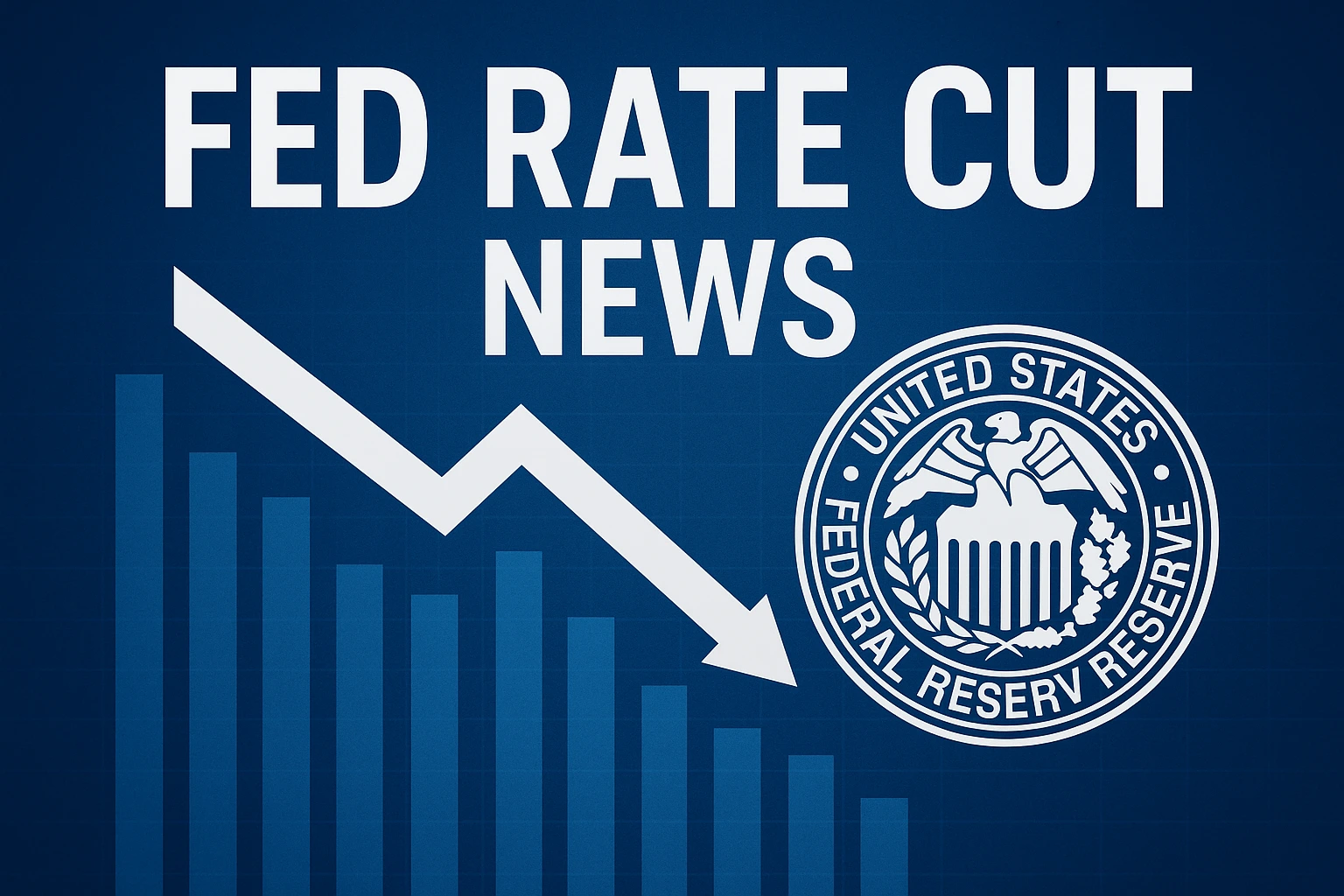
Stay updated with the latest Fed Rate Cut news, expert analysis, and market impact as the U.S. Federal Reserve adjusts interest rates. Get real-time insights on how the rate cut affects inflation, stocks, loans, and the global economy.
📉 Federal Reserve Cuts Rates for Third Consecutive Time Amid Economic Uncertainty
The U.S. Federal Reserve (Fed), following the conclusion of its Federal Open Market Committee (FOMC) meeting on Wednesday, December 10, 2025, announced a widely anticipated interest rate cut. This marks the third consecutive rate reduction this year, lowering the benchmark federal funds rate by 25 basis points (0.25 percentage points) to a new target range of 3.50% to 3.75%.
This move signals a significant shift in the central bank’s policy stance as it prioritizes supporting a softening labor market while balancing the ongoing concern of elevated inflation.
🔑 Fed Rate Cut News: Key Takeaways from the Latest FOMC Decision
- Third Consecutive Cut: The December reduction is the third 25-basis-point cut since September 2025, bringing the cumulative easing to 75 basis points.
- New Rate Range: The target range for the federal funds rate is now 3.50% to 3.75%, the lowest level since November 2022.
- Dual Mandate Focus: The Fed’s statement highlighted its concerns over a slowing labor market—with job gains slowing and the unemployment rate edging up—while acknowledging that inflation remains “somewhat elevated.”
- Divided Committee: The vote was not unanimous, with a 9-to-3 split among FOMC members. This is the highest number of dissents in six years, reflecting the deep uncertainty and conflicting economic signals currently facing policymakers.
- Three members dissented: two preferred keeping rates unchanged, and one favored a deeper 50-basis-point cut.
- Forward Guidance: Officials signaled a cautious approach for 2026, with the median forecast suggesting only one more rate cut next year. This points toward a potential “extended pause” in rate adjustments following this latest cut.
⚖️ Fed Rate Cut News: The Delicate Balancing Act
Fed Chair Jerome Powell, in his address, emphasized the policy’s intent to support the labor market’s momentum, which is showing unmistakable signs of fatigue.
“In support of its goals and in light of the shift in the balance of risks, the Committee decided to lower the target range for the federal funds rate…” – Official FOMC Statement
The Fed is currently navigating a complex economic landscape:
- Concerns for Employment: The primary driver for the cut is the weakening job market, with recent data and internal projections suggesting the unemployment rate could reach 4.5% by the end of 2025.
- Inflationary Headwinds: Inflation, while off its highs from the previous year, remains above the Fed’s 2% target. Powell noted that trade tariffs were contributing to elevated prices, suggesting inflation could remain persistent.
- Data Uncertainty: The recent government shutdown caused significant delays in key economic data releases (like October and November employment and inflation reports), complicating the committee’s decision-making process. The Fed is operating with a less complete picture of the economy than usual.
📈 Fed Rate Cut News: Impact and Market Reaction
The widely anticipated cut was generally well-received by financial markets, with stock indexes seeing an initial jump. The reduction in the federal funds rate typically translates to:
- Lower borrowing costs for banks, businesses, and consumers.
- Stimulation of economic activity, encouraging spending and investment.
- Lower rates for mortgages, car loans, and credit cards.
However, the signaling of a possible “extended pause” and a forecast of only one more cut in 2026 suggests the Fed is close to a “neutral rate”—a level that neither stimulates nor restricts the economy—and is prepared to wait for new data to guide its next move.
Global markets, including in India, are closely watching the Fed’s trajectory, as U.S. interest rate changes have significant implications for global capital flows and currency valuations.
🗓️ Fed Rate Cut News: What to Watch Next
Investors and economists will be laser-focused on the release of the delayed U.S. economic data for November and December, which will provide the clearest picture of the economy’s health. The next key FOMC meetings are scheduled for January 28-29 and March 18-19, 2026.
Also, read NZ vs WI 2nd Test: Live Score, Highlights & Latest Match Updates
🏠📊 Impact of the Fed Rate Cut on Housing, Bonds, and Stocks
The Federal Reserve’s decision to cut the federal funds rate for the third consecutive time has had a mixed and complex impact across different asset classes, largely influenced by the market’s focus on the Fed’s future guidance rather than the cut itself.
Here is a breakdown of the immediate and expected effects on the Housing Market, Bonds, and the Stock Market.
🏡 Housing Market: Marginal Relief, Not a Quick Cure
While the rate cut lowers the Fed’s benchmark rate, the impact on long-term fixed mortgage rates is often indirect and gradual.
- Mortgage Rates: Fixed-rate mortgages (like the 30-year fixed) are primarily influenced by the yield on the 10-year Treasury bond, not the short-term federal funds rate.
- The Trend: Mortgage rates were already trending lower from their peaks earlier in the year, and this latest Fed cut contributes to the momentum but doesn’t cause an immediate, equivalent drop. Current 30-year fixed rates are hovering around 6.19%–6.30%.
- Direct Impact: The cut has a more direct and immediate effect on short-term, variable-rate loans, such as:
- Adjustable-Rate Mortgages (ARMs)
- Home Equity Lines of Credit (HELOCs)
- These rates are expected to fall more quickly.
- Affordability and Demand: The high cost of borrowing has constrained home buyers. A sustained reduction in mortgage rates is necessary to spur significant activity. Lower rates in 2026, as forecasted by some experts, could encourage more Americans to refinance their current high-rate mortgages and potentially enter the home-buying market.
- Inventory: Many current homeowners are hesitant to sell because they hold a low fixed-rate mortgage secured before 2022 and would face a much higher rate if they bought a new home. This phenomenon is keeping inventory low, which continues to support home prices despite the reduction in purchase demand.
💰 Bond Market: Yields Decline on Dovish Outlook
The bond market is typically the most sensitive to Fed actions, as interest rates and bond prices move in opposite directions.
- Bond Prices vs. Yields: When the Fed cuts rates, it generally signals a lower interest rate environment, which causes bond prices to rise and bond yields to fall.
- Yield Curve Response:
- Short-Term Yields (e.g., 2-Year Treasury): These yields, which are most closely tied to the federal funds rate, saw a more pronounced drop, falling to around 3.56%. This reflects the immediate impact of the cut and expectations for the near term.
- Long-Term Yields (e.g., 10-Year Treasury): The 10-year Treasury yield also eased, settling around 4.15%. Its movement is also influenced by longer-term inflation expectations and the overall economic growth outlook.
- Investor Impact: Investors who own existing long-term bonds benefit from rising prices. New bonds, however, will be issued with lower coupon payments, potentially leading investors to seek higher-yielding alternatives like corporate bonds or riskier assets.
📈 Stock Market: Initial Surge on Confidence
The stock market reacted positively to the rate cut, with major indexes closing sharply higher.
- Initial Reaction: The Dow Jones Industrial Average (DJIA), the S&P 500, and the Nasdaq all surged, as lower interest rates generally translate to:
- Lower borrowing costs for corporations, increasing profitability.
- A reduced discount rate used to value future company cash flows, boosting stock valuations (especially for growth stocks).
- Increased investor confidence that the Fed is actively working to prevent an economic recession.
- Focus on the Pause: Critically, the market’s enthusiasm was also driven by Fed Chair Powell’s commentary, which signaled that a rate hike is unlikely anytime soon. This perceived “all-clear” signal on future rate increases provided a boost to risk appetite.
- Specific Sectors: The cut particularly benefits interest-sensitive sectors, such as Financials and sectors reliant on capital expenditure.