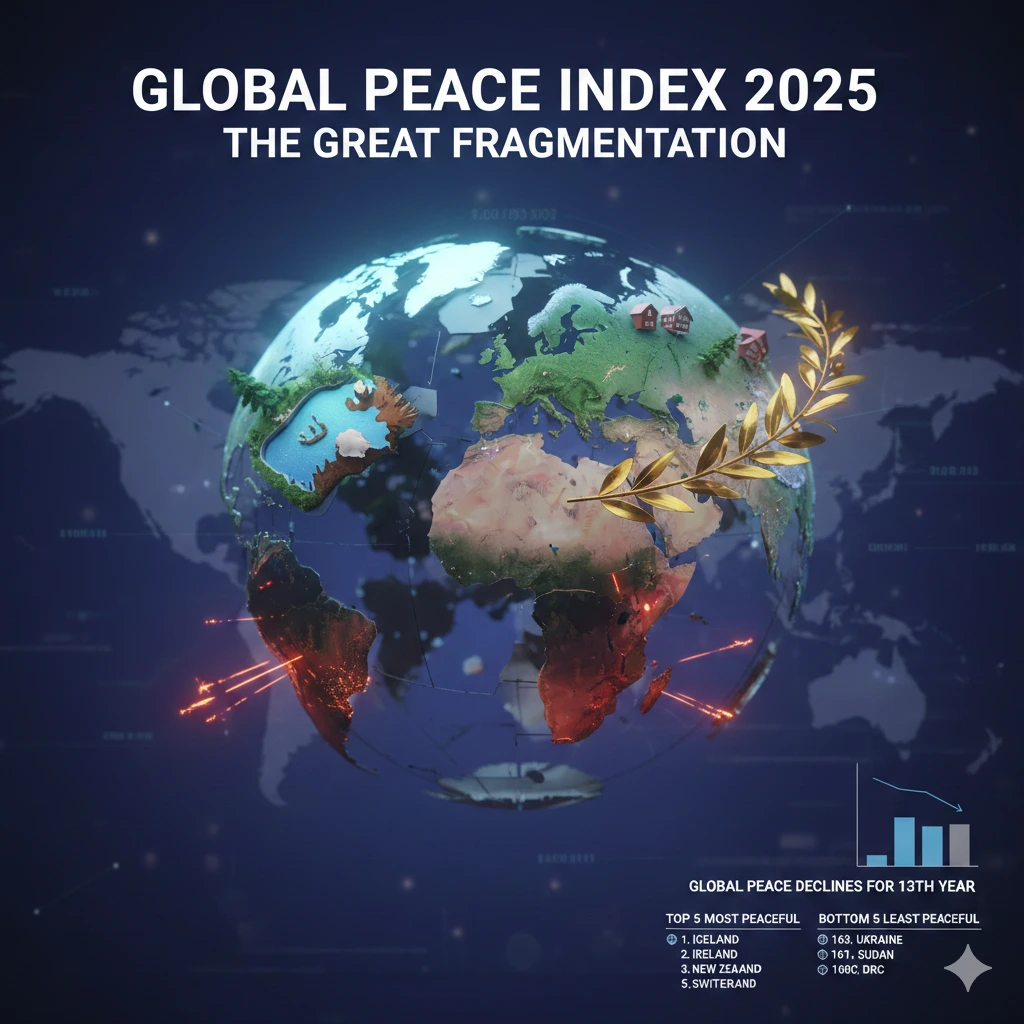
The Global Peace Index 2025 report is out. Discover the top 10 most peaceful countries, India’s ranking, and why global stability is at its lowest since WWII.
Global Peace Index 2025: A World at the Crossroads of Fragmentation
The year 2025 marks a pivotal moment in modern history. According to the 19th edition of the Global Peace Index (GPI), produced by the Institute for Economics and Peace (IEP), the world is witnessing a level of geopolitical fragmentation not seen since the end of the Second World War. As conflicts become more internationalized and “forever wars” persist, the divide between the most and least peaceful nations is wider than ever.
For readers of Trending News Fox, understanding these shifts is crucial. Peace isn’t just the absence of war; it is the foundation of economic prosperity, travel safety, and global cooperation.
The Big Picture: Global Peace Continues to Slide
The 2025 GPI report covers 163 independent states and territories, accounting for 99.7% of the world’s population. The verdict? Global peacefulness has deteriorated by 0.36% over the past year. While that may seem like a small number, it represents the 13th decline in the last 17 years.
Key Drivers of the 2025 Decline:
- Geopolitical Fragmentation: Major power competition and the rise of middle-level powers have made regional conflicts harder to resolve.
- Conflict Deaths: Fatalities from internal and external conflicts have reached their highest level this century, primarily driven by the wars in Ukraine and Gaza.
- Militarization: For the first time in decades, a majority of countries are increasing their military expenditure as a percentage of GDP.
The Top 10 Most Peaceful Countries in 2025
For the 18th consecutive year, Iceland remains the most peaceful country in the world. Its secret? A combination of low crime rates, high social cohesion, and the absence of a standing military.
| Rank | Country | Region | Stability Level |
| 1 | Iceland | Europe | Very High |
| 2 | Ireland | Europe | Very High |
| 3 | New Zealand | Oceania | Very High |
| 4 | Austria | Europe | Very High |
| 5 | Switzerland | Europe | Very High |
| 6 | Singapore | Asia-Pacific | Very High |
| 7 | Portugal | Europe | Very High |
| 8 | Denmark | Europe | Very High |
| 9 | Slovenia | Europe | Very High |
| 10 | Finland | Europe | Very High |
Europe continues to be the most peaceful region, housing eight of the top ten nations. Singapore stands out as Asia’s highest-ranking representative, proving that strict governance and economic prosperity can bolster internal security.
The Least Peaceful Countries: A New Low for Russia
In a significant shift, Russia has been ranked as the least peaceful country in the world for 2025, surpassing even Afghanistan and Yemen. The ongoing invasion of Ukraine and the subsequent domestic crackdown on dissent have pushed Russia to the bottom of the index (Rank 163).
The Bottom 5:
- Russia (163): Severely impacted by the ongoing war and international isolation.
- Ukraine (162): Despite high social resilience, the toll of total war dominates its score.
- Sudan (161): Ravaged by civil war between the SAF and RSF.
- Democratic Republic of the Congo (160): Plagued by regional instability and militia violence.
- Yemen (159): Still struggling with the aftermath of a decade-long humanitarian crisis.
Spotlight on India: A Steady Climb
There is a silver lining for the world’s most populous nation. India ranks 115th in the 2025 Global Peace Index, a slight improvement from its 116th position in 2024 and a massive jump from 141st in 2019.
This upward trajectory is credited to:
- Improved Law Enforcement: A reduction in perceptions of criminality in urban areas.
- Internal Stability: Better management of long-standing internal insurgencies.
- Economic Resilience: Growth has fostered a sense of “Positive Peace” through improved infrastructure and services.
However, India remains in the “Medium” peace category, primarily due to strained relations with neighbors and the potential for escalation in border regions like Kashmir.
Global Peace Index 2025: The Economic Cost of Violence
One of the most staggering revelations of the 2025 report is the price tag of conflict. The global economic impact of violence reached $19.97 trillion in 2024.
To put that in perspective:
- This is equivalent to 11.6% of the world’s GDP.
- It amounts to roughly $2,446 for every person on Earth.
- Investment in peacebuilding is just a fraction of this, with peacekeeping expenditures making up only 0.52% of total military spending.
Global Peace Index 2025: Escalation Hotspots to Watch
The IEP identifies several “hotspots” where conflict risks are accelerating. These regions are at risk of large-scale violence due to a “convergence of structural fragility”:
- The Sahel Region: Terrorism and environmental stressors are destabilizing West Africa.
- The Middle East: Specifically the Israel-Palestine-Lebanon corridor, which recorded the highest deterioration in the “Militarization” domain globally.
- The Horn of Africa: Specifically Ethiopia and Eritrea, where unresolved grievances remain volatile.
Conclusion: Is There Hope for 2026?
While the 2025 Global Peace Index paints a sobering picture of “The Great Fragmentation,” it also highlights that 74 countries improved their scores this year. Countries like Ireland and Portugal demonstrate that peace is a choice made through social welfare, inclusive governance, and neutral diplomacy.
For the global community, the 2025 report serves as a wake-up call. Without a renewed focus on “Positive Peace”—the attitudes, institutions, and structures that create and sustain peaceful societies—the cost of violence will continue to drain the world’s potential.
Stay tuned to Trending News Fox for more deep dives into the trends shaping our world.
Understanding the 2025 Global Peace Index
This video provides a professional breakdown of the 2025 report’s key findings, featuring insights from senior researchers at the Institute for Economics and Peace.
Also, read Biswa Bangla Loko Sanskriti Utsab: What to Expect?