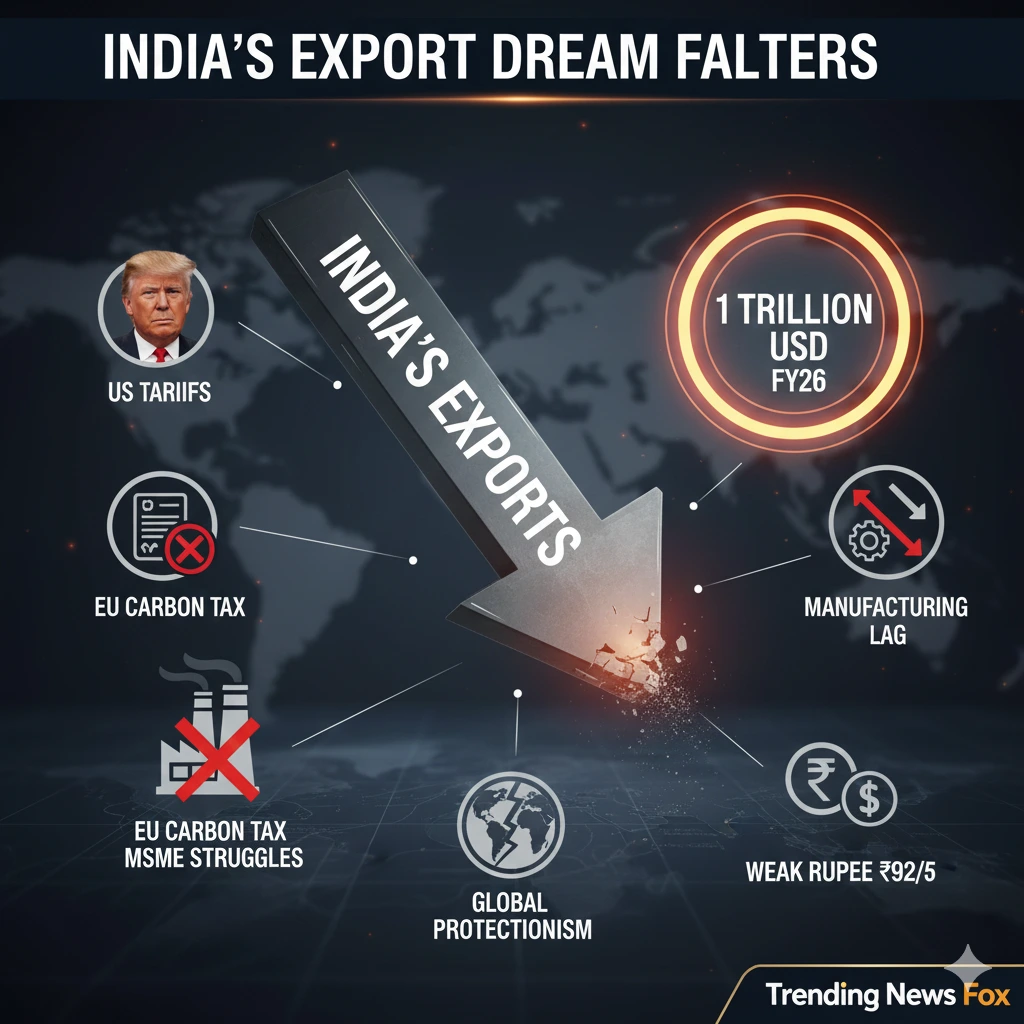
Discover the reasons behind India export target miss FY26. Analyze the impact on the economy and potential solutions for future growth.
The $150 Billion Gap: Why India is Poised to Miss the $1 Trillion Export Target in FY26
By Trending News Fox Business Desk | Published: December 25, 2025
India’s ambitious dream of hitting $1 trillion in total exports by the end of Fiscal Year 2026 (FY26) is facing a cold reality check. While the government has pushed for a “Viksit Bharat” (Developed India) through massive PLI schemes and 18 Free Trade Agreements (FTAs), a new assessment by the Global Trade Research Initiative (GTRI) suggests a significant shortfall.
According to latest projections, India will likely reach $850 billion—leaving a massive $150 billion hole in the original target. But what exactly went wrong? From Trump’s tariffs to the EU’s “Green Tax,” here is a deep dive into the headwinds slowing down the Indian export engine.
1. The “Trump Factor” and Reciprocal Tariffs
The United States remains India’s largest export destination, but the trade relationship has hit a rocky patch in late 2025. Between May and November, exports to the US plummeted by 20.7%.
- The Cause: The implementation of 50% tariffs on key Indian shipments has made goods like textiles and leather significantly more expensive for American buyers.
- The Impact: Unless a bilateral trade deal is signed in early 2026, the US market—which typically accounts for nearly 18% of India’s merchandise exports—will continue to erode.
2. EU’s Carbon Border Adjustment Mechanism (CBAM)
Starting January 1, 2026, the European Union will activate its “Carbon Tax” (CBAM). This policy forces importers to pay for the carbon footprint of goods like steel, aluminum, and cement.
- The MSME Crisis: Nearly 20-30% of Indian MSME exports are at risk. Small businesses often lack the green certification or the “supply chain records” required by the EU, effectively locking them out of the European market unless they undergo expensive technological upgrades.
3. The “Missing” Manufacturing Engine
While India’s services sector is booming—projected to cross $400 billion in FY26—merchandise exports (physical goods) remain stagnant.
- The Tech Gap: India’s export basket is still heavily weighted toward low-value commodities and petroleum. To hit the trillion-dollar mark, experts argue India needs a pivot to medium and high-tech manufacturing (electronics, advanced machinery, and EVs) where margins and demand are higher.
- Productivity Lag: Despite the PLI (Production Linked Incentive) scheme, India’s manufacturing productivity still lags behind competitors like Vietnam and China, making Indian goods less competitive in a price-sensitive global market.
4. Global Protectionism and WTO Deadlocks
We are entering 2026 in the most difficult trade climate in decades. G20 countries have imposed over 4,600 import restrictions since 2016. The World Trade Organization (WTO) has remained largely paralyzed, failing to address core trade agendas for the last 25 years.
- The Outcome: India is increasingly forced to rely on bilateral deals (like the recent CETA with the UK) rather than a stable global framework. Without a functional WTO to curb unilateral tariffs, India’s “export-led growth” strategy faces constant unpredictability.
5. Currency Pressure and the Rupee’s “Record Low”
The Indian Rupee has been under immense pressure, trading near the ₹92.00 per dollar mark toward the end of 2025.
- The Paradox: While a weak currency usually helps exporters by making their goods cheaper abroad, it has also spiked the cost of imported raw materials (like crude oil and electronics components). This has squeezed the profit margins of Indian manufacturers, making it harder for them to scale production for international markets.
The Silver Lining: Diversification has Begun
Despite the projected miss, there is good news. While exports to the US and EU have slowed, India’s trade with the “Rest of the World” (including the UAE, Japan, and parts of Africa) grew by 5.5% in the second half of 2025.
- Engineering & Electronics: These sectors remain the “shining stars,” with electronic goods exports jumping by 39% in November 2025 alone.
India export target miss FY26: Final Verdict for Investors
The $1 trillion target was always a “stretch goal.” While missing it might hurt the 2026 GDP headlines, the underlying shift toward high-value manufacturing and new trade partners suggests that India’s export story is maturing—even if the pace is slower than expected.
India export target miss FY26: Why Did India Fall Short of FY26 Export Goals?
Also, read NTA Facial Recognition 2026: Unlocking the Future
Textile Exporters Bearing Losses To Continue Exporting To US
This video is relevant as it provides a ground-level perspective from Indian textile exporters who are currently absorbing losses due to US tariffs, a key reason why the broader export target is at risk.