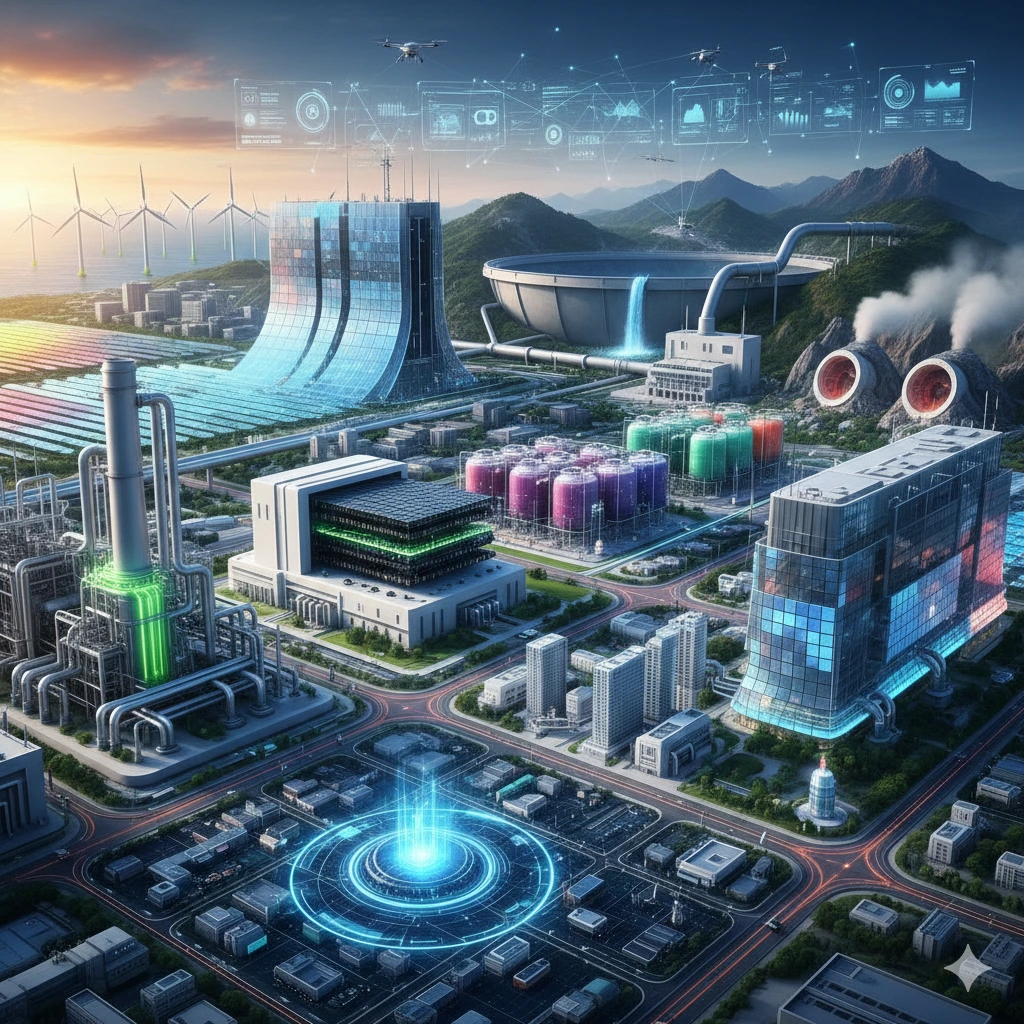
Stay updated on the latest energy technology trends. Learn how advancements are transforming the industry and paving the way for a sustainable future.
💡 The Power Shift: Revolutionizing Latest Energy Technology Trends
The global energy landscape is undergoing a rapid, technology-driven transformation. Spurred by the twin imperatives of decarbonization and energy security, investment in clean energy, grids, and storage is surging, setting the stage for a distributed, intelligent, and flexible power system.
Latest Energy Technology Trends: The Rise of the Smart, Flexible Grid
The integration of intermittent renewable sources like solar and wind is creating a more complex electricity network, necessitating significant technological upgrades.
- Smart Grids and Digitalization: The grid is becoming a Cyber-Physical Energy System. Smart Grids integrate generators, sensors, and users into a single digital ecosystem. They use real-time data analytics and edge computing to autonomously monitor and redistribute energy flows, significantly improving stability, reducing losses, and smoothly integrating renewables.
- AI and Machine Learning (ML): Artificial intelligence is no longer optional—it’s essential for managing complexity. AI/ML algorithms are used for predictive maintenance, identifying potential equipment failures before they occur, and for highly accurate demand forecasting, allowing utilities to automatically balance networks and prevent peak loads.
- Decentralized Energy Resources (DERs): The grid is moving away from large, centralized power plants. Technologies like Virtual Power Plants (VPPs) aggregate distributed resources (rooftop solar, home batteries, electric vehicles) to operate as a single, large energy resource, providing stability and flexibility to the main grid.
Energy Storage: The Key to 24/7 Power
Energy storage is the critical ‘buffer’ that resolves the instability of solar and wind, making 24/7 clean power a reality. The focus is on increasing energy density, lifespan, and safety.
- Advanced Battery Chemistry: While lithium-ion batteries remain dominant, new chemistries are emerging for specific applications. Solid-state batteries are being developed for increased safety, energy density, and longevity. Flow batteries offer scalability for industrial-level, long-duration storage (providing hours or days of backup power) by using liquid electrolyte solutions.
- Pumped-Storage Hydro (PSH): PSH, which uses excess electricity to pump water uphill to a reservoir for later release to generate power, is being reclassified and expanded globally as a massive, reliable, and long-duration energy storage backbone.
- Thermal Energy Storage (TES): TES technologies are gaining traction, converting surplus electricity into heat for storage in materials (like molten salt or phase-change materials) until it’s needed for industrial processes or heating/cooling a city.
Latest Energy Technology Trends: Emerging Decarbonization Pathways
Innovation in fuels and generation is targeting hard-to-abate sectors like heavy industry, shipping, and aviation.
- Green Hydrogen: Hydrogen produced via electrolysis powered by renewable energy (known as Green Hydrogen) is emerging as a zero-carbon fuel for sectors that are difficult to electrify. It is also being explored for long-term, seasonal energy storage.
- Advanced Solar Technologies: Beyond traditional crystalline silicon, Third-Generation Photovoltaics are showing great promise. Perovskite solar cells are cheaper to produce, require less material, and can be layered on top of silicon cells to form tandem cells that significantly boost efficiency.
- Enhanced Geothermal Systems (EGS): Geothermal energy is getting an upgrade. EGS involves injecting fluid into hot, dry rock deep underground to create an artificial reservoir, allowing constant, reliable baseload power generation in regions previously considered unsuitable.
Latest Energy Technology Trends: Global Investment and Policy Drivers
The shift is being accelerated by substantial global investment and strategic policy-making.
- Investment Surge: Global energy investment in grids, storage, and renewables is projected to continue its rapid ascent, signaling a strong market commitment despite geopolitical and economic pressures.
- Industrial Competitiveness: Countries like the US, China, and India are viewing clean energy manufacturing and technology leadership as a matter of industrial policy and national security, leading to localized supply chain development for solar, batteries, and critical minerals.
- The AI Energy-Demand Nexus: The explosive growth of Artificial Intelligence is driving unprecedented demand for electricity from data centers. This growing power hunger is becoming a key factor in data center site selection, accelerating the demand for on-site power generation and high-capacity renewable solutions like solar-plus-storage.
The energy world is rapidly transitioning from a brittle, one-way system to a resilient, flexible, and decentralized network. The convergence of hardware innovation (advanced storage, new PV) with digital technologies (AI, Smart Grids) is making a fully decarbonized, secure, and affordable energy future a tangible goal.
Also, read Putin India Visit: A New Era in Bilateral Relations
Green Hydrogen and the latest trends in Energy Storage, specifically comparing flow batteries and solid-state batteries, as well as the progress in Perovskite Solar Cells.
🟢 Green Hydrogen: Advancements & Digital Levers
Green Hydrogen, produced via electrolysis powered by renewable energy, is a critical technology for decarbonizing heavy industries (like steel and cement) and long-haul transport.
Technological Breakthroughs in Production
- Advanced Electrolysis: The efficiency and durability of electrolyzers are being rapidly improved.
- High-Temperature Solid Oxide Electrolyzer Cells (SOECs): These operate at high temperatures, which can make them more energy-efficient by utilizing waste heat from industrial processes.
- Anion Exchange Membrane (AEM) Electrolyzers: These aim to combine the cost advantages of Alkaline Electrolyzers (by avoiding noble metals) with the high current density and rapid response of Proton Exchange Membrane (PEM) electrolyzers.
- Direct Solar-to-Hydrogen: Research is accelerating in photocatalytic water splitting, where sunlight is directly harnessed to split water into hydrogen and oxygen without needing a separate solar panel and electrolyzer system, offering a potentially cheaper, simpler production pathway.
- Offshore Production: Companies are developing floating offshore wind platforms integrated with electrolyzers to produce hydrogen at sea. This approach eliminates the need to transmit large amounts of electricity back to shore, instead shipping the high-density hydrogen.
The Role of Digitalization
Digital technology is crucial for making Green Hydrogen economically viable:
- Digital Twins: Detailed virtual models of hydrogen production plants are used to optimize system configuration (PV capacity, electrolyzer size, storage buffers) before construction, which can reduce Capital Expenditure (CAPEX) by 10-15%.
- AI for Optimization: AI and Machine Learning are used for real-time monitoring and control, predicting equipment failure, and maximizing the efficiency of the electrolyzer by intelligently matching its power consumption with the variable output from solar and wind farms.
🔋 Energy Storage Trends: Solid-State vs. Flow Batteries
While Lithium-ion (Li-ion) batteries dominate the market, two other battery types are trending for their specific advantages in safety, energy density, and scale.
🧱 Solid-State Batteries
These batteries replace the flammable, liquid organic electrolyte found in traditional Li-ion cells with a solid ceramic, polymer, or glass electrolyte.
| Feature | Solid-State Battery Advantage | Primary Application |
| Safety | Eliminates flammable liquid, significantly reducing the risk of thermal runaway and fire. | Electric Vehicles (EVs) and high-density portable electronics. |
| Energy Density | Allows for the use of a pure lithium metal anode, which is much lighter and can store significantly more energy per unit volume/mass. | Enabling longer range for EVs. |
| Challenges | Maintaining stable, low-resistance contact between the solid materials, and developing cost-effective mass manufacturing processes. | Commercialization for EVs is a primary current focus. |
🌊 Flow Batteries (Redox Flow Batteries)
Flow batteries store energy in large tanks of liquid electrolytes, which are pumped through a central reactor cell (the stack) to generate power.
| Feature | Flow Battery Advantage | Primary Application |
| Scalability | Energy capacity is decoupled from power output; capacity is scaled simply by increasing the size of the external tanks. | Long-Duration Energy Storage (LDES) for the grid. |
| Durability | Extremely long cycle life (20+ years) and minimal degradation since energy storage relies on a stable liquid, not a solid electrode interface. | Utility-scale grid stabilization, wind/solar integration (10+ hours of backup). |
| Disadvantages | Lower energy density than Li-ion (meaning they are large and heavy) and lower energy efficiency (typically 50-80%). | Not suitable for mobile applications like EVs. |
Flow batteries are poised to become the backup backbone of the grid, complementing Li-ion (which excels in short-duration, high-power applications) and solid-state batteries (which excel in high-density mobile applications).
☀️ Perovskite Solar Cells (PSCs)
Perovskite is a low-cost, easily processable material that has been called a game-changer for photovoltaics (PV).
- Efficiency Trends: PSCs have seen the most rapid efficiency increase in PV history, with certified single-junction cell efficiency exceeding 26% and tandem cells (Perovskite layered on top of a traditional Silicon cell) achieving records around 34.85%. This is significantly higher than the theoretical limit for a single-junction silicon cell.
- Stability is the Key Challenge: The main hurdle for commercialization is long-term stability. PSCs are sensitive to moisture, heat, and light, causing performance degradation.
- Advancements: Researchers are making strides by using new interface engineering methods, like dipolar passivation, which have enabled cells to retain ~87% of their initial efficiency after over 1,000 hours of continuous operation in lab settings.
- Commercial Potential: Their simple, low-temperature, solution-based manufacturing process (potentially allowing for flexible, roll-to-roll production) makes them ideal for applications like building-integrated photovoltaics (BIPV), consumer electronics, and future low-cost tandem cells.
The convergence of these advancements is driving the energy transition forward, with each technology addressing a specific need for a cleaner, more flexible, and more robust energy system.
You can learn more about the latest innovations in Green Hydrogen from this video: Can These Green Hydrogen Breakthroughs Change the Future of Energy?