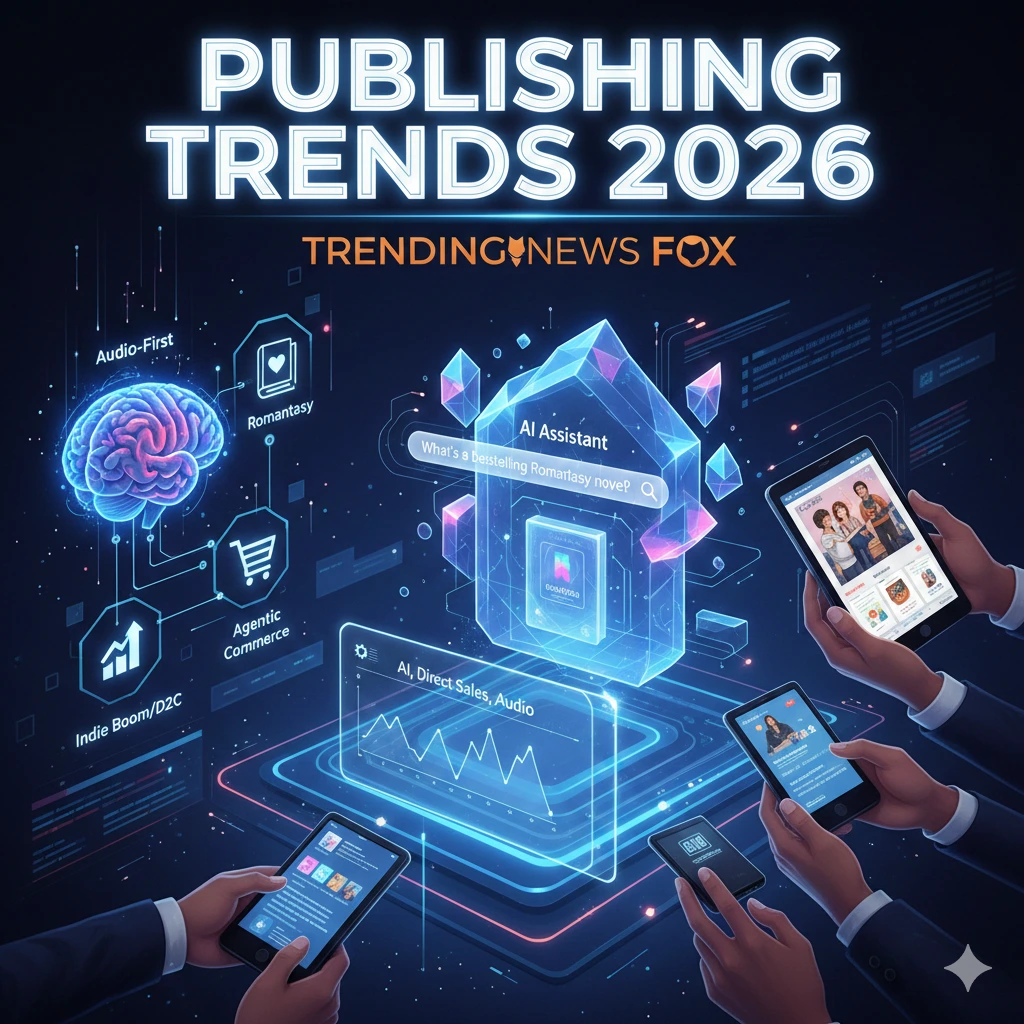
Explore the top publishing trends of 2026. From AI-driven agentic commerce and GEO to the “romantasy” boom and indie authors selling direct. Stay ahead now!
By Trending News Fox Editorial Team Published: February 18, 2026 | 1:25 PM IST
In the ever-evolving landscape of digital media, 2026 has emerged as a watershed year for the publishing industry. From the corridors of traditional Big Five houses to the home offices of independent “author-preneurs,” the rules of engagement are being rewritten by artificial intelligence, shifting consumer habits, and a new era of “Agentic Commerce.”
At Trending News Fox, we’ve analyzed the data, the market forecasts, and the technological breakthroughs to bring you the definitive guide to publishing trends in 2026. Whether you are a writer, a publisher, or a bibliophile, here is how the world of books is changing.
1. The AI Revolution: From “Assistance” to “Media in AI”
The conversation around Artificial Intelligence has shifted from fear of replacement to strategic integration. In 2026, we are no longer talking about “AI in Media”; we are witnessing “Media in AI.”
Publishing Trends: Generative Engine Optimization (GEO)
Move over SEO. As readers increasingly use AI chatbots and “answer engines” like ChatGPT, Claude, and Gemini to find their next read, publishers are pivoting to GEO. Instead of ranking on page one of search results, the goal is to be the primary source cited by an AI agent when a user asks, “What’s a high-stakes legal thriller set in Tokyo?”
Publishing Trends: Agentic Commerce
The most significant shift this year is the rise of Agentic Commerce. AI agents now have the authority to research, select, and even purchase books on behalf of the user. With the launch of the Universal Commerce Protocol (UCP), your AI assistant can now handle the “grunt work” of shopping, meaning publishers must ensure their metadata is machine-readable and highly optimized for these digital buyers.
2. The Indie Boom: Direct-to-Consumer (D2C) is King
The independent publishing market is expected to grow by 5–10% in 2026, with the total number of self-published titles reaching nearly 3 million. But the real story isn’t just the volume—it’s the method.
- Platform Independence: Fed up with fluctuating royalty rates and algorithm changes, 30% of indie authors now sell direct-to-consumer via Shopify, Kickstarter, and personal websites.
- The “Shopify-fication” of Books: Authors are becoming brands. By selling direct, they retain 90–95% of the revenue and, more importantly, own their customer data—a goldmine for long-term marketing.
3. The “Experience” Economy: Beyond the Printed Page
For the modern reader, a book is no longer just a static object; it is an entry point into an ecosystem. Platforms like BookTok and Bookstagram have transformed reading into a social experience.
Publishing Trends: The Rise of “Romantasy” and Immersive Worlds
Genres like “Romantasy” (Romance + Fantasy) continue to dominate, fueled by a desire for escapism. Publishers are responding by creating:
- Special Editions: Stenciled edges, hidden cover art, and “signed-by-author” digital certificates.
- Influencer Events: Book launches have become “aesthetic” parties designed for viral sharing, bridging the gap between digital buzz and physical sales.
“Books are not just about ‘reading’ anymore; they’re about experiencing.” — Industry Insight, 2026
4. Audio-First and Multi-Format Workflows
The audiobook market is projected to reach $8.68 billion this year, maintaining double-digit growth. This has led to the “Audio-First” release strategy, where the audio version of a book is treated as the primary product rather than an afterthought.
| Format | 2026 Market Share (Est.) | Key Driver |
| 45% | Collectibility and “Digital Detox” | |
| E-books | 35% | Accessibility and Subscription Models |
| Audiobooks | 20% | AI Narration and Smart Speaker Integration |
AI-Narrated Content: While celebrity-narrated “prestige” audiobooks remain popular, AI-generated narration has gone mainstream for backlist titles and niche genres, slashing production costs by nearly 80%.
5. Hybrid Publishing: The Professional Middle Ground
The stigma surrounding “pay-to-publish” has evaporated as Hybrid Publishing has matured. In 2026, reputable hybrid houses occupy a vital space for authors who have the budget to invest but want the professional “polish” of a traditional house.
- Selectivity: Legitimate hybrid publishers now reject 70–90% of submissions, maintaining high editorial standards.
- Royalties: Authors in this model typically keep 50–90% of net sales, making it a more lucrative option for those with established platforms.
6. Global Growth and Digital Accessibility
The European Accessibility Act (which took effect in late 2025) has forced a global standard for digital books. In 2026, “natively accessible” e-books are the baseline.
- Asia-Pacific Dominance: This region remains the largest market for book publishers, driven by high smartphone penetration and a massive youth population in countries like India and China.
- Education Licensing: Digital-first procurement is now the default for university libraries, with e-book licensing revenue growing at a 4.9% CAGR.
The Verdict for Publishing Trends 2026
The theme for this year is Flexibility. The most successful publishers and authors are those who treat their content as a “multi-channel digital asset.” A book is a podcast, a TikTok trend, a collectible object, and a training data point for an AI—all at once.
As the lines between reading, listening, and interacting continue to blur, one thing remains certain: the human appetite for storytelling is stronger than ever. The medium may change, but the “Why” remains the same.
Publishing Trends Video Podcast Below:
Publishing Trends 2026: Frequently Asked Questions
1. What is the biggest shift in book publishing for 2026?
The most significant shift is the transition from Search Engine Optimization (SEO) to Generative Engine Optimization (GEO). Publishers are no longer just fighting for a spot on page one of Google; they are optimizing their metadata and content to be the primary citation used by AI agents (like ChatGPT, Gemini, and Claude) when readers ask for book recommendations.+1
2. How is AI affecting the way people discover books?
Discovery has become “Agentic.” In 2026, we are seeing the rise of Agentic Commerce, where a user’s AI assistant doesn’t just suggest a book—it can research reviews, compare prices across platforms, and complete the purchase via the Universal Commerce Protocol (UCP). This means “machine-readability” of book data is now as important as the cover art.
3. Are indie authors still relying on Amazon?
While Amazon remains a giant, 2026 is the year of Platform Independence. Approximately 30% of independent authors now sell direct-to-consumer (D2C) through their own websites or platforms like Shopify and Kickstarter. This allows authors to keep higher royalty margins (often 90%+) and, crucially, own their customer data.
4. What genres are dominating the market this year?
The “Romantasy” (Romance + Fantasy) boom has matured into a stable market leader. However, we are also seeing a massive surge in:
- Vertical-scroll Webtoons: Especially those optimized for mobile reading.
- “Cosy Fantasy”: Low-stakes, high-comfort stories that serve as a “digital detox.”
- Audio-First Horror: Immersive audiobooks designed specifically for the spatial audio capabilities of 2026’s wearable tech.
5. Is AI-narrated audio replacing human voice actors?
Not entirely. The market has bifurcated. High-end “Prestige Audio” still features celebrity or award-winning human narrators. However, AI-narrated audio has become the standard for:
- Backlist titles: Allowing older books to be converted to audio cost-effectively.
- Niche academic texts: Where speed and accessibility are more important than performance.
- Instant translations: AI allows for simultaneous audio launches in multiple languages.
6. What does “Accessibility-by-Design” mean for 2026 publishers?
With the full enforcement of the European Accessibility Act and updated global standards, accessibility is no longer an afterthought. Publishers are now building “natively accessible” e-books from the editorial stage, ensuring that screen readers, braille displays, and text-to-speech tools work perfectly without extra conversion steps.
2026 Publishing Industry Snapshot
| Trend | Impact Level | Strategic Priority |
| GEO (AI Search) | Critical | Metadata & Entity Clarity |
| Direct Sales | High | Customer Data Ownership |
| Audiobooks | Increasing | AI-Assisted Production |
| Romantasy Genre | Dominant | Influencer & Community Marketing |
Pro-Tip for Trending News Fox Readers:
If you are an author or publisher, ensure your Schema Markup (Person and CreativeWork) is up to date. In 2026, AI “Answer Engines” use this code to verify your authority and link your name to your specific genre or expertise.
Publishing Trends Audio Podcast Below:
Disclaimer for Publishing Trends
The information provided in this Publishing Trends report is for general informational purposes only. While we strive to ensure accuracy and relevance, publishing industry data, forecasts, and market insights may change over time. We do not guarantee the completeness or reliability of any information presented. Readers are advised to verify details independently and use the content at their own discretion. Publishing Trends and its authors are not responsible for any decisions made based on this material.
saibal.bose.how36@gmail.com, saibal.bose.how36@gmail.com, saibal.bose.how36@gmail.com, & saibal.bose.how36@gmail.com. (2026p, February 18). Publishing Trends 2026: AI Agentic Commerce, Romantasy’s Grip. Trending News Fox. https://trendingnewsfox.com/publishing-trends-2026-ai-agentic-commerce-romantasys-grip/