Uncover the details of Putin India visit, focusing on strategic alliances, trade agreements, and the evolving relationship between Russia and India.
📰 Putin India Visit: Updates on the 23rd Annual Summit
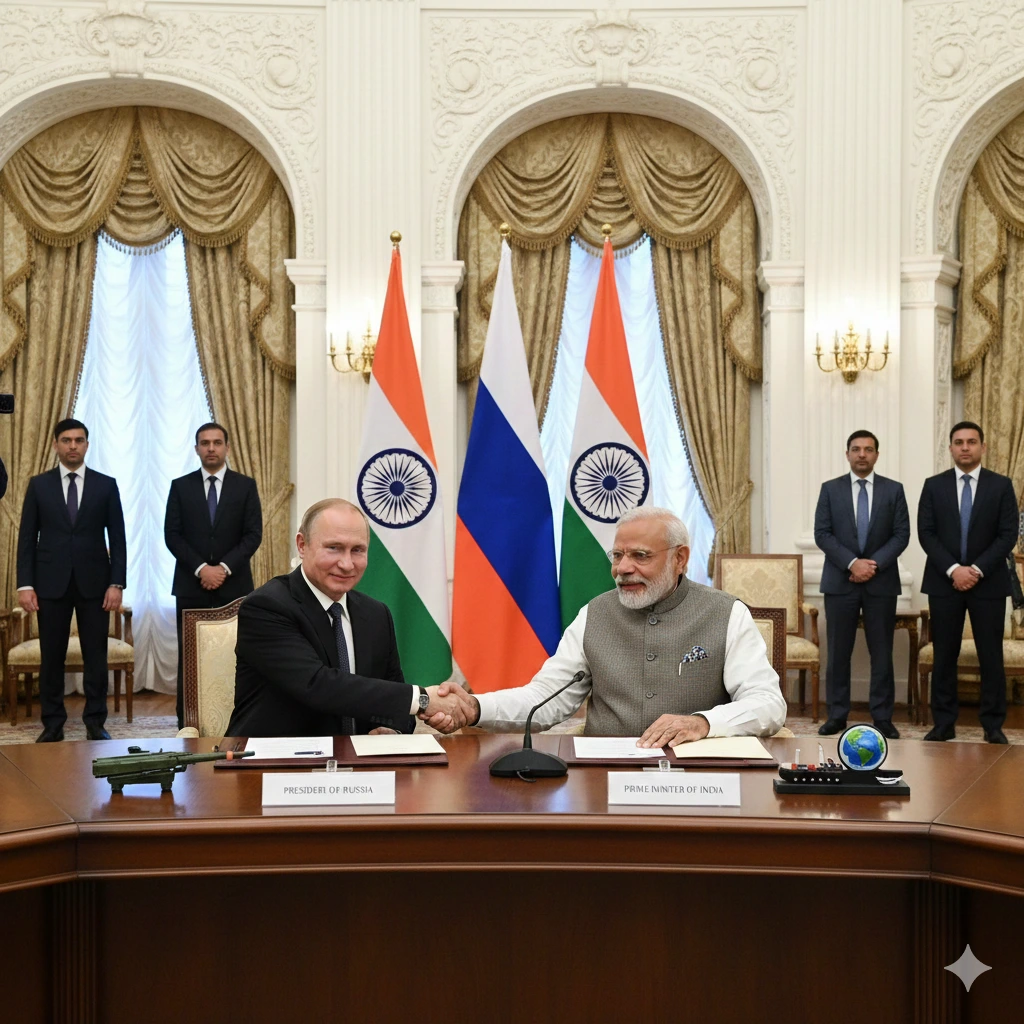
Russian President Vladimir Putin is scheduled to visit India for the 23rd India-Russia Annual Summit in December 2025. This high-stakes visit, his first to India since December 2021 (before the Ukraine conflict), is set to reinforce the “Special and Privileged Strategic Partnership” between the two nations and navigate a complex geopolitical landscape.
The Putin India Visit, which includes meetings with Prime Minister Narendra Modi and a state banquet hosted by President Droupadi Murmu, is expected to focus on three key pillars: Defence, Energy, and Economic Cooperation.
🛡️ Defence Cooperation: S-400 and Future Platforms
Defence ties remain a critical component, as a significant portion of India’s military equipment is of Russian origin. Key discussions are expected to center on accelerating deliveries and securing maintenance support.
- S-400 Air Defence System: India is reportedly seeking clarity on the timeline for the remaining deliveries of the S-400 Triumf regiments. Furthermore, a potential new contract for additional S-400 systems is high on the agenda. Moscow has signaled a willingness to offer up to 50% technology transfer on the missiles and supporting systems for the new contract, aligning with India’s ‘Aatmanirbhar Bharat’ (self-reliant India) initiative.
- Future Platforms and Upgrades: Talks are anticipated to address future collaborations, including the possible joint development or acquisition of the Su-57 stealth fighter jet, though this is viewed more as a long-term prospect. Discussions on spares, upgrades, and maintenance for existing Russian-sourced platforms like fighter jets, tanks, and submarines are also crucial.
- Reciprocal Exchange of Logistic Support (RELOS): Ahead of the visit, Russia’s State Duma formally ratified the RELOS pact. This agreement will simplify coordination by allowing military aircraft, ships, and personnel from both countries to use each other’s facilities for joint exercises, training, and disaster relief.
⛽ Energy & Trade: Bridging the Deficit
Energy now dominates the bilateral economic relationship, with Russia becoming India’s largest crude oil supplier following the Ukraine conflict, driven by discounted imports.
- Energy Security: New Delhi is expected to pursue long-term crude oil contracts with non-sanctioned Russian firms. Discussions will also cover the potential revival of Indian investments in Russian energy projects (like the Arctic LNG 2 or Vostok) and the advancement of nuclear cooperation beyond the existing Kudankulam project.
- Bridging the Trade Gap: Bilateral trade has surged, reaching nearly $68.7 billion in FY 2024–25. However, this is largely lopsided, with India’s imports from Russia (mostly oil and fertilizers) vastly outweighing its exports. Both sides are looking at ways to boost Indian exports (pharmaceuticals, machinery, etc.) to Russia to bridge the nearly $60 billion trade deficit.
- Financial Channels: To bypass Western sanctions and the dominance of the US Dollar, a key economic deliverable is exploring a plan to link India’s RuPay card network with Russia’s Mir payment network. This, along with formalizing alternative payment frameworks, is intended to facilitate smoother rupee-rouble trade settlements.
🤝 Putin India Visit: Strategic Alignment and Other Agreements
The summit is also expected to yield several agreements aimed at deepening people-to-people and economic ties.
- Labour Mobility Agreement: A significant expected agreement is a pact on the mobility of skilled and semi-skilled Indian workers to Russia, particularly in sectors like construction, healthcare, and hospitality.
- Free Trade Agreement (FTA): Both sides are looking to accelerate negotiations for a Free Trade Agreement with the Eurasian Economic Union (EAEU) to significantly boost market access.
- Global Issues: The leaders will exchange views on global and regional developments, including the situation in Ukraine, maintaining their long-standing diplomatic alignment in multilateral forums like BRICS and the Shanghai Cooperation Organisation (SCO).
The Putin India Visit is a crucial test of India’s commitment to strategic autonomy, as New Delhi seeks to maintain its vital partnership with Moscow for energy and defence needs while managing its growing strategic relationship with the US and other Western powers.
Also, read IND vs SA 2nd ODI: South Africa Needs 359 to Win
Given the complexity of the relationship and the current global environment, the Defence and Financial/Trade agreements are generating the most buzz.
Here are the latest updates on two of the most critical topics being discussed at the 23rd India-Russia Annual Summit:
1. 🛡️ Putin India Visit: S-400 and Future Defence Deals
The status of the S-400 Triumf air defence system and the potential for a new fighter jet acquisition are the highest-priority agenda items.
Current Status and Key Highlights:
- S-400 Expansion: India is reportedly pressing Russia to finalize the contract for an additional five squadrons of the S-400 system, going beyond the original five regiments ordered in the 2018 deal.
- Original Delivery Timeline: Of the original five regiments, three are already operational. Russia has committed to delivering the remaining two squadrons by early to mid-2026, making up for delays caused by the Ukraine conflict.
- Missile Procurement: The Indian government has approved a new contract worth approximately ₹10,000 crore (about $1.2 billion) for a large quantity of S-400 missiles to replenish stocks and build up reserves.
- Technology Transfer: For the potential new contract, Russia has reportedly offered up to 50% technology transfer for the S-400 missiles and supporting systems. This would be a significant boost to India’s domestic defense manufacturing under the ‘Aatmanirbhar Bharat’ initiative.
- Su-57 Stealth Fighter: The possible co-production or acquisition of the Russian Su-57 fifth-generation stealth fighter jet is also a key discussion point. While Russia is aggressively promoting the jet, Indian defense sources suggest talks are still at an exploratory stage, as India is also focused on its indigenous Advanced Medium Combat Aircraft (AMCA) program.
- MRO and Upgrades: Both sides are also finalizing a comprehensive annual maintenance contract and the establishment of a Maintenance, Repair, and Overhaul (MRO) facility in India for the S-400 systems. A major upgrade program for the Indian Air Force’s Su-30MKI fighter fleet is also on the table.
2. 🪖 Putin India Visit: Reciprocal Exchange of Logistic Support (RELOS)
Just before President Putin India Visit, Russia took a key formal step that significantly deepens military cooperation.
Current Status and Key Highlights:
- Formal Ratification: Russia’s parliament, the State Duma, officially ratified the RELOS agreement on December 3, 2025, just days before the summit.
- Core Purpose: RELOS is a military logistics pact that allows the armed forces of both nations to access each other’s military facilities for various purposes, including:
- Refueling and replenishment of ships and aircraft.
- Maintenance, repair, and berthing.
- Support during joint exercises, training, and humanitarian relief missions.
- Strategic Implications:
- For India: This grants the Indian Navy and Air Force access to Russian facilities, including ports along the strategically important Northern Sea Route (Arctic region).
- For Russia: It provides Russian military vessels access to Indian naval facilities across the Indian Ocean Region, including key strategic hubs like the Andaman & Nicobar Command.
- Streamlining Operations: The pact cuts down on bureaucracy, making joint military exercises and deployment support faster and more cost-effective.
3. 💳 Financial Linkage: RuPay-Mir and Rupee-Rouble Trade
With Western sanctions continuing to complicate financial channels, discussions are focused on building alternative payment rails.
Current Status and Key Highlights:
- RuPay-Mir Linkage: Negotiators are pushing for an agreement to link India’s domestic card network, RuPay, with Russia’s Mir payment network. If successful, this would allow:
- Indian tourists to use RuPay cards in Russia.
- Russian tourists to use Mir cards in India.
- This is a crucial step toward building non-Dollar financial channels for tourism and general trade.
- Rupee-Rouble Settlement: The current Special Rupee Vostro Account (SRVA) mechanism for settling trade has resulted in Russia accumulating a large surplus of rupees in India, which it struggles to fully utilize. Discussions are aimed at improving the framework to allow Russia to invest these surplus rupees more smoothly in Indian assets (like bonds and infrastructure) and to enhance the stability of the rupee-rouble exchange rate to encourage Indian exporters.
- Trade Surging Despite Challenges: Bilateral trade hit nearly $70 billion in FY 2024-25, driven largely by India’s discounted Russian crude oil imports. The challenge remains the severe trade deficit and resolving payment issues for Indian exporters.
Also, read International League T20 2025: A Global Cricket Showcase
That’s an excellent area to focus on, as the Free Trade Agreement (FTA) with the Eurasian Economic Union (EAEU) is one of the most critical long-term economic priorities for both India and Russia.
Here are the latest updates on the India-Eurasian Economic Union (EAEU) Free Trade Agreement negotiations:
📈 India-EAEU FTA: Accelerating Negotiations
The India-EAEU FTA talks have been significantly accelerated and strategically timed ahead of President Putin India Visit to New Delhi. This agreement aims to link India’s 1.4 billion people market with the EAEU’s customs union, which includes Russia, Armenia, Belarus, Kazakhstan, and Kyrgyzstan (a market of over 183 million people).
Key Updates & Milestones
| Milestone | Date & Status | Details |
| Terms of Reference (ToR) Signed | August 20, 2025 (Signed) | India and the EAEU formally signed the ToR, providing the framework and procedures to launch the negotiations. This set an 18-month roadmap to conclude the talks. |
| First Round of Negotiations | November 26-28, 2025 (Concluded) | The first round of formal negotiations was held in New Delhi, covering initial discussions on tariff liberalization, customs administration, and regulatory standards. |
| Summit Priority | December 4-5, 2025 (Current Summit) | The FTA is a major discussion point for PM Modi and President Putin, with both leaders expected to issue a joint statement expressing commitment to accelerate the process. |
| Target Timeline | Ongoing | Officials are aiming to keep the negotiations on track with the 18-month roadmap, potentially concluding the core text by mid-2027. |
Putin India Visit: Strategic Importance for India
- Market Diversification: The EAEU FTA is a strategic move to diversify India’s export destinations, especially amid rising trade tensions and tariffs from Western partners like the US. It gives Indian companies preferential access to a resource-rich market.
- Addressing the Trade Deficit: India’s trade deficit with the EAEU (mostly with Russia due to crude oil imports) has swelled to nearly $60 billion. The FTA is designed to significantly boost Indian exports (pharmaceuticals, engineering goods, chemicals, textiles) to the bloc, helping to narrow this gap.
- Connectivity & Logistics: The agreement complements India’s push for the International North-South Transport Corridor (INSTC) and the Chennai-Vladivostok Maritime Corridor, providing a rules-based framework for goods moving along these routes.
Putin India Visit: Key Hurdles in Negotiations
While political will is high, technical hurdles remain:
- Tariff Liberalization: India is traditionally protective of its domestic industries (especially agriculture and certain manufacturing sectors) and will be cautious about reducing tariffs on all goods from the EAEU.
- Non-Tariff Barriers (NTBs): Indian exporters, particularly in marine products and pharmaceuticals, frequently face difficulties with the EAEU’s complex Sanitary and Phytosanitary (SPS) and technical standards. Resolving these regulatory differences is a major focus.
- Services and Investment: While the current talks focus on goods, India is keen to include robust chapters on Services and Investment to allow freer movement for Indian IT, healthcare, and professional workers. The EAEU’s mandate for an FTA primarily covers goods, which will require some structural compromise.
The acceleration of these talks is a clear signal that both New Delhi and Moscow are committed to building robust, non-Western-dependent supply chains and economic partnerships.