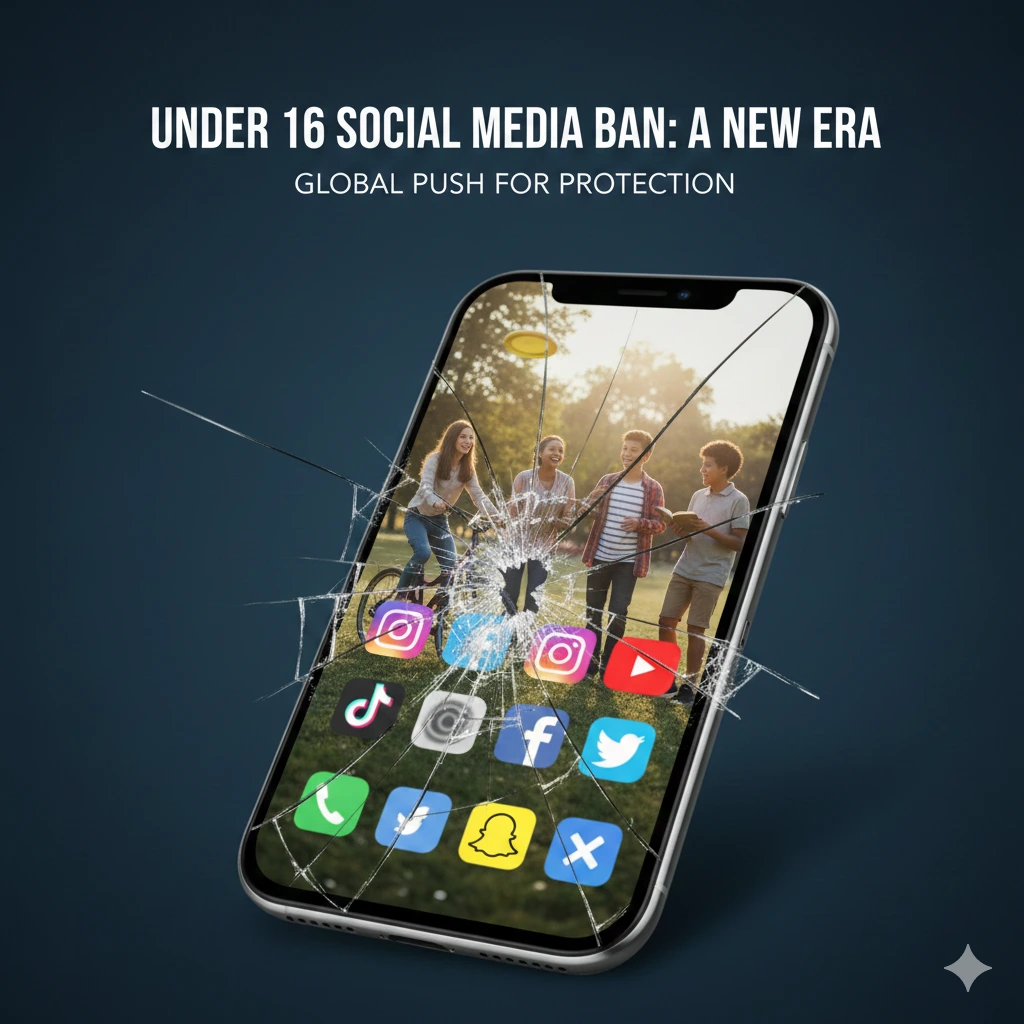
Explore the implications of the under 16 social media ban. Understand its impact on youth, mental health, and digital safety in today’s online landscape.
🌍 The Global Push for Protection: Under 16 Social Media Ban Take Centre Stage
The debate over the impact of social media on young people has escalated from concerned whispers to definitive legislative action. In a significant global development, several nations are moving to enforce age restrictions, with Australia becoming the first country in the world to implement a comprehensive ban on social media accounts for users under the age of 16.
This landmark decision signals a major shift in how governments are addressing the psychological and safety risks posed by digital platforms to minors.
Under 16 Social Media Ban: Australia’s World-First Ban Kicks In
On December 10, 2025, the Online Safety Amendment (Social Media Minimum Age) Act came into effect in Australia. The law mandates that major social media platforms—including TikTok, Instagram, Facebook, YouTube, Snapchat, X, Reddit, Threads, Kick, and Twitch—must take “reasonable steps” to prevent Australian residents under 16 from holding accounts.
Key Elements of the Australian Law:
- Platform Responsibility: The onus of compliance is placed entirely on the tech companies, not on parents or the children themselves. Platforms failing to comply risk substantial fines, potentially up to A$49.5 million (approx. US$33 million).
- Deactivation and Prevention: Companies are required to find and deactivate existing under-16 accounts and prevent them from registering new ones.
- Age Verification Challenges: The implementation has highlighted the technical difficulties of age verification. Reports have surfaced of young users successfully bypassing age checks through workarounds like using fake birth dates or exploiting loopholes in facial age-estimation systems.
- Government Rationale: Prime Minister Anthony Albanese stressed that the ban is about protecting young people from pressures like cyberbullying, grooming, and harmful content that can severely impact their mental health and development.
A Growing Global Trend
Australia’s move is being closely watched as a potential blueprint for other nations grappling with the same complex issues. Concerns over children’s worsening mental health and increased exposure to online harms are driving legislative proposals across continents.
| Country/Region | Proposed/Enacted Measures | Details |
| Australia | Ban on under-16 accounts | World-first ban on major social media platforms enacted December 2025. |
| European Union | Resolution for minimum age | European Parliament passed a non-binding resolution calling for a minimum age of 16 for social media access. |
| Denmark | Proposed Ban on under-15 | A majority of Parliament parties support a ban on social media for children under 15, with parental exemptions for ages 13+. |
| Malaysia | Planned Age Restriction | Announced plans to ban social media for under-16s, starting in 2026. |
| Norway | Proposed Age Hike | Government proposed raising the age of digital consent for social media from 13 to 15 years. |
| France | Parental Consent Law | Passed a law requiring parental consent for minors under 15 to create accounts, though enforcement has faced technical challenges. |
| United States (State Level) | Varied Legislation | Several states are proposing or enacting laws requiring parental consent for minors, regulating “addictive feeds,” or establishing minimum ages (often 13, but some proposals up to 16). |
⚖️ The Ongoing Debate: Protection vs. Rights and Effectiveness
The under-16 social media ban is a deeply divisive topic, pitting child safety advocates against civil liberties groups, tech industry lobbyists, and even some teenagers.
Arguments For the Ban:
- Mental Health Protection: Studies link excessive social media use to increased rates of depression, anxiety, body image issues, and self-harm among adolescents, whose brains are still developing critical structures for judgment and emotional regulation.
- Safety from Harm: It limits exposure to cyberbullying, online predators, inappropriate/extremist content, and misinformation.
- Reclaiming Childhood: It is seen as a way to free children from addictive design features and encourage healthier, real-life interactions.
Arguments Against the Ban:
- Freedom of Expression: Critics, including the Australian Human Rights Commission, argue a blanket ban curtails the rights of young people to free speech and access to information, especially for vulnerable groups like LGBTQ+ youth who rely on online communities for support.
- Ineffectiveness and Migration: Opponents warn that bans are difficult to enforce and will simply push teens to less-regulated platforms, “darker corners of the internet,” or less-private messaging apps, making them less safe.
- Digital Literacy: Removing access entirely may prevent teens from developing the necessary digital literacy and resilience skills needed to navigate the internet safely when they eventually gain access.
- Enforcement Concerns: Age verification methods, often involving government IDs or facial scans, raise significant concerns about user data privacy and the potential for creating a “gated” internet.
As the world observes Australia’s grand social experiment, policymakers everywhere face a monumental challenge: how to safeguard children from online harms without sacrificing their rights to digital connection and expression. The immediate future suggests a continued push for global regulation, with the effectiveness of these age-based restrictions serving as the next crucial point of scrutiny.
Also, read Indoor Mosquito Solutions: What Are the Most Effective?