Master intraday option trading with expert strategies and real-time insights. Elevate your trading skills and make informed decisions for better profits.
By Trending News Fox, News & Media Team, Published 17th March 2026
Master the Tides: Intraday Option Trading Guide for 2026
The Indian financial landscape has undergone a seismic shift as we move through March 2026. For active traders at Trending News Fox, the adrenaline of intraday option trading remains unmatched. Still, the rules of the game have evolved. The Nifty 50 is showing sharp volatility by dipping toward the 23,000 support level, then staging a 900-point recovery. Additionally, the West Asia conflict is keeping oil prices above $100 per barrel. Navigating the “F&O” (Futures and Options) segment requires more than just luck.
This comprehensive guide breaks down the essential strategies, technical indicators, and regulatory updates you need to thrive in today’s market.
Understanding the 2026 Market Dynamics
Intraday option trading involves buying and selling options contracts within the same trading session. Unlike equity investing, you aren’t just betting on a price move; you are battling Time Decay (Theta) and Volatility (Vega).
Currently, the India VIX (Volatility Index) is hovering near 21.60% till now. This signals that the market isn’t in a full-blown panic. The swings are wide enough to wipe out unprotected capital in minutes.
Key Levels to Watch (March 2026):
- Nifty 50: Resistance at 23,500; Strong Support at 23,000.
- Bank Nifty: Resistance at 54,500; Critical Demand Zone at 53,000.
Top Intraday Option Trading Strategies
To remain profitable, a trader must transition from “guessing” to “executing.” Here are the high-probability setups used by pros in 2026:
1. The Momentum Breakout Strategy
This strategy focuses on stocks or indices that break out of a consolidation range with high volume.
- Setup: Identify a range where the price has stayed for at least 60 minutes.
- Trigger: Buy a Call Option if the price breaks the upper resistance. Buy a Put Option if it breaks the lower support.
- Confirmation: Ensure the breakout is supported by a spike in volume and a positive MACD crossover.
2. The Gap and Go Strategy
The global geopolitical shifts occur often. As a result, “Gaps” are common. A “Gap” is where the market opens significantly higher or lower than the prior close.
- The Play: If the Nifty opens with a gap-down, traders need to be vigilant. They should buy At-the-Money (ATM) Calls if it holds the first 15-minute candle’s low. This strategy is often known as playing the “Gap Fill.”
3. Bull Put and Bear Call Spreads (Hedged Plays)
For those looking to reduce risk, credit spreads are the gold standard.
- Bull Put Spread: Sell an Out-of-the-Money (OTM) Put and buy a further OTM Put. This limits your downside if the market crashes. It also lets you pocket premium if the market stays flat or rises.
Technical Indicators for Day Trading
Successful intraday trading is a marriage of price action and technical data. Use these three indicators on a 5-minute or 15-minute chart:
- VWAP (Volume Weighted Average Price): The “Holy Grail” for intraday traders. If the price is above VWAP, the sentiment is bullish; below it, bearish.
- RSI (Relative Strength Index): In 2026’s volatile market, look for RSI divergence. If the price makes a new low but the RSI makes a higher low, a reversal is.
- Put-Call Ratio (PCR): A PCR below 0.65 often indicates an oversold market ready for a bounce, while a PCR above 1.5 suggests an overbought condition.
SEBI Guidelines: The 2026 Compliance Checklist
SEBI has introduced several “Ease of Doing Business” and investor protection measures in early 2026. As a trader on Trending News Fox, you must stay compliant:
- Peak Margin Requirements: Ensure your account is fully funded. Brokers now take multiple intraday snapshots, and any shortfall leads to heavy penalties.
- Risk Disclosures: Standardized disclosures now show that a vast majority of retail traders lose money in F&O. This is a reminder to trade with a plan, not emotions.
- Position Limits: Be aware of the Market-wide Position Limits (MWPL). If a stock enters the “F&O Ban” period, you can only exit existing positions, not create new ones.
Risk Management: The 1% Rule
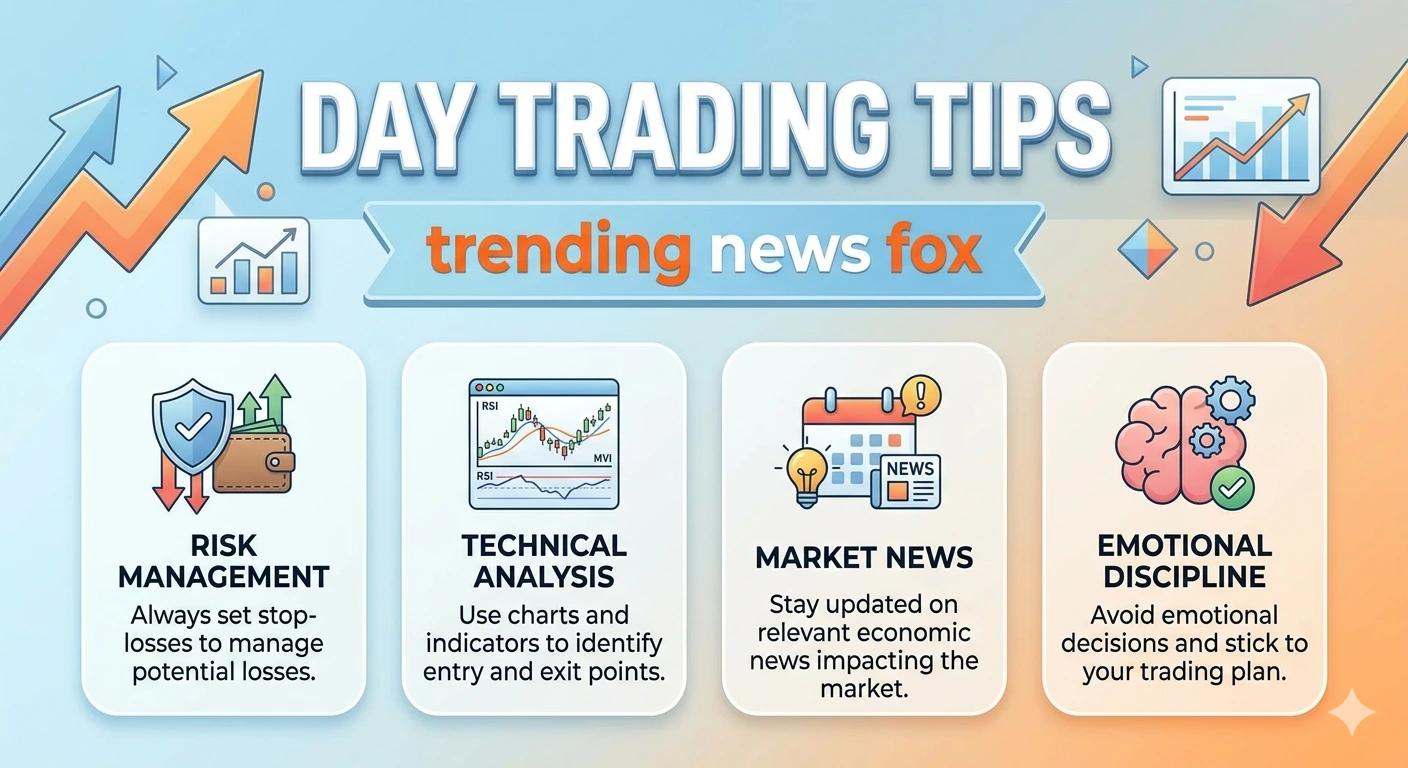
The biggest mistake traders make is “revenge trading” after a loss. To survive at the professional level, follow these rules:
- The 1% Rule: Never risk more than 1% of your total capital on a single trade.
- Stop-Loss is Mandatory: Never enter an option trade without a pre-defined system-based stop-loss.
- Avoid Overtrading: Limit yourself to 3-5 high-quality trades per day. The brokerage and taxes (STT) on 20 trades can eat up your entire profit.
Stock Picks for Intraday Trading
While the indices (Nifty and Bank Nifty) offer liquidity, certain sectors are showing higher “Beta” (volatility) right now:
- Metals: Stocks like Hindalco and JSW Steel are reacting sharply to global commodity trends.
- Banking: HDFC Bank remains the anchor of the market; its movements often dictate the Nifty trend.
- Cement: UltraTech Cement has shown strong intraday recovery patterns recently.
Conclusion
Intraday option trading in 2026 is a high-speed game of skill. The West Asia crisis creates daily volatility. Fluctuating oil prices add to this volatility. While the opportunities for profit are immense, the risks are equally high. Focus on technical levels like 23,000 on the Nifty. Use tools like VWAP. Adhere to SEBI’s margin rules. By doing so, you can position yourself among the successful minority.
Stay tuned to Trending News Fox. Get live market updates, breakout alerts, and expert analysis. These resources help you trade smarter every day.
Disclaimer: Trading in Options involves significant risk and is not suitable for all investors. The information provided here is for educational purposes only. Please consult with a SEBI-registered financial advisor before making any investment decisions.