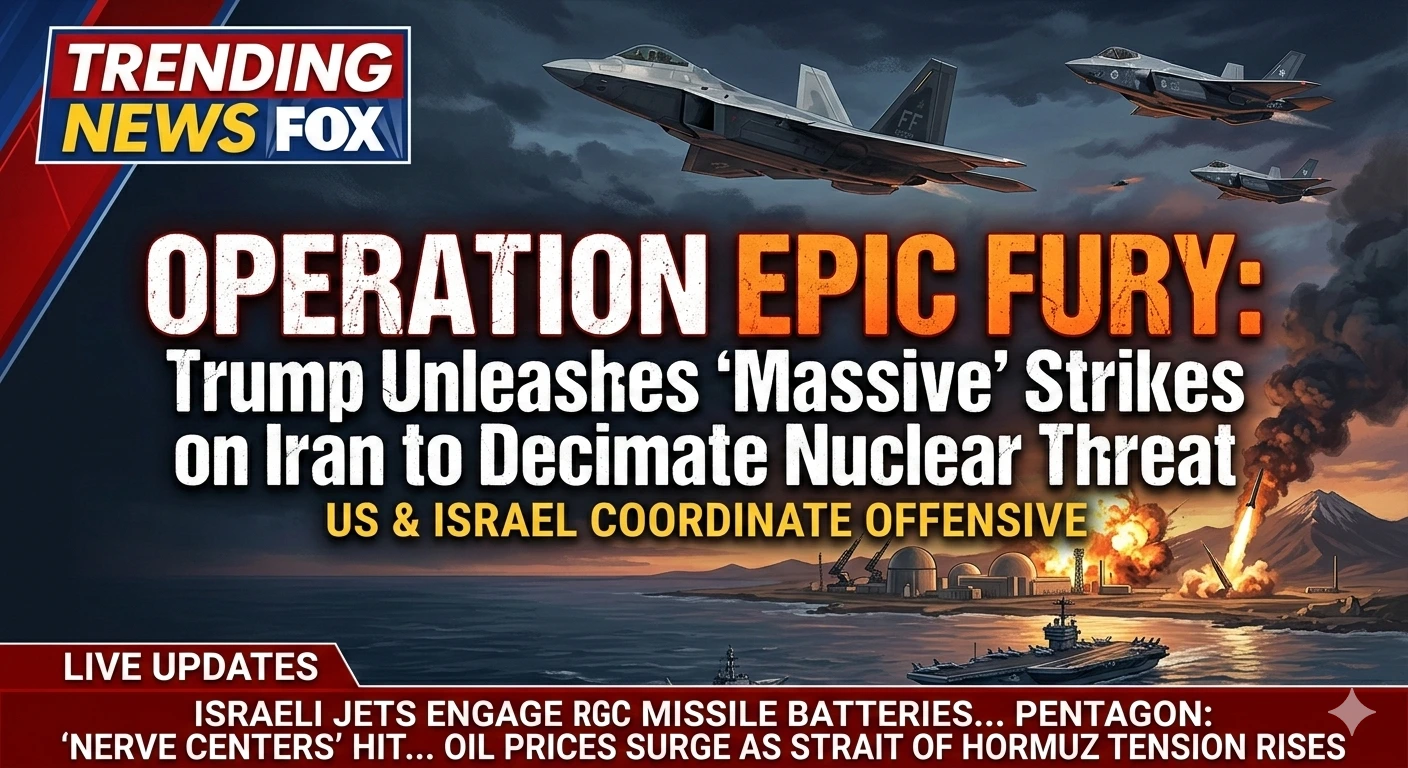
President Trump announces “Operation Epic Fury,” a massive joint U.S.-Israeli military strike on Iran’s nuclear and missile sites. Is regime change next? Get the latest updates.
Operation Epic Fury: Trump Unleashes ‘Massive’ Military Strike on Iran as Middle East Teeters on the Brink
By Trending News Fox, News & Media Service, Saturday, February 28, 2026
TEHRAN / WASHINGTON — In a stunning escalation that has sent global oil markets into a tailspin and effectively ended a multi-month diplomatic stalemate, President Donald Trump announced Saturday that the United States military, in a seamless coordination with Israeli Defense Forces (IDF), has launched “major combat operations” against the Islamic Republic of Iran.



The offensive, codenamed Operation Epic Fury by the Pentagon and Operation Roaring Lion by Jerusalem, represents the largest military intervention of President Trump’s second term. As dawn broke over Tehran on Saturday morning, a series of thunderous explosions rocked the southern districts of the capital, targeting what U.S. officials described as the “nerve centers” of the Iranian regime.
The Midnight Strike: ‘We Can’t Take It Anymore’
The operation began under the cover of darkness, just hours after high-stakes nuclear negotiations in Geneva, mediated by Oman, collapsed without a breakthrough. President Trump, addressing the nation via a video posted to Truth Social while wearing a navy suit and a “USA” baseball cap, didn’t mince words.
“Our objective is to defend the American people by eliminating imminent threats from the Iranian regime—a vicious group of very hard, terrible people,” Trump declared. “We sought repeatedly to make a deal. We gave them every chance. But Iran refused. Instead, they attempted to rebuild their nuclear program and develop long-range missiles that could soon reach the American homeland. We can’t take it anymore.”
The President confirmed that the strikes were not a limited “warning shot” but a sustained campaign designed to “annihilate” Iran’s naval capabilities and “raze their missile industry to the ground.”
Targets: From Nuclear Labs to the Supreme Leader’s Doorstep
Early reports from the ground in Iran suggest the scale of the attack is unprecedented. According to the Associated Press and Reuters, dozens of U.S. and Israeli fighter jets, supported by sea-based cruise missiles, struck targets across seven major Iranian provinces.
Key confirmed target zones include:
- Tehran: Multiple strikes hit University Street and the Jomhouri area. Significantly, reports indicate that a major strike occurred near the offices of Supreme Leader Ayatollah Ali Khamenei, whose current whereabouts remain unknown.
- Isfahan & Qom: Facilities linked to the regime’s nuclear enrichment and ballistic missile storage were reportedly hit by “bunker-buster” munitions.
- Bushehr: The site of Iran’s nuclear reactor was reportedly targeted, though the extent of the damage to the reactor itself remains unconfirmed by the IAEA.
- The Persian Gulf: U.S. naval assets engaged the Iranian Navy, with President Trump vowing to “annihilate” their presence in the vital waterway.
Israeli Prime Minister Benjamin Netanyahu corroborated the joint nature of the mission, stating the goal was to “remove an existential threat” posed by the “Ayatollah’s regime.”
Iran Fires Back: A Region in Flames
Tehran’s response was swift and violent. Within two hours of the initial strikes, the Islamic Revolutionary Guard Corps (IRGC) launched a massive barrage of retaliatory ballistic missiles.
Sirens blared across Israel, from the Galilee to Eilat, as the “Iron Dome” and “Arrow” defense systems worked overtime to intercept incoming threats. However, the retaliation extended far beyond Israel’s borders. Explosions were reported in Bahrain, Kuwait, Qatar, and the UAE, as Iran targeted U.S. military bases and allied infrastructure in the Gulf. In the UAE, local officials confirmed at least one fatality from falling missile shrapnel.
The Iranian Foreign Ministry issued a defiant statement, calling the strikes a “criminal military aggression” and asserting that the “sacred homeland” is prepared for a long-term war. “Now you have started down a path whose end is no longer in your control,” warned Ebrahim Azizi, head of the Iranian parliament’s national security commission.
The Domestic Fallout: ‘Help is on the Way’
In a move that mirrors the 2003 “Shock and Awe” playbook—but with a distinctly Trumpian twist—the President directly appealed to the Iranian people to overthrow their government.
“This is your moment for action,” Trump said in his address, urging the IRGC to “lay down your weapons and receive complete immunity, or face certain death.” This call to arms comes as Iran has been gripped by internal unrest and economic collapse since late 2025. Reports from human rights groups like HRANA suggest the regime’s recent crackdown on protesters has been brutal, with some estimates placing the death toll in the thousands.
In Washington, the reaction was polarized. While Republican allies praised the President’s “decisive strength,” Congressional Democrats moved quickly to draft a War Powers Resolution to block further strikes, arguing that a sustained war in the Middle East runs counter to Trump’s own campaign promise to end “endless foreign wars.”
Operation Epic Fury: Global Economic Shockwaves
The immediate impact on the world stage was felt in the pockets of consumers. Brent crude oil prices, which had already been climbing due to the military buildup, are expected to see a “war premium” of at least $10 to $15 per barrel when markets open Monday.
The Strait of Hormuz, which handles 20% of the world’s oil supply, is now effectively a combat zone. Iran has reportedly closed the strait for “live-fire drills,” a move that could paralyze global energy trade if the blockade holds.
Operation Epic Fury: A High-Stakes Gamble
The risks of Operation Epic Fury are immense. President Trump himself acknowledged the likelihood of American casualties, stating, “The lives of courageous American heroes may be lost… but we are doing this for the future.”
Critics argue that by targeting the Supreme Leader’s compound and calling for regime change, the administration has left the Iranian leadership with no “off-ramp,” potentially forcing a desperate regime to use whatever assets it has left—including its proxy networks like Hezbollah and the Houthis. Indeed, Houthi rebels in Yemen have already announced they will resume strikes on shipping in the Red Sea.
As of Saturday evening, the world watches the skies over Tehran. Is this the beginning of the end for the Islamic Republic, or the start of a regional conflagration that will define the next decade?
For now, the U.S. and Israel remain on the offensive, and President Trump’s message to Tehran remains unyielding: “No one should challenge the strength and might of the U.S. Armed Forces.”
What We Know Right Now: Operation Epic Fury
- The Strike: Coordinated U.S.-Israeli air and sea offensive targeting nuclear and military sites.
- The Goal: Destruction of Iran’s nuclear program and missile industry; potential regime change.
- The Retaliation: Iran has fired missiles at Israel and Gulf states; U.S. bases in Qatar and Bahrain are on high alert.
- The Economy: Oil prices are surging; the Strait of Hormuz is at risk of closure.
Stay tuned to Trending News Fox for live updates as this situation develops.
🔍 Operation Epic Fury: Frequently Asked Questions
What is Operation Epic Fury?
Operation Epic Fury is the official Pentagon codename for the joint U.S. and Israeli military strike launched on February 28, 2026. The operation involves precision airstrikes and naval engagements aimed at dismantling Iran’s nuclear infrastructure and ballistic missile capabilities.
Why did President Trump order the strikes now?
The strikes were ordered following the collapse of high-stakes nuclear negotiations in Geneva earlier this week. U.S. intelligence reportedly confirmed that Iran was within weeks of achieving a “breakout” nuclear capacity and was continuing a deadly crackdown on domestic protesters, with an estimated 32,000 civilians killed by the regime since late 2025.
Has Iran retaliated against the U.S. or its allies?
Yes. Within hours of the initial strikes, Iran launched a massive barrage of ballistic missiles. Targets included Israeli cities and U.S. military installations in the Persian Gulf, specifically the U.S. Fifth Fleet headquarters in Bahrain. Emergency alerts have been issued across Kuwait, the UAE, and Saudi Arabia.
Is this the start of a full-scale war?
While President Trump described the mission as a “major combat operation,” the administration has framed it as a “preemptive strike” to ensure Iran never obtains a nuclear weapon. However, with both sides trading missile fire and the U.S. deploying a second aircraft carrier (USS Gerald R. Ford) to the region, many experts warn of a prolonged regional conflict.
How will this affect gas prices and the economy?
Global markets are already reacting to the news. With the Strait of Hormuz—a vital artery for 20% of the world’s oil—now a combat zone, analysts expect a sharp spike in crude oil prices. Experts suggest a “war premium” could add $15+ per barrel as early as Monday morning.
What is the goal regarding the Iranian government?
In his address on February 28, President Trump made a direct appeal to the Iranian people and military, stating “the hour of your freedom is at hand.” While the official Pentagon objective is the destruction of military assets, the President’s rhetoric suggests that regime change is a primary desired outcome of the intervention.
Interactive Elements for our Readers: Operation Epic Fury
- Live Poll: “Do you support the President’s decision to use military force against Iran? [Yes / No / Unsure]”
- Newsletter Opt-in: “Get ‘War Room’ updates sent directly to your inbox as the situation in Tehran unfolds.”
Operation Epic Fury: Disclaimer
Last Updated: February 28, 2026
The information provided in this article is for informational and educational purposes only. While Trending News Fox strives to provide the most accurate and up-to-date coverage of the ongoing military operations in the Middle East, the situation is extremely fluid.
- Real-Time Updates: Reports regarding casualties, specific military targets, and retaliatory strikes are based on preliminary data from the Department of Defense, international news agencies, and ground-level sources. These figures and details are subject to change as more information is verified.
- No Professional Advice: This content does not constitute military, political, or financial advice. Readers are encouraged to consult official government bulletins (such as the U.S. State Department or Department of Defense) for travel advisories and safety protocols.
- External Links: This site may contain links to third-party websites. We are not responsible for the accuracy or content of those external sites.
Trending News Fox is committed to editorial integrity, but we assume no liability for any actions taken based on the information provided herein.