Unlock the secrets of intraday trading timing. Explore our comprehensive guide to improve your trading strategies and achieve better results.
By Trending News Fox, News & Media Team, Published 19th March 2026
How Does Timing Impact Intraday Trading Success?
Managing a successful trading day on the National Stock Exchange (NSE) or Bombay Stock Exchange (BSE) requires multiple elements. It involves more than just a winning strategy. It demands a deep understanding of the market’s internal clock. For intraday traders, every minute carries a different risk-to-reward profile.
At Trending News Fox, we analyze the critical windows of the Indian trading day. This helps you align your entries and exits with peak liquidity. It also ensures optimal volatility.
The Anatomy of the Indian Market Day: 9:15 AM to 3:30 PM
The Indian stock market operates on a fixed schedule, but the “feel” of the market shifts dramatically throughout the session. Effective trading requires treating the day as three distinct acts. These are the Morning Open, the Mid-day Lull, and the Afternoon Close.
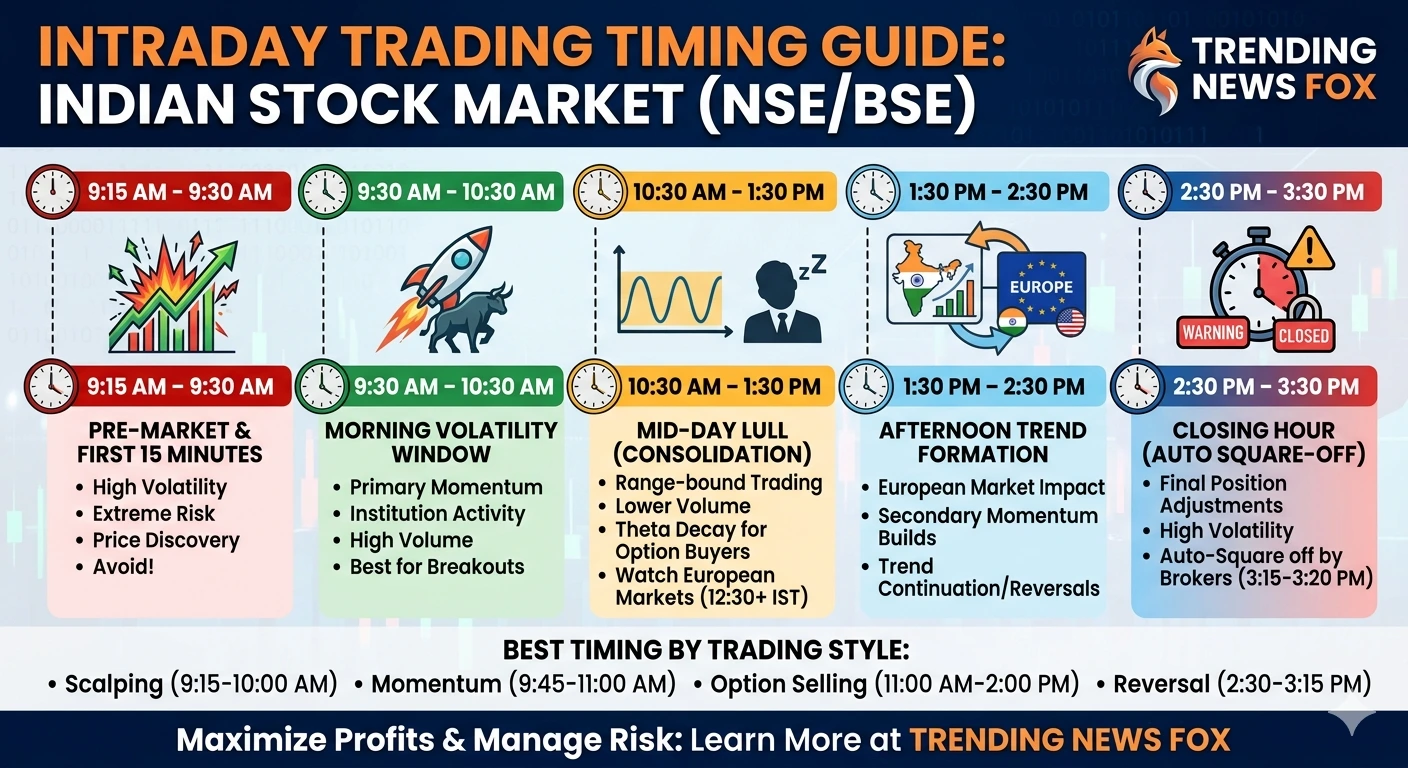
1. The Opening Bell: 9:15 AM – 10:30 AM (The Volatility Window)
This is often referred to as the “Power Hour.” It is the most active and liquid part of the day. The market’s reaction to overnight global cues, earnings reports, and economic data drives this activity.
- 9:15 AM – 9:30 AM: This is the most dangerous zone for beginners. Known as the “Dumb Money” window, prices often swing wildly as retail orders placed overnight are executed. Trends set in these first 15 minutes are usually “fakeouts” that reverse shortly after.
- 9:30 AM – 10:30 AM: This is the “Sweet Spot” for seasoned momentum traders. By 9:30 AM, the early chaos has settled. Professional institutional money then begins to define the true direction of the day. If you are looking for high-probability breakouts, this is your primary window.
2. The Mid-Day Lull: 10:30 AM – 2:00 PM (The Consolidation Phase)
After the morning frenzy, volume and volatility typically drop. European markets open around 12:30 PM – 1:00 PM IST. This can sometimes inject fresh life into the indices, especially Nifty and Bank Nifty. Generally, though, this period is characterized by range-bound movement.
- Strategy Tip: This is a dangerous time for “long-only” momentum traders. Stocks often “sideways” and decay the value of intraday options (Theta decay). It is, though, an excellent time for mean-reversion strategies or for traders who use Bollinger Bands to play the ranges.
3. The Closing Hour: 2:00 PM – 3:30 PM (The Trend Re-emergence)
As the day nears its end, intraday traders and institutional players start squaring off their positions. This creates a secondary spike in volume and volatility.
- 2:30 PM onwards: Large-scale portfolio rebalancing often occurs here. You will often see “V-shaped” recoveries or sharp sell-offs during this window.
- The 3:15 PM Deadline: Most Indian brokers (like Zerodha, Upstox, or Angel One) start auto-square-off at a specific time. This time is between 3:15 PM and 3:20 PM. To avoid extra charges, always aim to exit your positions manually by 3:10 PM. This ensures you get the price you want.
Best Intraday Trading Timings for Different Styles
Not every trader thrives in the same environment. Your “ideal” time depends heavily on your specific trading persona.
| Trading Style | Best Time Window | Why? |
| Scalping | 9:15 AM – 10:00 AM | Highest liquidity allows for large orders with minimal slippage. |
| Momentum Trading | 9:45 AM – 11:00 AM | Trends are established and have “room to run” before the mid-day lull. |
| Option Selling | 11:00 AM – 2:00 PM | Capitalizes on time decay (Theta) during low-volatility periods. |
| Reversal Trading | 2:15 PM – 3:10 PM | Captures the “End-of-Day” trend shifts and position squaring. |
Key Factors That Influence Timing in 2026
The Pre-Market Session (9:00 AM – 9:15 AM)
While retail trading begins at 9:15 AM, the price discovery happens earlier.
- 9:00 AM – 9:08 AM: Order entry and cancellation.
- 9:08 AM – 9:12 AM: Order matching and opening price determination.Monitoring the pre-market is essential to see which sectors are attracting “Big Money” before the regular session starts.
Global Market Overlaps
The Indian market does not move in a vacuum.
- Asian Markets (SGX/Gift Nifty): Watch these before 9:00 AM for opening direction.
- European Markets: Their opening hours are from 12:30 PM to 1:30 PM IST. This period often causes a trend reversal or a breakout in the Indian indices.
- US Futures: Fluctuations in S&P 500 or Nasdaq futures occur throughout the day. These fluctuations can influence Nifty’s direction. This is especially true for IT and Banking stocks.
Intraday Trading Timing Checklist: Optimizing Your Strategy
To consistently profit, you need to treat your trading like a business. Here is how to refine your “timing” strategy:
- Avoid the “Over-Trading” Trap: More time at the screen does not equal more profit. Many successful traders only trade from 9:30 AM to 11:00 AM and then walk away.
- Use 5-Minute and 15-Minute Charts: For timing, use the 15-minute chart to help find the trend. The 5-minute chart is better for finding the exact entry point.
- Watch the Volume: Never enter a “breakout” during the mid-day lull if it isn’t backed by a surge in volume. Low-volume breakouts are almost always traps.
- Economic Calendar: Always check for RBI policy meets or Union Budget announcements. In 2026, the market has shown extreme sensitivity to interest rate commentary. This often causes “volatility spikes” outside of regular high-volume hours.
Conclusion: The Golden Rule of Intraday Trading Timing
The “Best Time” for intraday trading is when Volatility meets Liquidity. For most traders in India, this means the 9:30 AM to 10:30 AM window. Wait just 15 minutes after the open. This allows the “noise” to clear. You then have a much higher probability of catching a move that lasts.
Remember, in the world of intraday trading, “Patience is a position.” Sometimes, the best trade you make is the one you don’t take during the erratic opening minutes.
Stay tuned to Trending News Fox for the latest technical indicators and stock picks to fuel your trading journey.
Intraday Trading Timing Audio Podcast Below:
Frequently Asked Questions: Intraday Trading Timing (NSE/BSE)
1. What is the best time for intraday trading in the Indian market?
The most profitable window for intraday trading is generally 9:30 AM to 10:30 AM. During this hour, the first opening volatility has settled, institutional volume is high, and clear trends start to emerge. This allows traders to capture significant price movements with lower risk than the opening 15 minutes.
2. Can I start trading exactly at 9:15 AM?
While the market opens at 9:15 AM, it is highly recommended that beginners wait until 9:30 AM. The first 15 minutes involve “price discovery” where overnight orders cause erratic swings. Professional traders often call this the “amateur hour” because price action is usually driven by emotion rather than technical logic.
3. Is the mid-day session (12:00 PM – 1:30 PM) good for trading?
Generally, no. This period is known as the “Mid-day Lull.” Volumes drop as institutional traders take breaks and European markets prepare to open. Stock prices often move sideways, which can lead to “Theta decay” (loss of value) for option buyers. Unless there is a major news event, it is often best to avoid fresh momentum trades during this time.
4. How do European markets affect Indian intraday timing?
The European markets (FTSE, DAX, CAC) typically open around 12:30 PM to 1:30 PM IST. This opening often injects new liquidity into the Indian indices, particularly the Nifty and Bank Nifty. If the Indian market has been sideways all morning, the European open can trigger a fresh breakout. It can also lead to a trend reversal.
5. At what time should I close my intraday positions?
You should aim to square off your positions by 3:10 PM. Most Indian brokers (like Zerodha or Angel One) begin their auto-square-off process between 3:15 PM and 3:20 PM, often charging an additional fee (e.g., ₹50 + GST per order) for this service. Closing manually by 3:10 PM ensures you maintain control over your exit price.
6. What is the “Power Hour” in Indian trading?
The “Power Hour” refers to the final hour of the trading session, from 2:30 PM to 3:30 PM. During this time, large institutions adjust their portfolios. Intraday players square off massive positions. This leads to high-volume price action and sharp trend continuations.
Important Trading Disclaimer
Financial Risk Warning: Trading in the Indian Stock Market (NSE/BSE) carries a high level of risk. Intraday trading is particularly risky. These activities may not be suitable for all investors. The high degree of leverage available can work against you as well as for you.
The “Intraday Trading Timing” strategies and data provided by Trending News Fox are for educational and informational purposes only. Past performance is not indicative of future results. Before investing in the equity or derivatives market, consider your investment objectives. Assess your level of experience. Understand your risk appetite.
Trending News Fox and its authors are not SEBI-registered advisors. We do not guarantee any profits or accept liability for any financial loss arising from the use of this information. Always consult with a certified financial advisor before making any investment decisions. Trade responsibly.