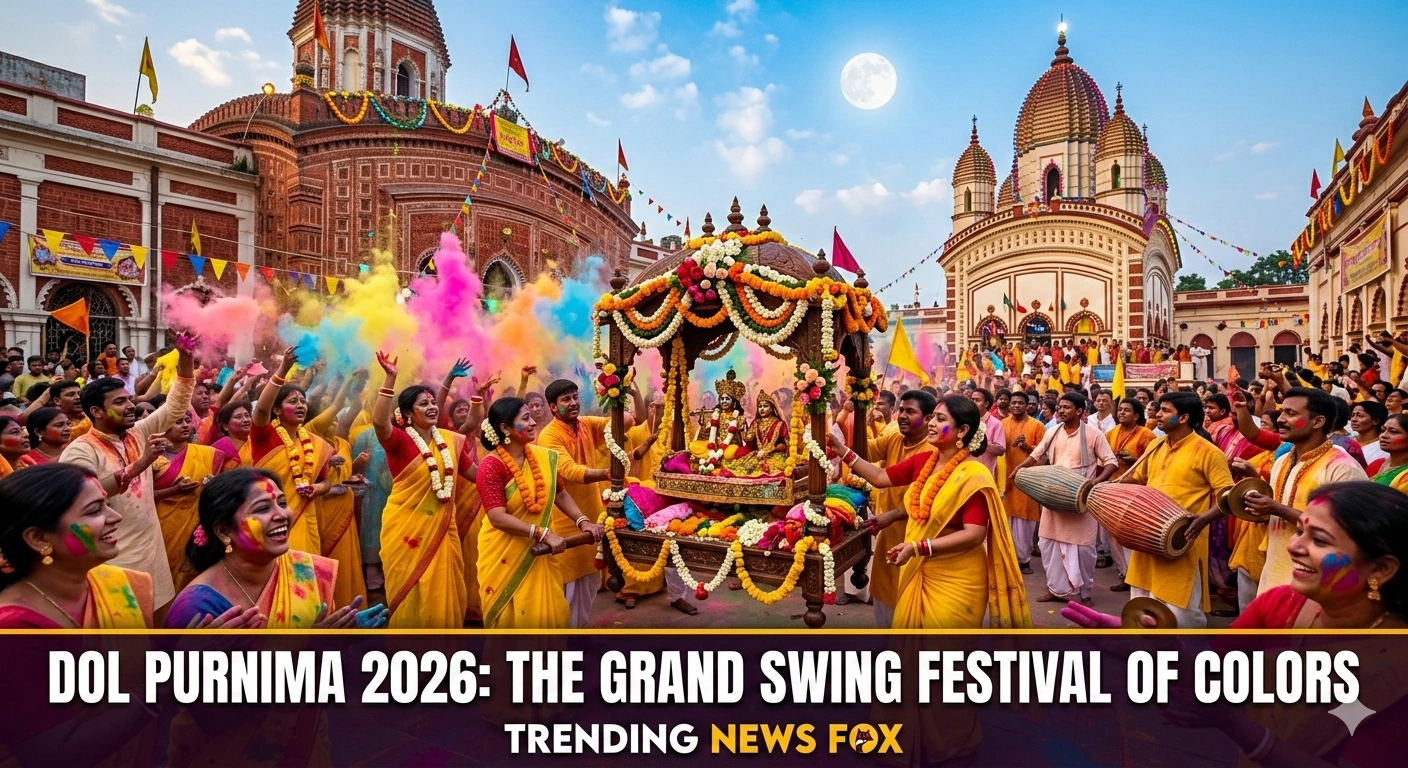
Dol Purnima 2026 will be celebrated with vibrant colours, Holi rituals, and cultural festivities across India. Discover the exact date, tithi timings, traditions, regional celebrations, spiritual significance, and latest updates. Perfect guide for readers on Trending News Fox.
By Trending News Fox Editorial Team, Published 3rd March 2026
Dol Purnima 2026: A Divine Celebration of Colors, Love, and Tradition
Dol Purnima, also known as Dol Jatra or Dol Utsav, is one of the most vibrant and spiritually significant festivals in Eastern India. While Northern and Western India celebrate Holi, the states of West Bengal, Odisha, and Assam transform into a canvas of devotion, music, and the “Abir” (colored powder).
In 2026, Dol Purnima falls on Tuesday, March 3, marking not just the arrival of spring (Basanta), but also the final major festival of the Bengali calendar year.
📅 Dol Purnima 2026: Date, Tithi, and Auspicious Timings
The festival is observed on the Purnima (full moon) of the Hindu month of Phalguna. For 2026, the celestial timings are crucial for devotees performing rituals and pujas.
| Event | Date | Time (IST) |
| Purnima Tithi Begins | March 2, 2026 | 05:55 PM |
| Purnima Tithi Ends | March 3, 2026 | 05:07 PM |
| Main Celebration Day | March 3, 2026 | All Day |
| Moonrise (Purnima) | March 3, 2026 | 06:20 PM |
Auspicious Muhurats for Puja
To receive the divine blessings of Radha and Krishna, the following windows are recommended for offerings and prayers:
- Laabh Muhurat: 10:49 AM – 12:17 PM (Ideal for Sankalpa and initial prayers).
- Amrit Muhurat: 12:17 PM – 01:44 PM (Best for Bhog and main rituals).
- Shubh Muhurat: 03:12 PM – 04:39 PM (Perfect for Aarti and Kirtan).
Important Note: A penumbral lunar eclipse (Ketu-grasta Chandra Grahan) coincides with Dol Purnima this year. In places like Puri, temple rituals at the Jagannath Temple may be shifted to before sunrise.
🕉️ The Spiritual Significance: Why We Celebrate
Dol Purnima is far more than a “festival of colors.” It carries deep mythological and historical roots that define the cultural fabric of the East.
1. The Divine Love of Radha-Krishna
The core of Dol Jatra is the “Swing Festival.” It is believed that on this day, Lord Krishna expressed his love for Radha. Devotees place idols of the divine couple on beautifully decorated swings (Dola) and gently rock them. This symbolizes the playful, eternal bond of Bhakti (devotion).
2. Birth of Sri Chaitanya Mahaprabhu
For followers of Gaudiya Vaishnavism, this day is exceptionally sacred as Gaura Purnima—the birth anniversary of Sri Chaitanya Mahaprabhu (1486–1534). He was a social reformer and saint who popularized the Sankirtana movement (communal chanting). His birthplace, Nabadwip, and the headquarters of ISKCON in Mayapur, see hundreds of thousands of pilgrims on this day.
🌸 Regional Flavors: How 2026 is Being Celebrated
West Bengal: Basanta Utsav in Shantiniketan
In the red-soiled land of Birbhum, the Nobel Laureate Rabindranath Tagore reimagined Dol Jatra as Basanta Utsav (Spring Festival).
- Attire: Thousands of men and women dress in traditional Basanti (yellow) or saffron clothing.
- Culture: Instead of loud music, the air is filled with Rabindra Sangeet. Students of Visva-Bharati University perform graceful dances like “Ore Grihabasi” to welcome spring.
- 2026 Update: While the university holds internal celebrations to preserve heritage, the surrounding town of Bolpur and the Sonajhuri Haat remain the epicenter for tourists to experience Baul music and organic Abir.
Odisha: Dola Jatra and the Vimanas
In Odisha, the festival is a multi-day affair. Idols of Lord Jagannath (as Dolagovinda) are carried in grand processions called Vimanas.
- Melana: Small village processions meet at a common ground for a “Melana” (grand gathering).
- Puri: At the Jagannath Temple, the deities are dressed in the Rajadhiraja Besha, adorned with gold ornaments, drawing massive crowds.
Assam: Doul Utsav
In the Satras (monasteries) of Assam, particularly in Barpeta, the festival is known as Doul Utsav. It lasts for 3–5 days and features local hymns called Holi Geet, traditional drums, and the symbolic “burning of the hut” (Meji) representing the victory of good over evil.
🍽️ Traditional Delicacies to Savour
No Indian festival is complete without a feast. On Dol Purnima 2026, households will be preparing:
- Sweets: Rasgulla, Sandesh, and Malpua (syrup-soaked pancakes).
- Offerings: Panchamrit (a mix of milk, curd, honey, sugar, and ghee) is a staple offering to the deities.
- Main Course: Traditional Bengali Luchi (fried flatbread) with Alur Dom or a wholesome Khichuri with mixed vegetable Labra.
🛡️ Tips for a Safe and Joyful Dol 2026
- Use Herbal Colors: Protect your skin and the environment by using natural Abir made from marigolds, hibiscus, or turmeric.
- Respect the Tithi: Try to complete your main puja before the Purnima Tithi ends at 05:07 PM on March 3.
- Travel Early: If you are heading to Mayapur or Shantiniketan, book your trains and accommodation months in advance as Bolpur and Nadia district see record footfall.
- Stay Hydrated: March in India can be warm. Keep water or traditional Beler Pora (Bael juice) handy.
Conclusion
Dol Purnima 2026 is a reminder of the beauty of spring and the power of devotion. Whether you are chanting “Hari Bol” in a procession in Kolkata or enjoying the soulful Baul songs of Shantiniketan, the festival promises a sense of renewal and communal harmony.
Shubho Dol Jatra to everyone!
❓ Dol Purnima 2026 – Frequently Asked Questions
1. When is Dol Purnima in 2026?
Dol Purnima in 2026 will be celebrated on March 3, 2026, marking the full moon day of the Phalguna month.
2. What is Dol Purnima?
Dol Purnima is a major Hindu festival celebrated mainly in West Bengal, Assam, Odisha, and parts of Eastern India, marking the joyous arrival of spring. It coincides with Holi in many regions.
3. Why is Dol Purnima celebrated?
The festival honours Lord Krishna and Radha and celebrates love, colours, devotion, and the onset of the spring season. It also marks the birth anniversary of Sri Chaitanya Mahaprabhu.
4. What rituals are performed on Dol Purnima?
Devotees participate in processions carrying idols of Krishna, apply abir (gulal), sing devotional songs, perform kirtan, visit temples, and offer bhog to the deity.
5. How is Dol Purnima different from Holi?
While Holi is widely celebrated across India with colours and bonfires, Dol Purnima focuses more on devotional celebrations, processions, and the worship of Krishna. The cultural rituals differ across states.
6. Is Dol Purnima a public holiday in India?
Dol Purnima is a holiday in several states, especially West Bengal, though it may not be a nationwide holiday.
7. What foods are prepared during Dol Purnima?
Traditional offerings include khichuri, payesh, laddoos, malpua, fruits, and sweets, often prepared as bhog in temples.
8. What is the significance of colours on Dol Purnima?
Colours represent joy, prosperity, spiritual awakening, and the playful love of Krishna and Radha. Applying colour is symbolic of unity and happiness.
9. Where is Dol Purnima celebrated most famously?
Major celebrations take place in Mayapur, Nabadwip, Shantiniketan, Vrindavan, and several temples across West Bengal.
10. Can tourists participate in Dol Purnima festivities?
Yes, Dol Purnima is open and welcoming to visitors. Tourists can join temple celebrations, cultural programs, and colourful processions.