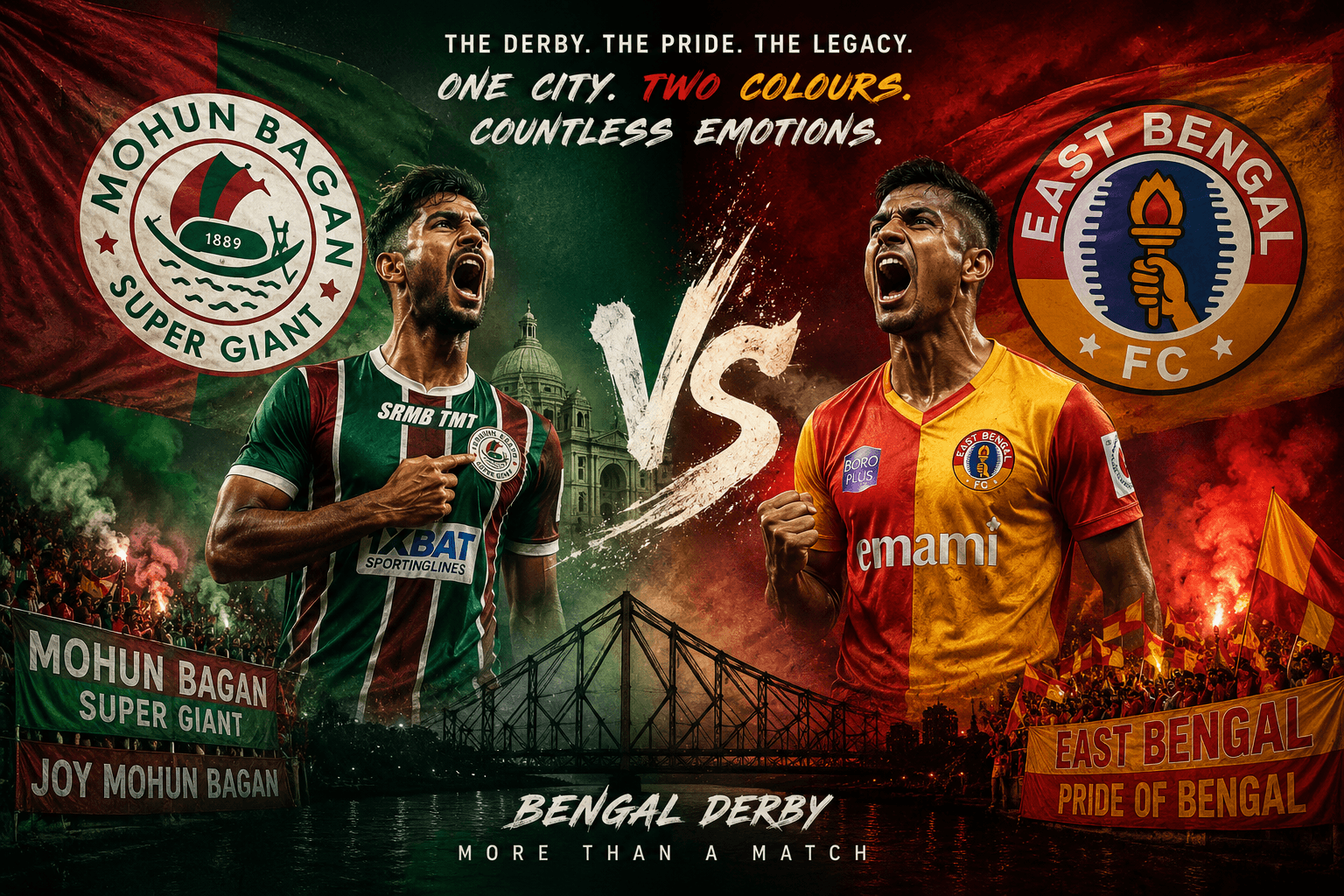
Dive into the fierce competition of Mohun Bagan vs East Bengal. Discover match highlights, player stats, and the passion that fuels this legendary rivalry.
By Trending News Fox, News & Media Team, Kolkata
What Makes Mohun Bagan vs East Bengal a Classic Rivalry?
For more than a century, when the green-and-maroon half of Kolkata collides with the red-and-gold half, time slows down across West Bengal. The Kolkata Derby, locally known as the Boro Match (The Big Match), transcends standard sport. It isn’t merely a 90-minute game of football played at the colossal Vivekananda Yuba Bharati Krirangan (Salt Lake Stadium). It is a profound, living, breathing sociological phenomenon deeply woven into the cultural, political, and emotional fabric of Indian football.
Whether it is fought on the muddy pitches of the Calcutta Football League (CFL) or under the glittering floodlights of the Indian Super League (ISL), Mohun Bagan Super Giant vs East Bengal FC remains Asia’s greatest football rivalry. But what exactly converts this fixture into an immortal classic? To understand the madness, one must dig deep into the history, the cultural identity, the generational culinary wars, and the sheer competitive drama that defines this timeless feud.
The Historical Divide: Ghotis vs Bangals
The root of this intense rivalry is not born of a simple geographical neighborhood dispute; it stems from a profound demographic split in Bengali society.
- Mohun Bagan (The Establishment): Founded in 1889, Mohun Bagan is one of the oldest existing football clubs in Asia. They achieved immortal status in 1911 by defeating the East Yorkshire Regiment to lift the IFA Shield—a victory that doubled as a seminal moment for Indian nationalism. Historically, Mohun Bagan became the team of the Ghotis—the native, indigenous residents of western Bengal. They represented the established, affluent, and traditional elite of Calcutta. Their logo, a country boat with its sails up, symbolizes navigating seamlessly through the currents of time.
- East Bengal (The Immigrants): The birth of East Bengal FC in 1920 was an act of defiant protest. When Suresh Chandra Chaudhuri, a vice-president of the Jorasanko-based club Jorabagan, found his star player Sailesh Bose excluded from a lineup against Mohun Bagan, he severed ties in frustration. Partnering with other stalwarts, he established a club dedicated to representing the people from the eastern districts of Bengal (now Bangladesh)—the Bangals. Following the partition of India in 1947, millions of refugees migrated to Calcutta, facing intense socioeconomic alienation. East Bengal FC became their rallying cry, their identity, and their primary vehicle for social validation. Their emblem—a burning torch (Mashal)—signified the fierce desire to conquer adversity and dispel darkness.
Thus, every derby became a symbolic struggle between the established local elite (Ghotis) and the resilient, fighting immigrants (Bangals). When these teams stepped onto the pitch, it was a battle for respect, survival, and societal bragging rights.
Culinary Warfare: Ilish vs Chingri
Nowhere else in the world is a sporting rivalry so intrinsically tied to the local fish market. In Bengal, football passion is matched only by an appetite for fine food, giving rise to the legendary Kolkata Derby fish wars.
The Rule of the Market: The morning after a derby, the victory is celebrated not just with firecrackers, but on the dinner table.
| Winning Team | Associated Delicacy | Cultural Symbolism |
| East Bengal | Ilish (Hilsa Fish) | Grown abundantly in the rivers of Padma and Meghna in eastern Bengal; symbolizes Bangal heritage. |
| Mohun Bagan | Golda Chingri (Jumbo Prawns) | Traditional favorite of Western Bengal; represents Ghoti affluence and luxury. |
If East Bengal wins, the market price of Ilish sky-rockets to astronomical figures within hours, yet fishmongers sell out instantly. If Mohun Bagan emerges victorious, the local markets are flooded with fans hoarding Chingri. The losing side is left to quietly consume Pui Shak (Malabar spinach) or Aloo Posto in bitter silence. This culinary connection ensures that the derby dominates domestic households long after the final whistle blows.
A Century of Historic Milestones and Records
The sheer competitive balance between the two powerhouses has kept the rivalry alive for over 105 years. Across 350+ official meetings in competitions like the Durand Cup, IFA Shield, Federation Cup, and the ISL, the statistical margins remain razor-thin.
The Historic 5-0 and the Boat Escape (1975)
The 1970s belonged completely to the Red-and-Gold Brigade. East Bengal went undefeated against their rivals for a staggering 1,932 consecutive days. This dominant run culminated on September 30, 1975, when East Bengal dismantled Mohun Bagan 5-0 in the IFA Shield final—the largest margin of victory in derby history. The defeat caused such massive fan outrage that several traumatized Mohun Bagan players reportedly spent the night hidden on a boat in the Ganges River to escape the wrath of their own supporters.
The 131,000+ Epic of 1997
On July 13, 1997, the Federation Cup semi-final at the Salt Lake Stadium recorded an unofficial attendance of 131,781 spectators—a record for any sporting event in India. The match pitted the legendary tactical mastermind Amal Dutta (pioneer of the Diamond Formation in India) against his fierce coaching rival PK Banerjee. The game turned into the ultimate breakthrough match for Indian icon Bhaichung Bhutia, who scored a magnificent hat-trick to power East Bengal to a historic 4-1 victory. Bhutia still stands as the all-time top scorer in Kolkata Derby history with 19 goals.
The Modern Era: The ISL Renaissance
With both clubs eventually transitioning into the modern franchise ecosystem of the Indian Super League (ISL), the Kolkata Derby received a massive global platform.
Initially, the modern era belonged firmly to the Mariners. Following their transition under the franchise model, the Mohun Bagan Super Giant established absolute dominance, registering a historic streak of consecutive victories over their arch-rivals in the ISL. Memorable moments, like 17-year-old Kiyan Nassiri (son of East Bengal legend Jamshid Nassiri) coming off the bench to score a stunning second-half hat-trick in January 2022, added fresh lore to the green-and-maroon history books.
However, the competitive balance has leveled out entirely. East Bengal, revitalized under precise tactical systems, has fought their way back to the upper echelons of Indian football.
Current Standings & High-Stakes Drama (May 2026)
The raw intensity of this classic rivalry was on full display just yesterday, on May 17, 2026, when the two giants played out a nerve-shredding 1-1 draw in front of a roaring, sold-out crowd at the Salt Lake Stadium.
Current ISL Table Context (Top Contenders)
==============================================
1. East Bengal FC       | 23 Pts | GD: +18
2. Mohun Bagan SG       | 23 Pts | GD: +13
3. Mumbai City FC       | 22 Pts
4. Punjab FC            | 22 Pts
With the 2025-26 ISL league shield race coming down to the wire, both clubs are deadlocked at the top with 23 points each from 12 matches. East Bengal maintains a razor-thin advantage due to a superior goal difference (+18 to Mohun Bagan’s +13). This current hyper-competitive parity ensures that the century-old rivalry isn’t a nostalgic look at the past—it is actively shaping the absolute pinnacle of modern Indian football.
Conclusion: More Than Just a Game
While European football boasts the intense drama of El Clásico or the bitter hostility of the Old Firm, the Kolkata Derby matches them blow-for-blow in raw emotion, heritage, and atmosphere. It survived the transition from a fractured post-partition landscape into a multimillion-dollar modern corporate league, without losing an ounce of its foundational soul.
The Mohun Bagan vs East Bengal rivalry is a classic because it serves as an living archive of Bengal’s history. It is an inheritance passed down through generations—a sacred vow renewed every time a child puts on a red-and-gold or green-and-maroon jersey. As long as football is played in the subcontinent, the Boro Match will remain the ultimate showcase of the beautiful game in India.
Also, read What Are the Historical Results of KKR vs GT?
Frequently Asked Questions (FAQ): Mohun Bagan vs East Bengal
Mohun Bagan vs East Bengal: General & Historical Origins
What is the Kolkata Derby?
The Kolkata Derby, known locally as the Boro Match (The Big Match), is the historic football rivalry between Kolkata’s two iconic clubs: Mohun Bagan and East Bengal. Spanning over a century, it is widely recognized as Asia’s greatest and most intensely contested football rivalry.
Why is the rivalry called a demographic split between “Ghotis” and “Bangals”?
The roots of the rivalry lie deep within Bengali socio-cultural identity:
- Mohun Bagan represents the Ghotis—the original, native inhabitants of Western Bengal, historically associated with the local affluent establishment.
- East Bengal represents the Bangals—the immigrant and refugee population that migrated from Eastern Bengal (now Bangladesh), especially around the partition of India in 1947. The club became their voice and vehicle for social identity.
When was the first official match played between the two teams?
The very first official competitive encounter took place on August 8, 1921, in the Cooch Behar Cup, which ended in a 0-0 draw.
Mohun Bagan vs East Bengal: Head-to-Head Records & Statistics
Who has won more Kolkata Derbies?
Historically, East Bengal holds the edge in the overall official head-to-head records across major competitive fixtures (including the ISL, Durand Cup, IFA Shield, and Federation Cup).
- Total Matches: 349
- East Bengal Wins: 129
- Mohun Bagan Wins: 105
- Draws: 115
- Goals Scored: East Bengal (324) | Mohun Bagan (286)
(Note: Total counts vary slightly depending on whether minor local tournaments and walkovers are included, but East Bengal retains the historic lead in competitive match wins).
What is the highest attendance ever recorded for a Kolkata Derby?
The record was set on July 13, 1997, during a Federation Cup semi-final match at the Salt Lake Stadium. An astonishing, unofficial crowd of 131,781 spectators packed the venue, making it one of the most attended sporting events in Asian history.
What is the biggest margin of victory in a derby?
The largest victory belongs to East Bengal, who famously defeated Mohun Bagan 5-0 in the IFA Shield Final on September 30, 1975.
Who is the all-time top goalscorer in the Kolkata Derby?
The legendary Indian striker Bhaichung Bhutia holds the record with 19 goals scored in the derby. Remarkably, he scored for both sides during his career, netting 13 goals for East Bengal and 6 for Mohun Bagan.
Mohun Bagan vs East Bengal: Cultural Superstitions & Fan Lore
What is the significance of “Ilish” and “Chingri” in the derby?
The culinary rivalry is just as fierce as the football match. The morning after a derby, the winning fans celebrate by rushing to the local fish markets:
- An East Bengal victory triggers a massive demand for Ilish (Hilsa), the traditional favorite fish of East Bengal (Bangals).
- A Mohun Bagan victory sees fans sweep up Golda Chingri (Jumbo Prawns), a delicacy associated with West Bengal (Ghotis).
Where is the Kolkata Derby played?
While historically played on the iconic Maidan club grounds, the modern-day high-stakes derbies are held at the massive Vivekananda Yuba Bharati Krirangan (Salt Lake Stadium) in Kolkata, which holds a capacity of around 68,000 to 85,000 depending on configurations.
Mohun Bagan vs East Bengal: Modern Era & ISL Context
When did the teams enter the Indian Super League (ISL)?
Both giants officially joined the top-tier Indian Super League ahead of the 2020–21 season, transitioning the historic rivalry into the modern, corporate franchise era of Indian football.
What is the latest result between the two sides?
The two powerhouses played out a dramatic 1-1 draw on May 17, 2026 at the Salt Lake Stadium. A late 85th-minute breakthrough by East Bengal’s Edmund Lalrindika was canceled out by a dramatic 90th-minute equalizer from Mohun Bagan’s Jason Cummings, keeping the current ISL title race incredibly tight.