Unlock the secrets to mastering computer science in the age of AI. From essential data structures to high-paying niches like Machine Learning and Cybersecurity, this 2026 guide covers everything you need to become a top-tier engineer.
By The Trending News Fox, Web News & Media Team, Wednesday 21st January, 2026
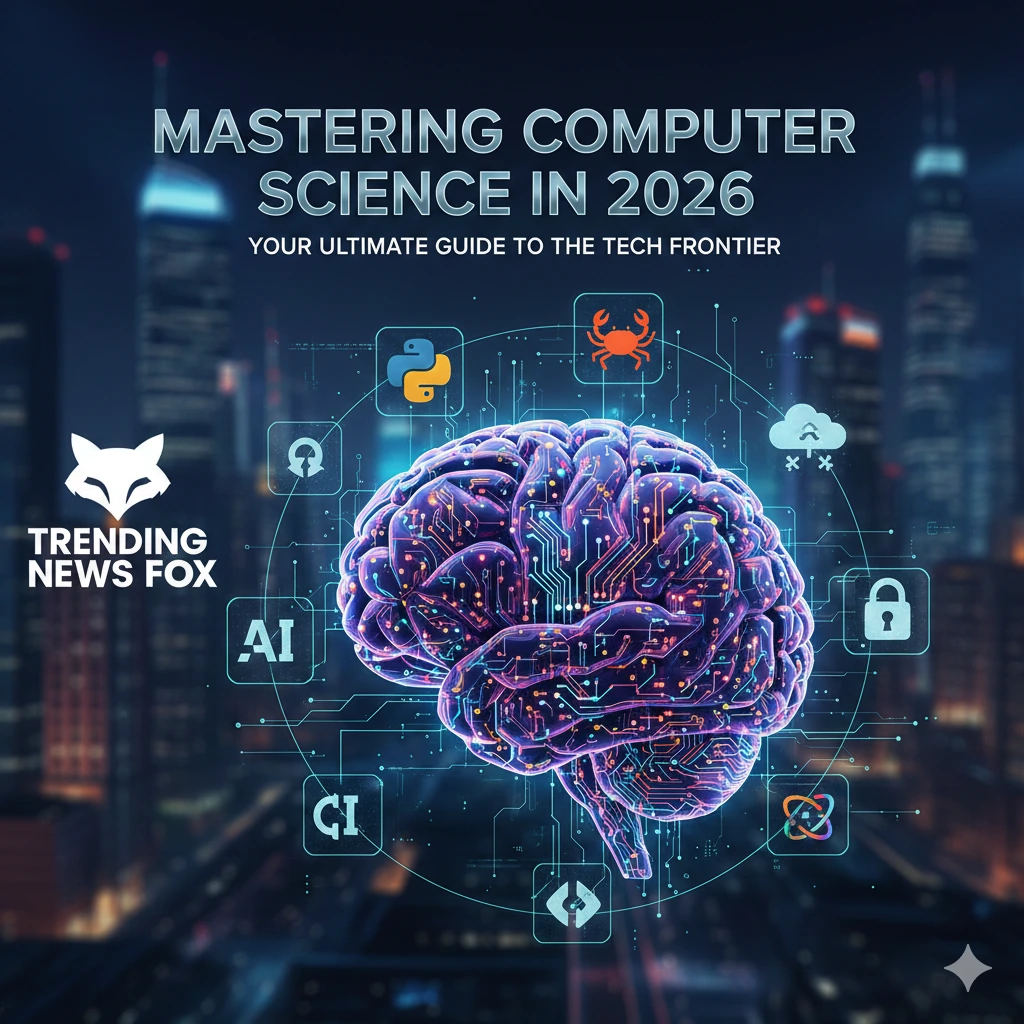
Mastering Computer Science in 2026: Your Ultimate Guide to the Tech Frontier
In the rapidly shifting landscape of 2026, the definition of “mastering computer science” has undergone a radical transformation. We are no longer in an era where knowing a few syntax rules or having a degree is enough. As Artificial Intelligence (AI) becomes the primary interface for coding and system management, the true masters of computer science are those who bridge the gap between foundational theory and cutting-edge automation.
Whether you are a student, a career switcher, or a seasoned developer looking to stay relevant, this guide provides a strategic roadmap to mastering computer science in the age of AI.
1. The Core Foundations: Why Basics Matter More Than Ever
It is a common myth in 2026 that AI makes learning fundamentals unnecessary. In reality, the opposite is true. When AI generates 80% of your boilerplate code, your value lies in the 20% that requires deep architectural understanding.
Mastering Computer Science: Data Structures and Algorithms (DSA)
Mastering the efficiency of code is non-negotiable. You must understand how to optimize memory and time complexity, especially as data sets grow into the petabyte range. Focus on:
- Graph Theory: Essential for social networks and recommendation engines.
- Tree Structures: The backbone of databases and file systems.
- Dynamic Programming: Solving complex problems by breaking them into simpler sub-problems.
Mastering Computer Science: Operating Systems and Networking
To build “Cloud-First” applications, you must understand the environment they live in. Mastering Concurrency, Memory Management, and TCP/IP protocols allows you to debug distributed systems that AI-only “coders” cannot fix.
2. The 2026 Tech Stack: Essential Skills
The “Full Stack” developer of today is expected to be an “AI-Integrated” developer. Mastering computer science now requires proficiency in several emerging domains.
| Category | Must-Know Technologies | Why It’s Vital |
| Languages | Python, Rust, TypeScript, Mojo | Rust for safety; Mojo for AI-specific performance. |
| AI/ML | PyTorch, LangChain, Vector Databases | Integrating LLMs into functional apps is a top 2026 skill. |
| Cloud/DevOps | Kubernetes, AWS/Azure, Terraform | Companies are moving from “Cloud-using” to “Cloud-native.” |
| Cybersecurity | Zero Trust, Ethical Hacking, IAM | As AI-driven threats rise, security is everyone’s job. |
3. The Shift to “Hybrid Engineering”
The most sought-after professionals in 2026 are Hybrid Engineers. These are individuals who possess deep technical expertise but also excel in “Human-Centric” skills.
- Prompt Engineering & AI Orchestration: Learning to treat AI models as “junior developers” who need precise instructions.
- System Architecture: Designing modular systems that are resilient, scalable, and easy to maintain.
- Technical Communication: The ability to explain complex trade-offs to stakeholders. In an automated world, being the person who can “think clearly” is a superpower.
4. Specializing in High-Growth Niches
While being a generalist is good for entry-level roles, mastery requires a “T-shaped” skill set: broad knowledge with deep expertise in one area.
Mastering Computer Science: Artificial Intelligence & Machine Learning
Demand for AI talent is expected to cross 1 million roles by late 2026. Mastery here isn’t just about using APIs; it’s about understanding Retrieval-Augmented Generation (RAG), fine-tuning models, and managing “ModelOps.”
Mastering Computer Science: Cybersecurity and Ethical Hacking
With cyber threats becoming more sophisticated through automation, the need for ethical hackers is at an all-time high. Mastering network security, encryption, and threat intelligence is a recession-proof career path.
Mastering Computer Science: Edge and Quantum Computing
While still emerging, Edge computing (processing data close to the source) is vital for the Internet of Things (IoT). Quantum computing is also beginning to crack problems in drug discovery and encryption that traditional computers cannot handle.
5. Practical Learning: Building Your Portfolio
Degrees are no longer the sole proof of readiness. In 2026, recruiters value proof of work over paper credentials.
- Open Source Contributions: Use GitHub to contribute to real-world projects. It shows you can work in a team and handle a complex codebase.
- Build “End-to-End” Projects: Don’t just build a frontend. Build a system that uses a cloud database, integrates an AI API, and is deployed via a CI/CD pipeline.
- The “Dev” Community: Platforms like DEV Community and Stack Overflow are essential for staying updated on the “unwritten” rules of modern coding.
6. The Learning Roadmap for 2026
If you are starting today, follow this 12-month mastery plan:
- Months 1-3: Foundations. Learn Python or Rust. Master basic algorithms and data structures.
- Months 4-6: Systems & Web. Understand how the web works (HTML/CSS/JS) and dive into databases (SQL/NoSQL).
- Months 7-9: AI & Data. Learn data manipulation and how to integrate LLMs into applications using frameworks like LangChain.
- Months 10-12: Architecture & Deployment. Learn Docker, Kubernetes, and AWS. Build and deploy a major capstone project.
7. Conclusion: The Mindset of a Master
Mastering computer science in 2026 is less about memorizing code and more about problem-solving at scale. The field moves too fast for static knowledge. The true masters are those who have a “permanent beta” mindset—always learning, always building, and always questioning how to make systems more efficient.
The tech industry is moving toward a future where AI handles the “how” and humans handle the “why.” By mastering the fundamentals and embracing the tools of the future, you won’t just find a job—you’ll build the future.
Ready to Start Your Journey?
Also, read Sustainable Fashion Innovation 2026: The Tech Redefining Style
Here are the most frequently asked questions about mastering computer science in 2026. This FAQ is designed to address the common concerns of students and professionals navigating the AI-driven tech landscape.
Mastering Computer Science: 2026 FAQ
1. Is a Computer Science degree still worth it in 2026?
Yes. While self-taught paths and bootcamps are viable for learning specific tools, a CS degree remains highly valuable for its focus on systems-level thinking and foundational theory. In 2026, employers are moving away from hiring “syntax coders” and toward “engineering architects” who understand how hardware, operating systems, and AI models interact at a deep level.
2. Will AI replace Computer Science jobs?
AI is not replacing computer scientists; it is transforming the role. Routine tasks like writing boilerplate code or basic debugging are increasingly automated. However, this has created a massive surge in demand for professionals who can manage AI Orchestration, design complex system architectures, and ensure AI ethical compliance. The “Master” of 2026 uses AI as a productivity multiplier, not a replacement.
3. Which programming languages should I prioritize in 2026?
While the “best” language depends on your niche, the 2026 industry leaders are:
- Python: The undisputed king of AI and Data Science.
- Rust: Increasingly preferred for system-level programming due to its memory safety features.
- TypeScript: The standard for building robust, scalable web applications.
- Mojo: A rising language specifically designed to bridge the gap between Python’s ease of use and C++’s performance in AI environments.
4. What is the “most important” skill for a CS student right now?
Beyond coding, the most critical skill is Problem Decomposition. With AI able to generate code instantly, the bottleneck is no longer how to code, but what to build and how to break a massive, complex problem into smaller, logical parts that an AI can help solve correctly.
5. Do I need to be a “math genius” to master Computer Science?
Not necessarily, but you cannot avoid it entirely. Mastery in 2026 requires a solid grasp of Discrete Mathematics (for logic and algorithms) and Linear Algebra/Calculus (if you plan to specialize in Machine Learning). For general software engineering, logical reasoning is more important than advanced calculus.
6. How do I make my portfolio stand out in an AI-saturated market?
Recruiters in 2026 are tired of seeing generic “AI-generated” clones. To stand out:
- Show the “Why”: Document your decision-making process. Why did you choose this database over that one?
- Proof of Work: Contribute to Open Source projects.
- Edge Cases: Show how your project handles failures or unexpected data—areas where simple AI-generated code often fails.
7. What are the highest-paying niches in 2026?
The highest salaries are currently found in:
- AI/ML Engineering: Designing and fine-tuning large-scale models.
- Cybersecurity (Ethical Hacking): Protecting systems against automated, AI-driven threats.
- Cloud Architecture: Managing global, distributed infrastructures on AWS, Azure, or Google Cloud.
- Agentic AI Development: Building autonomous AI “agents” that can perform multi-step tasks.
Also, read Ranji Trophy 2026 Live: Points Table, Scores & Phase 2 Knockout Updates
saibal.bose.how36@gmail.com. (2026ae, January 21). Mastering Computer Science in 2026: The Ultimate Career Roadmap. Trending News Fox. https://trendingnewsfox.com/mastering-computer-science-in-2026-the-ultimate-career-road/