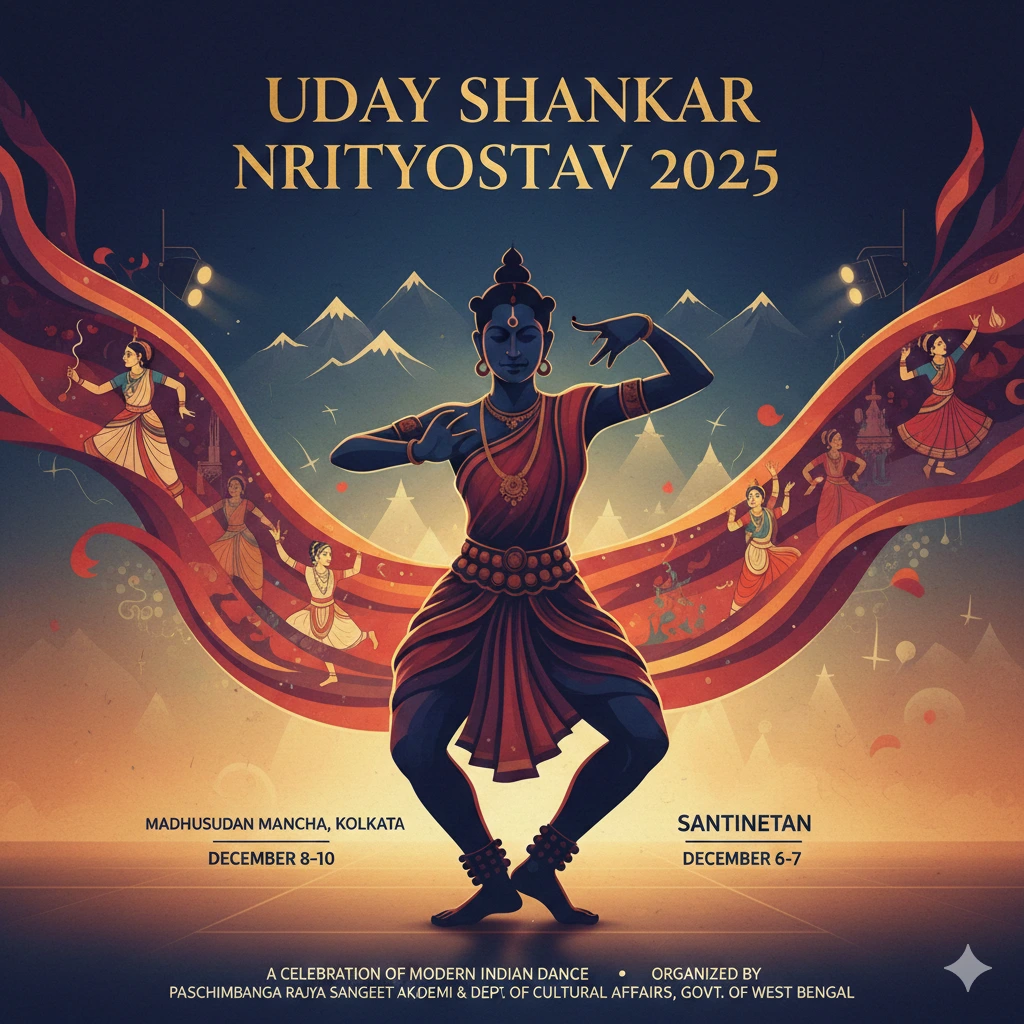
Experience the vibrant Uday Shankar Nrityotsav, a celebration of classical dance and culture. Join us for mesmerizing performances and artistic excellence.
💃 Uday Shankar Nrityotsav: Celebrating the Pioneer of Modern Indian Dance
The Uday Shankar Nrityotsav (Dance Festival) continues its tradition as a significant cultural event, paying a vibrant homage to the legendary dancer and choreographer, Uday Shankar, widely regarded as the Father of Modern Indian Dance. This annual festival, typically organized by institutions like the Paschimbanga Rajya Sangeet Akademi and the Information & Cultural Affairs Department, Government of West Bengal, showcases the enduring influence of his innovative, fusion-based style.
🗓️ Uday Shankar Nrityotsav: Latest Festival Highlights (2025 Updates)
Based on recent announcements and tenders by the Department of Information & Cultural Affairs, Government of West Bengal, the festival appears set to continue its annual tradition in the December timeframe, coinciding with the maestro’s birth month.
- Anticipated Main Dates & Venue: The Uday Shankar Nrityotsav is tentatively scheduled for December 8th to 10th, 2025, at the Madhusudan Mancha in Kolkata.
- Decentralized Events: In a move to expand the reach of the festival, events were also noted to have taken place in other locations, such as a prior phase held in Santiniketan on December 6th and 7th, 2025. This effort aims to promote the performing arts and provide a platform for artists outside the major metropolitan area.
Note: Official dates and schedules are usually finalized and announced closer to the event by the organizing body.
🎭 Uday Shankar Nrityotsav: A Platform for Dance Organizations
The festival serves as a crucial platform for numerous dance organizations from Kolkata and surrounding districts. The 2024 edition, for example, saw participation from approximately 24 dance organizations, underscoring its role in fostering the wider dance community.
The event generally features:
- Classical Performances: Showcasing Indian classical dance forms that often inspired Shankar.
- Contemporary & Fusion Works: Performances that directly reflect Uday Shankar’s legacy of blending Indian and Western theatrical techniques.
- Homage and Inauguration: The festival often features the presence of eminent dance personalities, including members of the Shankar family, such as Mamata Shankar, who actively promote the maestro’s vision.
💡 Uday Shankar Nrityotsav: The Enduring Legacy of Uday Shankar
The Nrityotsav is more than just a dance show; it is a commemorative event that reinforces Uday Shankar’s pivotal role in cultural history:
- Pioneer of Fusion Dance: Shankar was a pioneer in adapting European stagecraft and lighting to traditional Indian dance, creating a unique “Hindo Ballet” style.
- Global Popularity: He took Indian dance to international audiences in Europe and the United States in the 1920s and 30s.
- Cultural Hubs: He established the Uday Shankar India Cultural Centre in Almora, which became a training ground for several future legends of Indian dance and music.
The Uday Shankar Nrityotsav ensures that his innovative spirit continues to inspire and inform the next generation of dancers, keeping the evolution of Indian stage performance alive.
Also, read Ind vs SA 3rd ODI: Battle for the Series Decider Heats Up
The Uday Shankar Nrityotsav is a major showcase for dance talent in West Bengal.
The latest festival, which took place in December 2024, featured a diverse lineup of dance organizations across its two main phases in Santiniketan and Kolkata.
🌟 Featured Organizations and Performers (2024)
The festival saw participation from approximately 24 dance organizations in total. The most prominent groups and individuals highlighted included:
| Performance Focus | Dance Organizations Mentioned | Key Details |
| Inaugural Performance | Mamata Shankar Dance Company | Led by Uday Shankar’s daughter, Mamata Shankar, this company often performs an inaugural or headline piece, embodying the direct legacy of the Uday Shankar style. |
| Leading Participants (Day 1) | * Dancers’ Guild | A well-known institution in Kolkata’s dance circuit. |
| * Anandadhara | ||
| * Shilpa Bitan | ||
| * Suchana | ||
| Leading Participants (Day 2) | * West Bengal Dance Group Federation | A collaborative group, often acting as an organizer/contributor to the overall event. |
| * Nritya Upasana | ||
| * Anandadhwani | ||
| * Steps and Rhythm |
The overall event was also inaugurated by Mamata Shankar, alongside other eminent personalities like Parbati Gupta, Chandradoy Ghosh, Jonaki Sarkar, Pradipto Niyogi, and Amit Adhikari.
The festival’s aim was to provide a platform not just for Kolkata-based groups, but also for talented organizations from other districts of West Bengal, keeping with the spirit of the state-level organization.
As the genius of Uday Shankar lies in his unique, revolutionary style, which is often referred to as Creative Dance or Hi-Dance.
Uday Shankar is widely hailed as the Father of Modern Indian Dance because he broke away from the rigid, traditional frameworks of classical dance to create a more expressive and theatrical form.
Here are the key elements of the Uday Shankar style:
1. 💫 Fusion and Synthesis (The Core Philosophy)
The fundamental characteristic of his dance is its fusion of Eastern and Western elements.
- Indian Inspiration: He drew heavily on the poses, grace, and themes of Indian classical and folk dances (like Kathakali, Bharatanatyam, and Manipuri), as well as the iconography of Indian sculpture and painting (such as the Ajanta Caves frescoes).
- Western Theatricality: His time spent in Europe, particularly his work with the famous Russian ballerina Anna Pavlova, exposed him to Western stagecraft, lighting, and costume design. He adapted these techniques to make Indian dance dramas visually spectacular and accessible to a global audience.
2. 🤸 Freedom and Expression (Movement Vocabulary)
Unlike classical dance, which follows strict rules (like the araimandi stance or codified mudras), Shankar prioritized the body’s natural flow and expressive potential.
- Flowing Movements: The style emphasizes fluidity, spontaneity, and expressive body language over technical footwork or rhythmic complexity (tala).
- Emotional Narrative: His choreography is strongly narrative-driven, using dance to tell stories, often based on Indian mythology, folklore, or social commentary (like his famed production, Labour and Machinery). The focus is on the emotional and visual impact.
- Minimal Hand Gestures (Abhinaya): While classical forms rely heavily on detailed hand gestures (hasta abhinaya), Shankar’s style uses them more broadly and intuitively to convey meaning.
3. 🎶 Integrated Music and Staging
Shankar was a pioneer in creating music specifically for his ballets, rather than relying on pre-existing classical compositions.
- Creative Music: He collaborated with maestros like Ustad Allauddin Khan and Vishnudass Shirali to compose unique “sound images” that blended Indian and European musical structures to match the creative movements.
- Set and Costume Design: His productions were revolutionary for their use of elaborate, imaginative sets, dramatic lighting, and vibrant costumes, creating a rich, immersive theatrical experience.
In essence, Uday Shankar’s style is an Indian Creative Dance—a non-traditional, yet profoundly Indian art form that balances the spiritual and aesthetic essence of India with the universal appeal and theatrical grandeur of modern stage performance. The artists at the Nrityotsav continue to uphold this legacy of innovation and dramatic storytelling.
Uday Shankar’s full-length productions were not just dance shows; they were powerful cultural and social statements that defined the term “Indian Ballet.”
Two of his most famous and impactful works are the film Kalpana and the dance-drama Labour and Machinery.
🎬 1. Kalpana (Imagination) – 1948
Kalpana (meaning “Imagination” or “Fantasy”) is Uday Shankar’s only feature film, which he wrote, directed, and starred in alongside his wife, Amala Shankar. It is considered a landmark in world cinema for its unique blend of dream, reality, and non-stop dance.
| Key Aspect | Details |
| Genre | Dance-Drama, Musical, Surrealist Film |
| Plot | The film is framed by Udayan (Uday Shankar), a young idealist, pitching his dream project to a greedy, box-office-obsessed film producer. The main narrative is Udayan’s dream: his lifelong quest to establish a national academy of dance (a reflection of Shankar’s own Almora Centre) that would liberate and redefine Indian art for a newly independent nation. |
| Themes | Art vs. Commerce (The conflict between the pure artist and the exploitative businessman); Social Critique (The film contains dream sequences that critique colonialism, industrial greed, the class system, and exploitation); Vision for New India (A call for an India where art and culture are the foundation of society). |
| Significance | It is essentially a cinematic portfolio of Uday Shankar’s entire artistic philosophy and choreography. It uses incredible stagecraft, surreal visual effects, and dance to convey its political and social messages, making it a masterpiece of early Indian art cinema. |
| Legacy | The film was digitally restored by Martin Scorsese’s World Cinema Project in 2008, recognizing its immense historical and artistic value. |
⚙️ 2. Labour and Machinery
Labour and Machinery is a powerful, politically charged dance-drama that perfectly exemplifies Shankar’s fusion style to deliver social commentary.
| Key Aspect | Details |
| Genre | Abstract / Creative Dance Ballet |
| Plot | The ballet juxtaposes two worlds: the natural, rhythmic life of the rural Indian villager (Labour) and the harsh, mechanical, soul-crushing force of industrialization (Machinery). The dance dramatizes the transition from an agrarian society to a rapidly industrializing one, and the ensuing exploitation of the workers. |
| Choreography | The choreography is a striking display of contrast: |
| * Labour (Villagers): Movements are fluid, organic, and rooted in Indian folk and nature-inspired dance, expressing human emotion and community. | |
| * Machinery (Workers/Factory): Movements are sharp, angular, and robotic. Dancers often move in mechanical unison, mimicking the cold, relentless rhythm of cogs, pistons, and gears, showing how humans are reduced to mere cogs in the system. | |
| Significance | It was one of the first major non-traditional dance pieces to take a contemporary social issue as its central theme, showing that Indian dance could be used for profound social and political commentary, not just mythological storytelling. A famous sequence from this ballet was later incorporated into the dream sequences of the Kalpana film. |
These works cemented Uday Shankar’s position as a visionary who used dance to bridge continents, integrate ancient art forms with modern sensibilities, and articulate the dreams and struggles of a changing nation.
Uday Shankar’s collaboration with the legendary Russian ballerina Anna Pavlova was the true turning point that convinced him to abandon his career as a painter and dedicate his life to dance. It was the catalyst for his entire creative journey.
Here are the key details of their partnership:
🎭 The Catalyst: A Meeting of Worlds (1923)
- The Context: In the early 1920s, Uday Shankar was in London studying painting at the Royal College of Art. He had no formal training in classical Indian dance, but he was an enthusiast of the folk dances he had seen in India and was skilled in art.
- The Encounter: Shankar’s father, an amateur impresario, organized a charity performance where Uday performed a short, self-taught Indian-inspired dance piece. Anna Pavlova, the world’s most famous ballerina, was in the audience. She was captivated and was also looking for authentic Indian elements for her new production, Oriental Impressions.
- The Proposal: Pavlova recognized Shankar’s natural grace and his deep understanding of Indian art and iconography (he was translating Indian sculpture and painting into movement). She persuaded him to leave his painting studies to join her company and help her choreograph pieces on Indian themes.
🌟 Uday Shankar Nrityotsav: Their Famous Co-Creations
During their one-and-a-half-year partnership, Shankar worked with Pavlova and her company to co-choreograph and perform two seminal Indian-themed ballets for her production, Oriental Impressions:
- Radha and Krishna: This was a beautiful duet where Pavlova played Radha and Shankar played Krishna. It was a romantic, imaginative interpretation of the divine love story, using flowing movements and artistic poses inspired by Rajput and Mughal miniature paintings.
- A Hindu Wedding: This piece depicted scenes from a traditional Indian wedding ceremony. The music for this was often composed by Commalata Banerji, an Indian musician based in London.
🌎 Uday Shankar Nrityotsav: The Lasting Impact on Shankar’s Career
His time with Pavlova was invaluable, providing him with essential exposure and training that shaped his future style:
- Global Stagecraft: He learned about the technical requirements of the professional stage: lighting, elaborate costumes, set design, and theatrical presentation—all European techniques he later adapted to his Indian “Hi-Dance” or “Creative Dance.”
- A Call to Authenticity: Although he was learning Western ballet techniques, Pavlova famously advised him not to become a Western dancer. She encouraged him to “go back to India, study your own art, and develop your style from that heritage.”
- The Launch Pad: The critical acclaim he received as Pavlova’s partner provided him with instant global recognition, giving him the confidence and contacts needed to launch his own independent, world-touring company in Paris a few years later.
His collaboration with Anna Pavlova truly set the course for his life, transforming him from an art student into the pioneer of modern Indian dance.
The Uday Shankar India Cultural Centre in Almora was a brief but brilliant experiment that became the crucible for modern Indian dance, producing an entire generation of creative artists.
🏔️ The Vision: A Creative Utopia (1940–1944)
After achieving tremendous success touring the West, Uday Shankar realized that to sustain his unique style of dance, he needed a permanent institution in India. Inspired by his interactions with the art community at Dartington Hall in England, he sought to create a residential school far from urban distraction.
- Location: He chose Simtola, near Almora in the Himalayan foothills (then in the United Provinces, now Uttarakhand). This remote, serene location was intended to foster uninterrupted focus and creativity.
- Goal: The centre was conceived not just as a school, but as a holistic cultural institution (Sanskriti Kendra) to train dancers, musicians, and artists in all aspects of stage performance, focusing on creativity, improvisation, and composition rather than strict adherence to classical texts.
- Curriculum: The five-year course was incredibly comprehensive, covering:
- Shankar’s Creative Dance technique.
- Improvisation, Stagecraft, Lighting Design, and Costume Design.
- Traditional Indian forms (he invited gurus for Kathakali, Bharatanatyam, and Manipuri).
- Music composition (Indian and Western).
🌟 Uday Shankar Nrityotsav: The Gathering of Legends
The true magic of the Almora Centre lies in the incredible talent it gathered under one roof. It attracted a who’s who of future luminaries who would go on to shape India’s cultural landscape:
| Category | Famous Names Associated with the Centre |
| Dancers/Choreographers | Amala Shankar (Uday’s wife and dance partner), Zohra Sehgal (renowned actress and dancer), Uzra Butt, Narendra Sharma, Shanti Bardhan, Sachin Shankar, and Prabhat Ganguly. |
| Musicians | Pandit Ravi Shankar (Uday’s youngest brother, the legendary Sitar maestro, who was a student and musical collaborator), Ustad Allauddin Khan (master of the Sarod and Ravi Shankar’s guru, who directed the music department), and Vishnudass Shirali. |
| Film/Theatre | Guru Dutt (the iconic actor and filmmaker, who studied dance there), and Ruma Guha Thakurta. |
🛑 The Closure: A Short-Lived Dream
Despite its artistic success and the brilliance of its students, the Uday Shankar India Cultural Centre closed down after only about four years, in 1944.
The primary reason for its closure was a paucity of funds and financial strain. Maintaining such a large, remote, residential institution with a huge faculty and student body proved unsustainable, especially during the tumultuous years of World War II, which made international touring and fundraising difficult.
Though it was short-lived, the Almora Centre acted as a creative incubator. When it closed, its students dispersed across India, carrying Shankar’s spirit of creative freedom into every corner of the arts—from Bollywood filmmaking (Guru Dutt) to modern dance choreography (Shanti Bardhan and Narendra Sharma) and contemporary musical exploration (Ravi Shankar).
The original Uday Shankar India Cultural Centre at Simtola closed in 1944. The modern project, established by the government, is known as the Uday Shankar Academy for Dance and Music (sometimes called the National Theatrical Academy).
Here is the latest update and status of the new academy in Almora:
🏛️ The New Uday Shankar Academy at Falsima
The new academy is located at Falsima, a quiet area about 7 km from Almora town, and its creation was a long and difficult process:
- Foundation: The foundation stone for the new academy was laid by the former President of India, Dr. A.P.J. Abdul Kalam, in October 2002.
- Construction: The project, sanctioned with funding from both the Central and State governments (Uttarakhand), faced significant delays due to fund shortages and official apathy. The main building, including a large auditorium, was finally completed around 2015.
- The Big Question: Despite the completion of the physical structure, the key issue that plagued the project for years was clarity on its purpose and administration. The state government struggled to decide whether it should:
- Function as a fully independent, national-level Uday Shankar Dance and Music Academy, focused on his specific creative style.
- Be incorporated as the Department of Cultural and Performing Arts within a newly established residential university in Almora.
📅 Latest Status (2025)
The latest reports suggest that the building is now officially operational, at least for events and workshops, but its status as a dedicated, full-fledged residential ‘National Academy’ in the spirit of Uday Shankar’s original vision remains somewhat mixed:
- Current Use: The venue is known to host local cultural programs, including the celebration of Uday Shankar’s birth anniversary (December 8th) by the local Uday Shankar Sangeet and Natya Akademi unit and the Uttarakhand State Department of Culture.
- Focus on Local Arts: While the space is named after Shankar, there has been an emphasis on using the facility to promote local folk arts and Kumaoni theatre (Ramlila), alongside classical dance and music, which does align with Shankar’s philosophy of synthesis.
- Community Hub: The academy facility, with its spacious auditorium and art gallery, is now seen as a boon for budding artists and researchers in the Almora district, providing a platform for performances and research.
In summary, the dream of a large, continuously functioning, national-level residential academy dedicated exclusively to Uday Shankar’s creative dance technique in Almora, similar to his original vision, has been partially fulfilled with the completion of a grand physical structure. The facility now exists and is active, but its core function seems to have evolved into a State Cultural Centre/Auditorium that hosts diverse performing arts, paying homage to Uday Shankar’s legacy while also supporting local Kumaoni culture.
The Uday Shankar India Cultural Centre in Almora was absolutely critical in shaping the destiny of his younger brother, Pandit Ravi Shankar, transforming him from a dancer and performer into the legendary Sitar maestro we know today.
Here are the four major ways the Almora Centre influenced him:
1. 🛑 The Decision to Embrace Music (The Pivot)
Ravi Shankar, born Robindra Shankar, began his career at the age of 10 as a dancer and multi-instrumentalist in Uday Shankar’s professional troupe while they toured Europe. He was fully immersed in the world of Uday’s innovative dance-dramas for nearly a decade.
- The Turning Point: While touring with Uday’s troupe, the family met Ustad Allauddin Khan (the ‘Baba’ of Maihar), who was the music director for a short period. Ravi Shankar was deeply moved by the Ustad’s music and recognized his own deep calling to be a serious, disciplined classical musician.
- The Sacrifice: Uday Shankar, recognizing his brother’s immense potential and serious intent, encouraged him to make the drastic move: to give up the comfortable, glamorous life of a world-touring performer and dedicate himself entirely to the rigorous practice of Indian classical music. This decision to prioritize music marked the end of his career as a dancer.
2. 🎶 The Foundation of the Maihar Gharana (The Guru)
Uday Shankar brought Ustad Allauddin Khan, one of the century’s greatest music teachers, to the Almora Centre, cementing Ravi Shankar’s apprenticeship.
- Formal Taalim (Training): When the Uday Shankar India Cultural Centre opened in 1940, Ustad Allauddin Khan was appointed as the Head of the Music Department. This meant that Ravi Shankar, along with other music students, received intense, formal training (guru-shishya parampara) right there in Almora for part of the Centre’s duration.
- Discipline: The Almora Centre reinforced the strict discipline and devotion necessary for a classical artist, as Ustad Allauddin Khan was a famously demanding teacher. This period was formative in building the focus and stamina that defined Ravi Shankar’s lifelong career.
3. 🎻 Exposure to Synthesis and Orchestration (The Creative Spark)
Although Ravi Shankar left dancing, he never lost the influence of his brother’s artistic philosophy.
- Integrated Arts: Almora was designed to integrate all arts—dance, music, costume, and theatre. This environment instilled in Ravi Shankar a broader perspective than a traditional classical gharana might have, teaching him how music could be used to enhance a dramatic or visual narrative.
- Orchestration and Fusion: He saw his brother’s attempts to use Indian instruments in an orchestral setting. Later, as the Music Director for All India Radio and in his famous collaborations with Western musicians like Yehudi Menuhin and The Beatles, Ravi Shankar used this early exposure to effortlessly fuse and orchestrate Indian and Western musical forms, much like his brother had fused dance.
4. 🌟 Training a Generation of Artists (The Network)
The Almora Centre created a powerful network of contemporary Indian artists. The students who trained alongside Ravi Shankar went on to become major figures in modern Indian cinema, theatre, and dance, including Guru Dutt and Zohra Sehgal. This community laid the groundwork for the modern, professional arts scene in post-Independence India.
In essence, Uday Shankar gave Ravi Shankar two of the most critical things: the vision that Indian art had global potential and the guru (Ustad Allauddin Khan) who guided him to fulfill his own creative destiny.