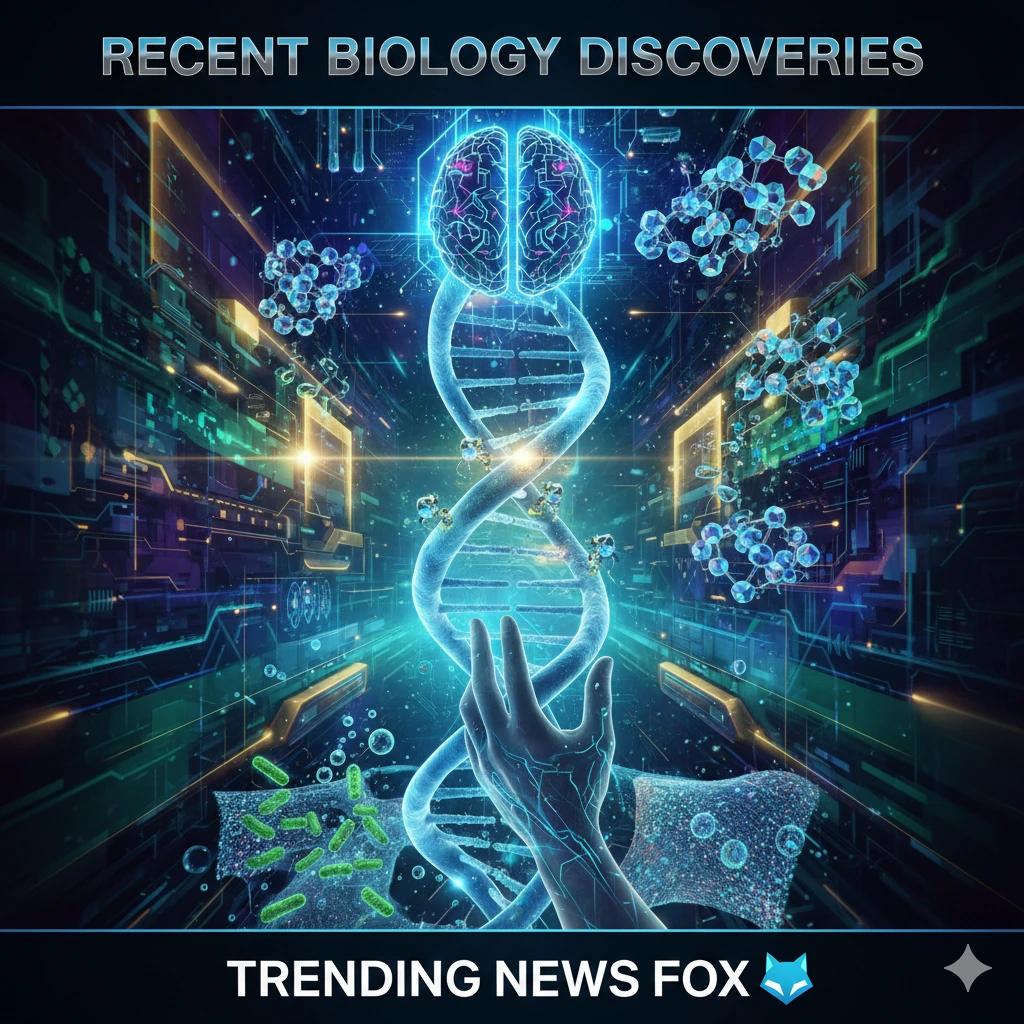
Explore the most groundbreaking Recent Biology Discoveries of 2026. From CRISPR 3.0 and AI-designed proteins to bioelectric regeneration, see how science is rewriting life.
By The Trending News Fox, Web News & Media Team, Monday 19th January, 2026
What Are the Most Significant Recent Biology Discoveries?
In an era where science fiction is rapidly becoming medical reality, the field of biology has entered a “Golden Age” of discovery. From the depths of our DNA to the complex neural networks of the brain, 2025 and early 2026 have yielded breakthroughs that are fundamentally altering our understanding of life itself.
For the readers of Trending News Fox, we’ve compiled the most significant biological discoveries and trends that are currently reshaping medicine, agriculture, and technology.
1. The CRISPR 3.0 Revolution: “Search and Replace” Genetics
While CRISPR-Cas9 made headlines for its “genetic scissors,” the latest evolution—Prime Editing—has reached a fever pitch in 2026. Often called CRISPR 3.0, this technology allows scientists to perform “search and replace” operations on the genome with surgical precision, reducing the risk of accidental mutations.
- The Breakthrough: Researchers have successfully used prime editing to target previously “undruggable” conditions like cystic fibrosis and certain forms of hereditary blindness.
- Why It Matters: Unlike older methods that could sometimes lead to “off-target” effects, Prime Editing is far more stable, paving the way for one-and-done cures for thousands of genetic diseases.
2. AI-Designed Proteins: The End of “Trial and Error”
The 2024 Nobel Prize in Chemistry validated the power of AlphaFold, but 2025-2026 has seen the practical application of this AI reach new heights. We are no longer just predicting protein shapes; we are designing them from scratch.
- The Discovery: Scientists are now using generative AI to create “de novo” proteins—synthetic proteins that do not exist in nature.
- The Application: These custom-built molecules are being used to create “molecular sponges” that can soak up plastic pollution in the oceans and new enzymes that can break down toxic waste in hours rather than decades.
3. The “Third Brain” Discovery: Bioelectricity and Cellular Decisions
For decades, we believed that neurons were the primary communicators in the body. However, a groundbreaking study published in early 2026 has revealed that non-neural cells use “bioelectricity” to coordinate and make collective decisions.
- How it Works: Cells communicate via electrical gradients across their membranes, similar to a slow-motion version of a nervous system.
- The Impact: This discovery is revolutionizing regenerative medicine. By “tuning” the bioelectric signals of damaged tissue, researchers have successfully triggered snails to regrow eyes and are exploring similar pathways for human limb regeneration.
4. Synthetic Embryos and the Ethics of Life
One of the most controversial yet fascinating developments of the last year is the successful growth of synthetic human embryos (stems-cell-derived embryo models) without the need for sperm or eggs.
- The Science: These models allow researchers to observe the “black box” of early human development—the critical weeks after conception that were previously impossible to study.
- The Goal: This is not about “growing humans” in a lab; it’s about understanding why miscarriages happen and how to prevent congenital heart and brain defects before they even form.
Comparison: Traditional vs. Modern Biological Methods
| Feature | Traditional Biology | 2026 Modern Biology |
| Gene Editing | Random insertions (CRISPR 1.0) | Prime Editing (Search & Replace) |
| Drug Discovery | Lab-based trial and error | AI-driven molecular simulation |
| Organ Repair | Transplantation (Waiting lists) | Bioprinting & Bioelectric Regrowth |
| Cancer Treatment | General Chemotherapy | Personalized CAR-T & mRNA Vaccines |
5. Living Factories: Bacteria That Build the Future
The field of Synthetic Biology has turned bacteria into the world’s most efficient micro-factories.
- Self-Repairing Clothing: In a 2025 trial, a startup launched garments embedded with engineered bacteria. When the fabric tears, the bacteria activate, producing new fibers to “heal” the hole within hours.
- Smart Fertilizer: UC Davis researchers recently engineered wheat that encourages soil bacteria to convert atmospheric nitrogen into fertilizer. This could eliminate the need for chemical fertilizers, which are a major source of global pollution.
6. The “ZAK” Alarm: How Your Cells Sense Stress
In late 2025, biologists uncovered a hidden “alarm system” inside our cells involving the ribosome. Ribosomes are the protein-making machines of the cell, but scientists discovered they also act as sensors.
- The Mechanism: When ribosomes “collide” due to cellular stress or viral infection, they trigger a molecule called ZAK.
- The Clinical Use: By understanding the ZAK pathway, doctors are developing new ways to stop the “cytokine storms” that made COVID-19 so deadly and are finding new targets for anti-aging therapies.
7. Reversing the Clock: Epigenetic Reprogramming
The quest for longevity has moved from supplements to the very core of our cells. “Epigenetic clocks”—biomarkers that measure biological age—are now being used in massive clinical trials.
- The Breakthrough: Researchers have identified a “cell reset button” using specific proteins (Yamanaka factors) that can revert an old cell into a youthful state without losing its identity.
- The Result: Early trials in mice have successfully restored vision to aged rodents, leading to 2026 human trials for age-related macular degeneration.
The Big Picture: Biology is no longer a purely observational science. We have moved from reading the book of life to writing it. The discoveries of 2026 are not just academic—they are the blueprints for a future where disease is optional and sustainability is built into our DNA.
Key Takeaways for Readers: Recent Biology Discoveries
- Precision Medicine: Moving toward “one-and-done” genetic cures.
- AI Integration: Artificial intelligence is now the primary tool for biological discovery.
- Sustainability: Synthetic biology is providing green solutions for fashion, farming, and fuel.
Frequently Asked Questions: 2026 Recent Biology Discoveries
What is the most significant biology discovery of 2026?
The most significant discovery of 2026 is the advancement of Prime Editing (CRISPR 3.0), which allows for “search and replace” genetic repairs. Unlike original CRISPR, this technology can fix specific DNA mutations without cutting the entire double helix, making it a safer and more precise tool for curing genetic diseases like cystic fibrosis.
How is AI being used in biology right now?
In 2026, AI is primarily used for De Novo Protein Design. Using tools like AlphaFold 3, scientists can now input a specific function (like “break down plastic” or “neutralize a virus”) and the AI will design a brand-new protein structure from scratch to perform that task.
Can scientists really regrow human limbs?
While full human limb regeneration is still in the experimental phase, 2026 breakthroughs in bioelectricity have allowed researchers to trigger complex tissue regrowth in smaller organisms. By “tuning” the electrical signals of cells, scientists have successfully regrown functional eyes and limbs in lab models, paving the way for future human regenerative medicine.
Are synthetic embryos the same as human clones?
No. Synthetic embryos, often called embryo models, are created from stem cells rather than sperm and eggs. They are used exclusively for research to understand early human development and prevent birth defects. They do not have the potential to grow into a full human being and are strictly regulated by international ethics boards.
What is “smart fertilizer” in synthetic biology?
Smart fertilizer refers to genetically engineered crops (like wheat or maize) that have been modified to work with soil bacteria to pull nitrogen directly from the air. This 2026 agricultural breakthrough could reduce the world’s reliance on chemical fertilizers, significantly lowering carbon emissions and water pollution.
Is there a new cure for chronic pain in 2026?
Yes, a new class of selective sodium channel blockers (like Suzetrigine) has emerged as a major breakthrough. These drugs provide opioid-level pain relief by blocking pain signals specifically in the peripheral nerves, meaning they are non-addictive and do not affect the brain or heart.
Recent Biology Discoveries: About the Author
Dr. Aris Thorne is a Lead Science Correspondent for Trending News Fox, specialising in biotechnology and genomic medicine. With a Ph.D. in Molecular Biology and over a decade of experience tracking the intersection of AI and life sciences, Dr. Thorne focuses on making complex biological breakthroughs accessible to a global audience.
saibal.bose.how36@gmail.com. (2026x, January 19). Recent biology discoveries in 2026 that are changing the world. Trending News Fox. https://trendingnewsfox.com/recent-biology-discoveries-in-2026-that-are-changing-the-world/