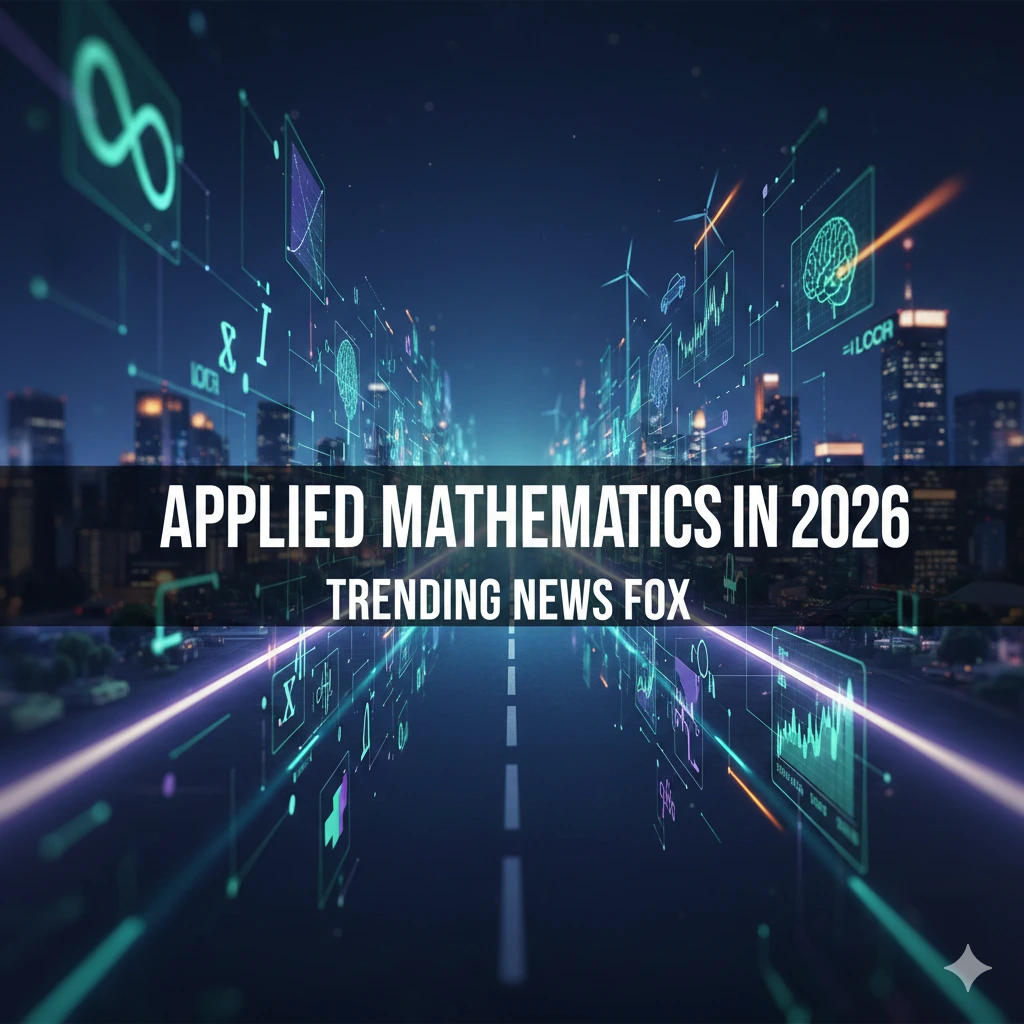
Discover how applied mathematics is revolutionizing AI, climate science, and Wall Street. Explore top-paying careers, essential skills, and why math is the most “future-proof” degree in 2026.
By The Trending News Fox, Web News & Media Team, Tuesday 20th January, 2026
In an era defined by Big Data, Artificial Intelligence, and global climate shifts, math has moved out of the dusty chalkboard era and into the driver’s seat of the world economy. For readers of Trending News Fox, understanding applied mathematics is no longer just for academics—it is the secret language of the 2026 job market and the engine behind every app on your smartphone.
Applied mathematics is the bridge between theoretical concepts and real-world solutions. While “pure” mathematics explores the beauty of numbers for their own sake, applied mathematics asks: How can we use this to cure a disease, stabilize a bridge, or predict the next stock market crash?
1. What is Applied Mathematics?
At its core, applied mathematics is the use of mathematical methods across various fields such as science, engineering, business, and industry. It’s not just about solving for $x$; it’s about creating a mathematical model—a digital or numerical representation of a real-world system—to see how it behaves under different conditions.
Whether it’s the Navier-Stokes equations used to design more aerodynamic Formula 1 cars or the Stochastic Calculus that powers Wall Street trading algorithms, applied math is the silent partner in every major human achievement.
2. The 2026 Power Players: Where Math Meets Reality
As we move through 2026, several key industries have become the primary battlegrounds for applied mathematicians.
Applied Mathematics: Artificial Intelligence & Machine Learning
Modern AI isn’t “magic”; it’s matrix algebra and calculus. Large Language Models (LLMs) like the ones powering today’s virtual assistants rely on optimization algorithms to minimize “loss functions.” In 2026, we are seeing the rise of AI Lab Assistants, where math models suggest new chemical compounds for medicines before a scientist even enters the lab.
Quantum Computing: The Next Frontier
2026 is being hailed as the year quantum computing moved from the lab to “Quantum-as-a-Service” (QaaS). Applied mathematicians are currently developing Post-Quantum Cryptography to protect our bank accounts from being hacked by these ultra-powerful machines. This involves complex number theory that even the fastest classical supercomputers can’t crack.
Applied Mathematics: Climate Modeling and Green Energy
With the global push for Net Zero, applied math is essential for survival. Meteorologists use partial differential equations (PDEs) to simulate atmospheric changes.
The Navier-Stokes equations (above) are used to model everything from ocean currents to the airflow around wind turbines.
3. High-Stakes Career Paths in 2026
If you’re looking for a career that is “future-proof,” applied mathematics is a top contender. According to recent industry reports, the demand for “Math-Centric” roles is projected to grow by over 30% through 2031.
| Career Path | Primary Focus | 2026 Impact |
| Data Scientist | Statistical Modeling | Optimizing supply chains for global retail. |
| Quantitative Analyst (Quants) | Financial Engineering | Managing risk in high-frequency trading. |
| Cryptographer | Number Theory | Securing digital currencies and national secrets. |
| Biostatistician | Biological Modeling | Predicting the spread of new viral variants. |
| Operations Researcher | Optimization | Reducing flight delays for major airlines. |
4. Why It Matters to You: Everyday Math
You don’t need a PhD to benefit from applied math. It impacts your daily life in ways you might not realize:
- Streaming Services: Netflix uses algorithms (Linear Algebra) to recommend your next binge-watch.
- Navigation: GPS uses the Theory of Relativity and Trigonometry to pin down your location within inches.
- Personal Finance: Compound interest is a basic exponential growth model that determines your retirement savings.
5. The Ethical Challenge
As math becomes more powerful, the responsibility grows. In 2026, “Algorithmic Bias” is a major headline. Applied mathematicians are now working alongside ethicists to ensure that the models used for hiring, loan approvals, and policing are fair and transparent.
Applied Mathematics: How to Get Started
For those looking to pivot into this field, the “Big Three” skills for 2026 are:
- Programming: Proficiency in Python or R.
- Statistics: Understanding how to interpret “noisy” data.
- Communication: The ability to explain a complex model to a CEO who hasn’t taken a math class in twenty years.
Applied Mathematics: Final Thoughts
Applied mathematics is the ultimate tool for the curious mind. It provides a framework to solve the world’s most “wicked” problems. Whether we are colonizing Mars or solving the energy crisis, the solution will likely be written in the language of mathematics.
Applied Mathematics: Frequently Asked Questions
1. What is the difference between Pure and Applied Mathematics?
Pure mathematics is the study of mathematical concepts for their own sake, focusing on abstract theories, proofs, and internal logic. Applied mathematics, by contrast, takes those theories and uses them to solve real-world problems in science, engineering, business, and industry. In short: Pure math asks “Is this true?” while applied math asks “How can I use this?”
2. Do I need a PhD to work in Applied Mathematics?
No. While research and university teaching roles often require a PhD, there is a massive demand in 2026 for those with a Bachelor’s or Master’s degree. Roles in data science, financial analysis, and software engineering are highly accessible to graduates who can demonstrate strong modeling and programming skills.
3. Which industries are hiring the most applied mathematicians in 2026?
The “Big Three” for 2026 are:
- Technology & AI: Designing the next generation of neural networks.
- Finance (FinTech): Developing algorithms for high-frequency trading and risk assessment.
- Sustainability & Green Energy: Modeling climate change impacts and optimizing renewable energy grids.
4. Is Applied Mathematics “harder” than Pure Mathematics?
It depends on your strengths. Pure math requires intense deductive reasoning and a high tolerance for abstraction. Applied math requires those same skills plus interdisciplinary knowledge—you must understand the “language” of the field you are working in, whether it’s biology, economics, or physics.
5. What programming languages should I learn?
In 2026, Python remains the industry standard due to its extensive libraries for machine learning and data analysis. R is still vital for high-level statistical work, and C++ is preferred in finance and aerospace for its speed and efficiency.
6. Can I switch from a different STEM field to Applied Math?
Absolutely. Many successful applied mathematicians began in Physics, Computer Science, or Engineering. The transition usually involves strengthening your foundations in linear algebra, differential equations, and probability.
7. How does math help in the fight against climate change?
Applied mathematicians use Partial Differential Equations (PDEs) to simulate the earth’s atmosphere and oceans. These models help scientists predict rising sea levels, optimize the placement of wind farms, and calculate the carbon footprint of global supply chains.
saibal.bose.how36@gmail.com. (2026aa, January 20). Applied Mathematics in 2026: Careers, AI, and Real-World Impact. Trending News Fox. https://trendingnewsfox.com/applied-mathematics-in-2026-careers-ai-and-real-world-impact/