Breaking news for World Cancer Day 2026. Discover the “United by Unique” theme, the latest 70% survival rate milestones, and how new AI treatments are changing the fight against cancer.
By Trending News Fox Staff Published: February 4, 2026
World Cancer Day 2026: “United by Unique” Campaign Targets Global Care Gaps and Celebrates Survival Milestones
Every year on February 4, the world pauses to recognize one of the most significant health challenges of our time. World Cancer Day 2026 arrives at a pivotal moment in medical history. While we are celebrating record-breaking survival rates and “miracle” immunotherapy breakthroughs, the global community is also grappling with a sobering reality: your zip code still often determines your chance of survival.
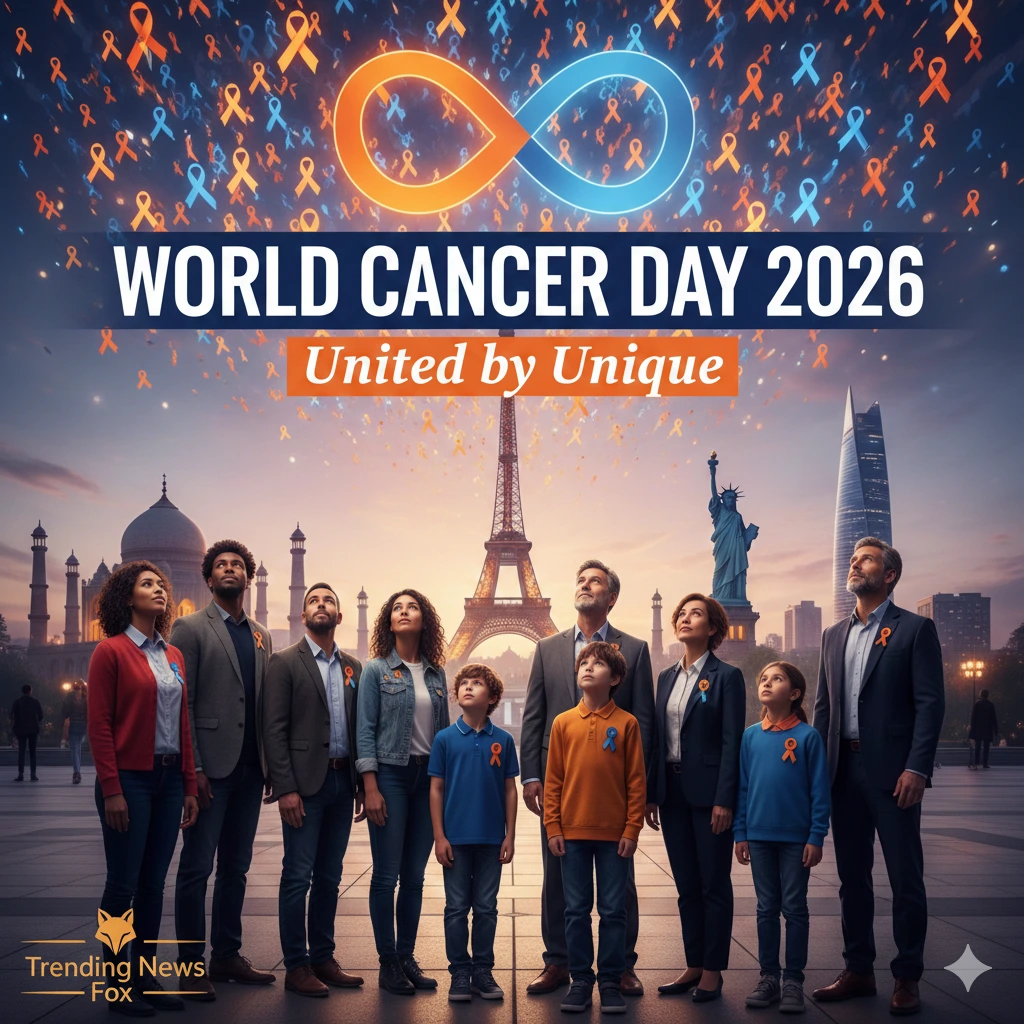
Under the 2026 theme “United by Unique,” the Union for International Cancer Control (UICC) and global health leaders are shifting the focus from clinical statistics to the human heart of the disease. This second year of the three-year campaign emphasizes that while every patient’s journey is distinct, our collective action must be unified to ensure that high-quality care isn’t a luxury for the few, but a right for all.
The 2026 Milestone: 70% Survival Rate Reached
Perhaps the most encouraging news to break this World Cancer Day is the latest report from the American Cancer Society. For the first time in history, the five-year relative survival rate for all cancers combined has reached 70%.
To put this in perspective, in the mid-1970s, a cancer diagnosis carried a survival rate of only about 50%. This 20% jump represents millions of lives saved through:
- Targeted Therapies: Drugs that attack specific genetic mutations in tumors.
- Immunotherapy: Treatments that “unmask” cancer cells so the body’s own immune system can destroy them.
- Early Detection: Advanced screening for breast, prostate, and lung cancers that catches the disease before it spreads.
However, experts at Trending News Fox warn that these victories are uneven. While survival for cancers like melanoma and certain leukemias has soared, high-mortality types like pancreatic and liver cancer still require urgent research funding.
“United by Unique”: Why Personal Stories Matter in 2026
The “United by Unique” theme for 2026 is a call to move beyond “cookie-cutter” medicine. It recognizes that a single mother in a rural village, a corporate executive in a skyscraper, and a teenager in a suburban school experience cancer differently—not just biologically, but socially and emotionally.
World Cancer Day 2026: The Focus on People-Centred Care
The UICC is advocating for people-centred care, which means health systems must adapt to the patient, rather than forcing the patient to navigate a cold, complex system. This includes:
- Addressing Co-morbidities: Recognizing that many patients deal with mental health issues or disabilities alongside their diagnosis.
- Cultural Sensitivity: Ensuring that life-saving information is available in every language and respects local traditions.
- Financial Support: Tackling “financial toxicity,” where the cost of treatment leaves families in debt.
“Every individual facing cancer has a unique story, a unique experience—and yet, we’re all united by our shared commitment to see the person before the patient,” says the UICC 2026 manifesto.
2026 Global Cancer Statistics: The Numbers You Need to Know
Despite medical progress, the sheer volume of new cases continues to rise as the global population ages. Here is a look at the projected landscape for 2026:
| Category | 2026 Projections (U.S. Data) | Global Trends |
| New Cases | Approx. 2.1 Million | Rising due to aging populations |
| Cancer Deaths | Approx. 626,000 | Declining mortality rates (down 34% since 1991) |
| Top Male Cancer | Prostate Cancer | Lung cancer remains the #1 killer |
| Top Female Cancer | Breast Cancer | Cervical cancer elimination remains a priority |
| Preventable Cases | 40% of all diagnoses | Linked to tobacco, obesity, and alcohol |
Source: American Cancer Society & WHO 2026 Reports
World Cancer Day 2026: The Fight to Eliminate Cervical Cancer
A major highlight of World Cancer Day 2026 is the global push to make cervical cancer a disease of the past. Unlike many other forms of the disease, cervical cancer is almost entirely preventable through the HPV vaccine and regular screenings.
The World Health Organization (WHO) has reaffirmed its “90-70-90” targets for 2030:
- 90% of girls vaccinated against HPV by age 15.
- 70% of women screened with a high-performance test.
- 90% of women with pre-cancer or invasive cancer receiving treatment.
In 2026, new initiatives in Latin America and Southeast Asia are launching “Cervical Cancer Dashboards” to track progress in real-time, ensuring that no region is left behind in the race for elimination.
Lifestyle and Prevention: The 40% Rule
While we often look to scientists for a “cure,” doctors on World Cancer Day 2026 are reminding the public that nearly 40% of cancer cases are preventable. Small lifestyle shifts can have a massive impact on long-term health.
Top Risk Factors to Manage in 2026: World Cancer Day 2026
- Tobacco Use: Still the leading cause of preventable cancer death. This includes vaping, which continues to be a point of concern for younger generations.
- Diet and Weight: Excess body weight is linked to 13 different types of cancer, including colorectal and pancreatic.
- Alcohol Consumption: Even moderate drinking is increasingly linked to higher risks of breast and liver cancers.
- UV Exposure: With rising global temperatures, skin cancer protection is more critical than ever.
How to Get Involved: The #UpsideDownChallenge
Social media is buzzing today with the #UpsideDownChallenge. Participants are posting photos or videos of themselves upside down to symbolize how a cancer diagnosis turns a person’s world upside down.
Other ways to take action today: World Cancer Day 2026
- Light Up the Night: Landmarks from the Empire State Building to the Sydney Opera House will be illuminated in orange and blue.
- The 21-Day Challenge: Sign up for a 21-day program to build a healthy habit, such as daily exercise or quitting smoking.
- Advocate: Use your voice to demand that local governments increase funding for cancer registries and equitable healthcare access.
Looking Ahead: The Future of Oncology
As we look past 2026, the horizon is bright. Research into cancer vaccines (mRNA technology similar to COVID-19 vaccines) is currently in human trials for melanoma and lung cancer. Artificial Intelligence (AI) is now being used to read mammograms and CT scans with higher accuracy than ever before, catching tumors when they are the size of a grain of sand.
However, the “Care Gap” remains the greatest hurdle. Innovation is meaningless if it doesn’t reach the people who need it most.
World Cancer Day 2026: Final Thoughts from Trending News Fox
World Cancer Day 2026 is more than just a date on the calendar; it is a reminder of our resilience. We have turned many “death sentences” into “chronic conditions,” and we are closer than ever to a world where cancer is no longer a feared word.
But as we celebrate the 70% who survive, we must work twice as hard for the 30% we still lose. Whether you are a survivor, a caregiver, or a supporter, today is your day to be United by Unique.
Check Your Risk Today
Also, read Global Top News Today: Republic Day 2026, AI Investigations & US Risks
World Cancer Day 2026: Frequently Asked Questions
1. What is the theme for World Cancer Day 2026?
The official theme for 2026 is “United by Unique.” This is the second year of a three-year campaign (2025–2027) led by the Union for International Cancer Control (UICC). While the overarching goal is to close the care gap, 2026 specifically focuses on transforming personal stories into advocacy tools to influence policymakers and healthcare providers.
2. When is World Cancer Day 2026?
World Cancer Day is observed globally every year on February 4. In 2026, the event falls on a Wednesday.
3. What is the “#UpsideDownChallenge”?
The #UpsideDownChallenge is the 2026 social media movement where participants post a photo or video of themselves (or their surroundings) upside down. It symbolizes how a cancer diagnosis turns a person’s world upside down and calls for “people-centred care” that supports the whole person, not just the disease.
4. Why are the colors orange and blue used for World Cancer Day?
Orange and blue are the official colors of World Cancer Day. Orange represents the energy and passion of the global movement, while blue represents peace, hope, and the professional medical community. On February 4, landmarks worldwide are illuminated in these colors.
5. How much of cancer is actually preventable?
According to the World Health Organization, between 30% and 50% of all cancer cases are preventable. By managing risk factors like tobacco use, alcohol consumption, diet, and physical inactivity, millions of lives can be saved annually.
6. What are the “Big Four” cancers most common globally?
While prevalence varies by region, the four most commonly diagnosed cancers worldwide remain:
- Breast Cancer
- Lung Cancer
- Colorectal Cancer
- Prostate Cancer
7. How can I get involved if I’m not a medical professional?
Everyone has a role to play. You can:
- Share your story: Use the hashtag #UnitedByUnique to share your experience as a survivor or caregiver.
- Map of Activities: Visit the official World Cancer Day website to find local events or bake sales in your city.
- Advocate: Write to local representatives to demand better funding for cancer screening in underserved communities.
Also, read Happy Australia Day 2026: Events, Fireworks, and Citizenship Ceremonies Across the Nation