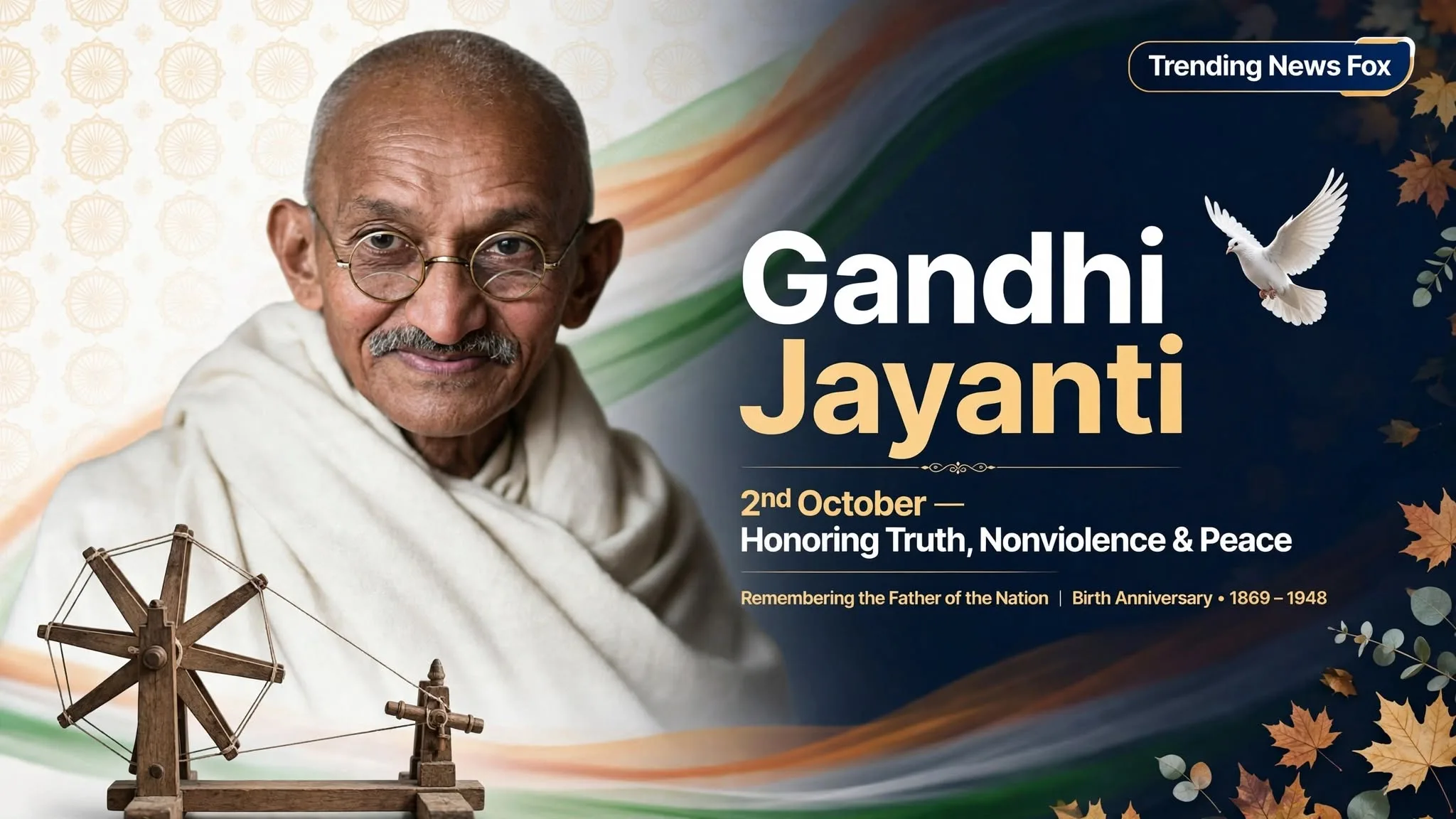
Gandhi Jayanti 2026 will be observed on October 2. Know Mahatma Gandhi’s life, freedom movement, Satyagraha, non-violence and the significance of Gandhi Jayanti.
By Trending News Fox | October 1, 2026
Gandhi Jayanti 2026: History, Significance, Mahatma Gandhi’s Life and Why His Ideals Still Matter Today
Gandhi Jayanti 2026 will be observed across India on Friday, October 2, marking the birth anniversary of Mahatma Gandhi, who was born on October 2, 1869, in Porbandar, Kathiawad. The day is observed every year to remember Gandhi’s life, his contribution to India’s freedom movement and his emphasis on truth, non-violence, simplicity and social responsibility.
For millions of Indians, Gandhi Jayanti is more than a commemorative occasion. It provides an opportunity to reflect on questions of peace, social harmony, equality, responsible citizenship and ethical public life.
Trending News Fox looks at the history and significance of Gandhi Jayanti 2026, Gandhi’s contribution to India’s freedom struggle and the continuing relevance of his ideas in contemporary society.
Gandhi Jayanti 2026: Date and Significance
Gandhi Jayanti is observed on October 2 every year. In 2026, the occasion falls on Friday, October 2.
Mahatma Gandhi was born in 1869 to Karamchand Gandhi and Putlibai Gandhi. According to the chronology maintained by Gandhi Smriti and Darshan Samiti, he received his early education in Rajkot, later travelled to England to study law and subsequently went to South Africa, where experiences of racial discrimination played an important role in shaping his public activism.
His later life in India became closely associated with campaigns involving Satyagraha, non-violent resistance, social reform and India’s independence movement.
Gandhi Jayanti therefore serves as a day to remember both the historical figure and the principles associated with his public life.
Who Was Mahatma Gandhi?
Mohandas Karamchand Gandhi became internationally known as Mahatma Gandhi. His political and social work developed around ideas including truth, non-violence, self-discipline, simplicity and constructive social action.
After returning to India, Gandhi became an important figure in the country’s nationalist movement. His approach relied heavily on mass participation and forms of non-violent resistance.
The official Gandhi Smriti chronology records several major stages of his public life, including his involvement in Satyagraha campaigns, opposition to discriminatory practices, efforts against untouchability and his leadership during the final phase of India’s independence movement.
His political work was also closely connected with social and economic questions. Gandhi promoted village industries, education, sanitation, communal harmony and efforts toward social equality.
Gandhi and the Principle of Non-Violence
One of the most widely associated ideas with Gandhi is Ahimsa, or non-violence.
For Gandhi, non-violence was not simply the absence of physical violence. It was connected to a broader ethical approach involving self-discipline, respect for others and resistance to injustice without relying on violence.
The Gandhi Smriti and Darshan Samiti describes non-violence as a central part of Gandhi’s philosophy and mission. Its stated vision is to promote a just and peaceful society inspired by Gandhi’s life and thought.
Gandhi’s experiments with non-violent action also influenced discussions about peaceful resistance beyond India. The principles associated with Satyagraha have subsequently been studied in different historical and academic contexts.
What Is Satyagraha?
Satyagraha is one of the key concepts associated with Gandhi’s political philosophy.
The term is commonly connected with the pursuit of truth and non-violent resistance. Gandhi developed and applied the method during his activism in South Africa and later in India.
Rather than treating political action solely as a contest of physical strength, Satyagraha emphasized moral conviction, discipline and organized non-violent action.
Gandhi Smriti’s historical material notes that Gandhi’s campaigns included Satyagraha and civil-disobedience movements at different stages of India’s freedom struggle.
Gandhi’s Role in India’s Freedom Movement
Gandhi became one of the most prominent leaders associated with India’s independence movement.
Among the major phases of his political activism was the development of mass movements based on non-cooperation, civil disobedience and Satyagraha.
In 1942, the Indian National Congress adopted the Quit India resolution, which became the final major nationwide Satyagraha campaign led by Gandhi before independence.
His political strategy encouraged ordinary citizens to participate in the national movement. This mass participation became an important feature of India’s struggle against British colonial rule.
At the same time, Gandhi’s activities extended beyond political independence. He repeatedly emphasized social reform, village development, sanitation, education, economic equality and communal harmony.
Gandhi’s Constructive Programme
An important but sometimes less-discussed part of Gandhi’s thought was his Constructive Programme.
According to Gandhi Smriti and Darshan Samiti, the programme focused on building social institutions and encouraging individual and community transformation. Areas associated with the programme included communal unity, removal of untouchability, Khadi, village industries, sanitation, basic education, women’s emancipation, economic equality, labour and the welfare of marginalized communities.
This approach reflected Gandhi’s belief that political freedom alone was not sufficient. Social responsibility and community development were also important elements of nation-building.
Why Gandhi Jayanti Is Important Today
The significance of Gandhi Jayanti extends beyond remembering a historical personality.
In today’s world, societies continue to face challenges involving conflict, misinformation, social divisions, inequality and intolerance. Gandhi’s emphasis on truth, peaceful communication, self-discipline and constructive community participation provides a framework that continues to be discussed in educational and social contexts.
Gandhi Smriti and Darshan Samiti continues to organize programmes examining Gandhi’s philosophy and its contemporary relevance. In February 2026, for example, the organization held a colloquium examining ethical and moral lessons from Gandhi’s autobiography, including truth, self-control, forgiveness, non-possession, responsible citizenship and social harmony.
These discussions demonstrate that Gandhi’s legacy is not limited to historical study; his ideas continue to be examined in relation to ethics and public life.
Gandhi Jayanti and International Day of Non-Violence
October 2 also has an international significance.
The United Nations observes October 2 as the International Day of Non-Violence, marking the birthday of Mahatma Gandhi. The observance recognizes the promotion of a culture of peace and non-violence.
This international association has helped connect Gandhi’s birthday with wider discussions about peaceful conflict resolution, human dignity and non-violent action.
Gandhi’s Message for the Digital Age
Gandhi lived in an era very different from today’s digitally connected world. Yet several themes associated with his philosophy can be considered in the context of modern communication.
The principle of truth, for example, has particular relevance in an environment where information can spread rapidly through social media and digital platforms.
Responsible communication requires users to verify information before sharing it, distinguish facts from rumours and avoid deliberately misleading content.
Similarly, the principle of non-violence can be considered beyond physical actions. Respectful communication and avoiding abusive or threatening language can contribute to healthier online communities.
For young people especially, Gandhi Jayanti can therefore become an opportunity to think about responsible digital citizenship as well as historical events.
How Gandhi Jayanti Is Observed
Gandhi Jayanti is commonly marked through prayer meetings, educational programmes, cleanliness and community activities, discussions, cultural programmes and tributes at Gandhi memorials.
Schools and colleges often organize essay competitions, speeches, debates, quizzes and exhibitions focusing on Gandhi’s life and philosophy.
In New Delhi, Gandhi Smriti is located at the Old Birla House on Tees January Marg. Gandhi lived there from September 9, 1947, until January 30, 1948. The Government of India acquired the property in 1971 and converted it into a national memorial, which opened to the public in 1973.
Gandhi Darshan, located near Rajghat, also presents exhibitions related to Gandhi’s life, the freedom struggle and his message of truth and non-violence.
Gandhi Jayanti 2026: A Day for Reflection
Gandhi Jayanti 2026 comes at a time when conversations about peace, social harmony, ethical leadership and responsible citizenship remain significant.
Remembering Gandhi does not require viewing history without criticism or debate. His life, political methods and ideas have been studied and debated extensively. A meaningful observance can instead encourage people to examine historical evidence, understand different perspectives and consider which principles can contribute positively to society today.
For students, Gandhi Jayanti can be an opportunity to learn about India’s freedom movement. For communities, it can encourage service and social responsibility. For digital audiences, it can serve as a reminder about responsible communication and the importance of verifying information.
Gandhi Jayanti 2026: Key Facts
- Occasion: Gandhi Jayanti
- Date: October 2, 2026
- Day: Friday
- Birth of Mahatma Gandhi: October 2, 1869
- Birthplace: Porbandar, Kathiawad
- Known for: Satyagraha, non-violent resistance and social reform
- Major themes: Truth, non-violence, simplicity, service and social harmony
- International observance: October 2 is the UN’s International Day of Non-Violence
- Gandhi Smriti: New Delhi
- Gandhi Darshan: Rajghat, New Delhi
Frequently Asked Questions About Gandhi Jayanti 2026
When is Gandhi Jayanti 2026?
Gandhi Jayanti 2026 will be observed on Friday, October 2, 2026.
Why is Gandhi Jayanti celebrated?
It marks the birth anniversary of Mahatma Gandhi and provides an opportunity to remember his contribution to India’s freedom movement and his ideas concerning truth, non-violence and social responsibility.
When was Mahatma Gandhi born?
Mahatma Gandhi was born on October 2, 1869, in Porbandar, Kathiawad.
What is Gandhi best known for?
Gandhi is particularly associated with Satyagraha, non-violent resistance, truth, social reform and his role in India’s independence movement.
What is the International Day of Non-Violence?
October 2 is observed by the United Nations as the International Day of Non-Violence, coinciding with Gandhi’s birthday.
Where is Gandhi Smriti located?
Gandhi Smriti is located at 5, Tees January Marg, New Delhi, at the former Birla House where Gandhi spent the final months of his life.
Conclusion
Gandhi Jayanti 2026 is an occasion to remember a major figure in India’s modern history and to explore the ideas associated with his life—truth, non-violence, self-discipline, service and social responsibility.
As India observes October 2, the day offers an opportunity for citizens, students and communities to learn from history while considering how principles of peaceful communication, responsible citizenship and social harmony can be applied in contemporary life.
For Trending News Fox, Gandhi Jayanti is not only a historical observance but also an opportunity to bring informed discussion about India’s past and its continuing influence into today’s digital news environment.
Trending News Fox — News, Trends & Stories That Matter.