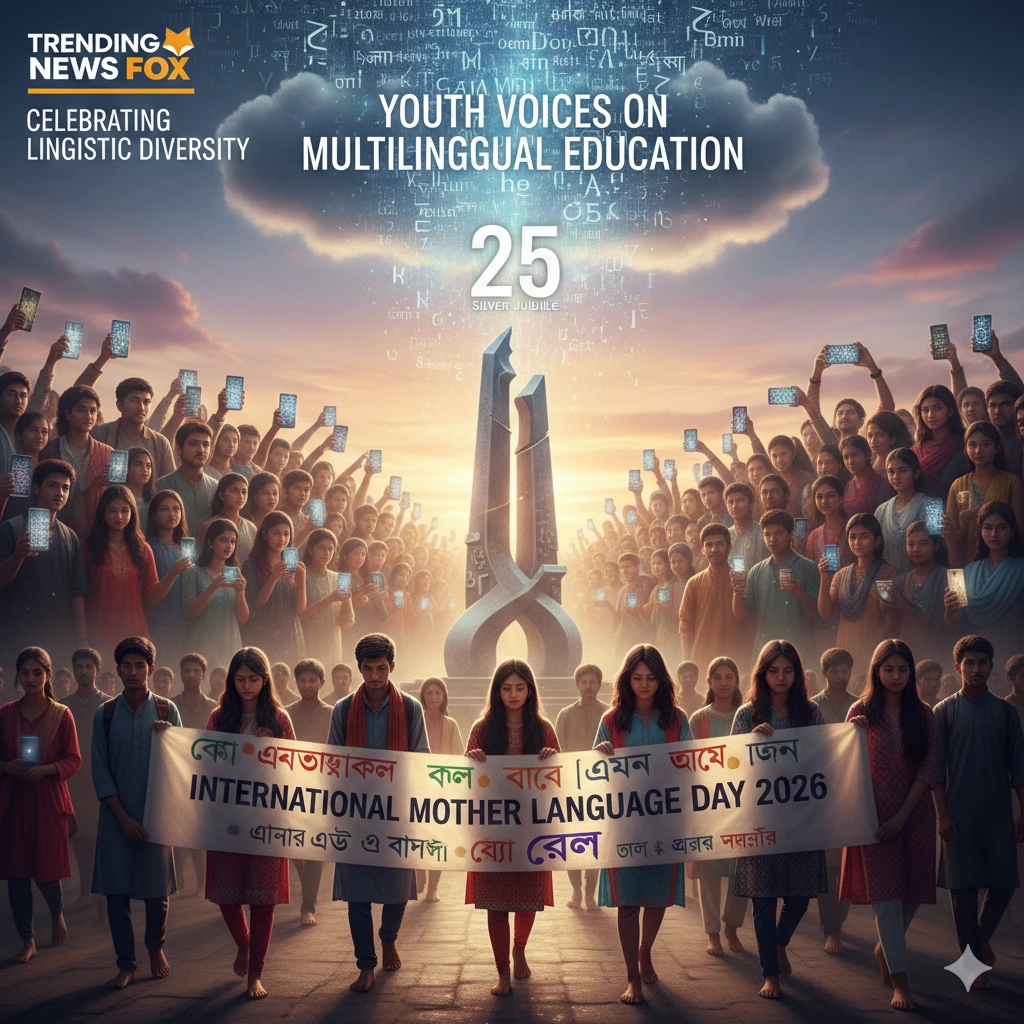
Discover why International Mother Language Day 2026 is a historic Silver Jubilee milestone. Explore the 2026 theme, youth-led language trends, and the fight to save 1,500 endangered dialects.
By Trending News Fox Editorial Team Published: February 20, 2026 | 7:15 PM IST
International Mother Language Day 2026: Celebrating the Silver Jubilee of Linguistic Diversity
International Mother Language Day 2026 marks a historic milestone—the Silver Jubilee of a global movement dedicated to the preservation of the world’s 7,000+ languages. Observed every year on February 21st, this day serves as a poignant reminder that languages are more than just tools for communication; they are the vessels of our history, identity, and soul.



As we step into 2026, the theme “Youth Voices on Multilingual Education” takes center stage, highlighting the critical role the next generation plays in keeping ancestral tongues alive in an increasingly digital and globalized world.
The Heart of the Movement: History and Significance
The origins of International Mother Language Day are rooted in sacrifice. In 1952, students in what was then East Pakistan (now Bangladesh) launched the Language Movement. On February 21 of that year, several young activists were martyred while protesting for the right to speak and recognize their mother tongue, Bangla, as an official language.
In 1999, UNESCO officially recognized this day, and since 2000, it has been celebrated worldwide. Today, it stands as a global beacon for:
- Linguistic Human Rights: The right for every individual to learn and communicate in their native language.
- Cultural Preservation: Safeguarding the oral traditions, folklore, and local wisdom embedded in rare dialects.
- Social Inclusion: Ensuring that minority groups are not marginalized by dominant “global” languages.
Why Mother Tongue Education Matters in 2026
Despite the global reach of English, Mandarin, and Spanish, UNESCO reports a startling reality: 40% of the global population still lacks access to education in a language they speak or understand. This “language gap” creates significant barriers to learning, especially for children in indigenous and rural communities.
The Cognitive and Emotional Edge
Research consistently shows that children who begin their education in their mother tongue perform better across all subjects, including mathematics and science.
“If you talk to a man in a language he understands, that goes to his head. If you talk to him in his language, that goes to his heart.” — Nelson Mandela
The benefits of mother-tongue-based multilingual education (MTB-MLE) include:
- Improved Comprehension: Concepts are grasped faster when they aren’t filtered through a foreign vocabulary.
- Higher Retention Rates: Students are less likely to drop out when they feel represented in the classroom.
- Cultural Confidence: Learning in one’s native language fosters a sense of pride and belonging.
2026 Theme: Youth Voices and the Digital Frontier
The 2026 theme, “Youth Voices on Multilingual Education,” emphasizes that the future of linguistic diversity lies in the hands of Gen Z and Gen Alpha. In an era dominated by AI and social media, young people are the ultimate “digital ambassadors” for their languages.
Languages in the Age of AI
A major focus this year is the digital divide. Currently, fewer than 100 languages are used in the digital world. As AI models like ChatGPT and DeepSeek evolve, there is a growing push to ensure they are trained on diverse datasets that include indigenous and underrepresented languages.
UNESCO’s high-level panels in Paris this year are specifically addressing how technology can be used to revitalize rather than replace local dialects through digital dictionaries, speech-to-text tools for oral languages, and multilingual social media campaigns.
Global Celebrations: How the World Marks February 21
From the bustling streets of Dhaka to the tech hubs of Silicon Valley, International Mother Language Day 2026 is being celebrated with a variety of events:
| Region | Primary Celebration Style | Key Focus |
| Bangladesh | Prabhat Feri (Barefoot processions) | Wreath-laying at the Shaheed Minar to honor martyrs. |
| India | Cultural Festivals & Digital Launches | Promoting the National Education Policy (NEP) 2020 and 22 official languages. |
| South Africa | Community Workshops | Focus on indigenous languages and sustainable development. |
| United Kingdom | “Voiced” Festivals | Manchester’s celebration of endangered languages and multilingual poetry. |
| France (UNESCO) | Global Symposia | High-level panels on “The Future of Mother Languages in the AI Era.” |
The Crisis of Extinction: A Call to Action
While we celebrate, we must also confront a sobering truth: A language disappears every two weeks. When a language dies, we lose more than just words; we lose a unique way of seeing the world.
What is at risk?
- Indigenous Wisdom: Knowledge of medicinal plants and local ecosystems often only exists in native dialects.
- Oral Histories: Stories passed down through generations that have never been written down.
- Linguistic Diversity: The “biological diversity” of the human mind.
How You Can Participate and Make an Impact
You don’t need to be a linguist to make a difference. Here are practical ways to celebrate International Mother Language Day 2026:
- Speak It at Home: If you are a heritage speaker, dedicate the day to speaking only your mother tongue with your family.
- Support Local Creators: Read a book, watch a film, or listen to music in a regional or minority language.
- Digital Advocacy: Share a proverb or a beautiful word from your native language on social media using the hashtag #MotherLanguageDay.
- Learn a “Small” Language: Use apps or community centers to learn the basics of an endangered or local indigenous language.
Conclusion: Languages Matter for a Sustainable Future
International Mother Language Day 2026 is a reminder that diversity is our greatest strength. As we celebrate 26 years of global advocacy, the goal remains clear: to build a world where every child can learn in the language of their heart, and where no culture is left behind in the digital shadows.
By protecting our mother tongues, we aren’t just looking backward at our roots; we are ensuring a more inclusive, peaceful, and intellectually rich future for the generations to come.
Also, read World Day of Social Justice 2026: UN Calls for Urgent Action on Global Inequality
Video Podcast Below:
Frequently Asked Questions: International Mother Language Day 2026
1. What is the theme for International Mother Language Day 2026?
The official theme for 2026 is “Youth Voices on Multilingual Education.” This year emphasizes the role of the younger generation in using digital tools and social media to revitalize native dialects and advocate for inclusive education.
2. Why is February 21st celebrated as Mother Language Day?
The date commemorates February 21, 1952, when students in Dhaka (then East Pakistan, now Bangladesh) were killed by police during a protest. They were fighting for the recognition of their mother tongue, Bangla, as an official state language. UNESCO officially declared the day in 1999 to honor their sacrifice.
3. Who started International Mother Language Day?
The initiative was proposed by Bangladesh and approved at the 1999 UNESCO General Conference. It has been observed globally since 2000 to promote linguistic and cultural diversity.
4. Why is mother tongue education so important?
UNESCO research shows that 40% of the world’s population does not have access to education in a language they speak or understand. Learning in a mother tongue improves comprehension, boosts student confidence, and prevents the erosion of cultural heritage.
5. How many languages are currently at risk of extinction?
According to linguistic experts, a language disappears approximately every two weeks. Currently, at least 43% of the world’s 7,000+ languages are considered endangered, often because they are not used in schools or the digital world.
6. How is the 2026 “Silver Jubilee” being celebrated?
The 2026 celebrations mark over 25 years of the global movement. Events include:
- UNESCO Panels in Paris: Focusing on AI’s role in preserving minority languages.
- The “Shaheed Minar” Tribute: Massive barefoot processions in Bangladesh.
- Digital Campaigns: Global youth using hashtags like #IMLD2026 to share poetry and stories in their native tongues.
7. How can I participate if I only speak a dominant language?
You can participate by advocating for linguistic diversity! Support local authors who write in minority languages, learn a few phrases in an indigenous dialect, or share information about the importance of multilingualism to raise awareness.
Also, read Shivaji Maharaj Jayanti 2026: History, Significance, and Celebration
Audio podcast Below:
Disclaimer: The information provided in this article is for educational and informational purposes only. While we strive to maintain the highest standards of accuracy regarding historical events and UNESCO global themes, linguistic statistics and cultural celebrations may vary by region. All views expressed are intended to promote global linguistic diversity and human rights.
saibal.bose.how36@gmail.com, saibal.bose.how36@gmail.com, saibal.bose.how36@gmail.com, & saibal.bose.how36@gmail.com. (2026s, February 20). International Mother Language Day 2026: Youth & Digital Future. Trending News Fox. https://trendingnewsfox.com/international-mother-language-day-2026-theme-trends/