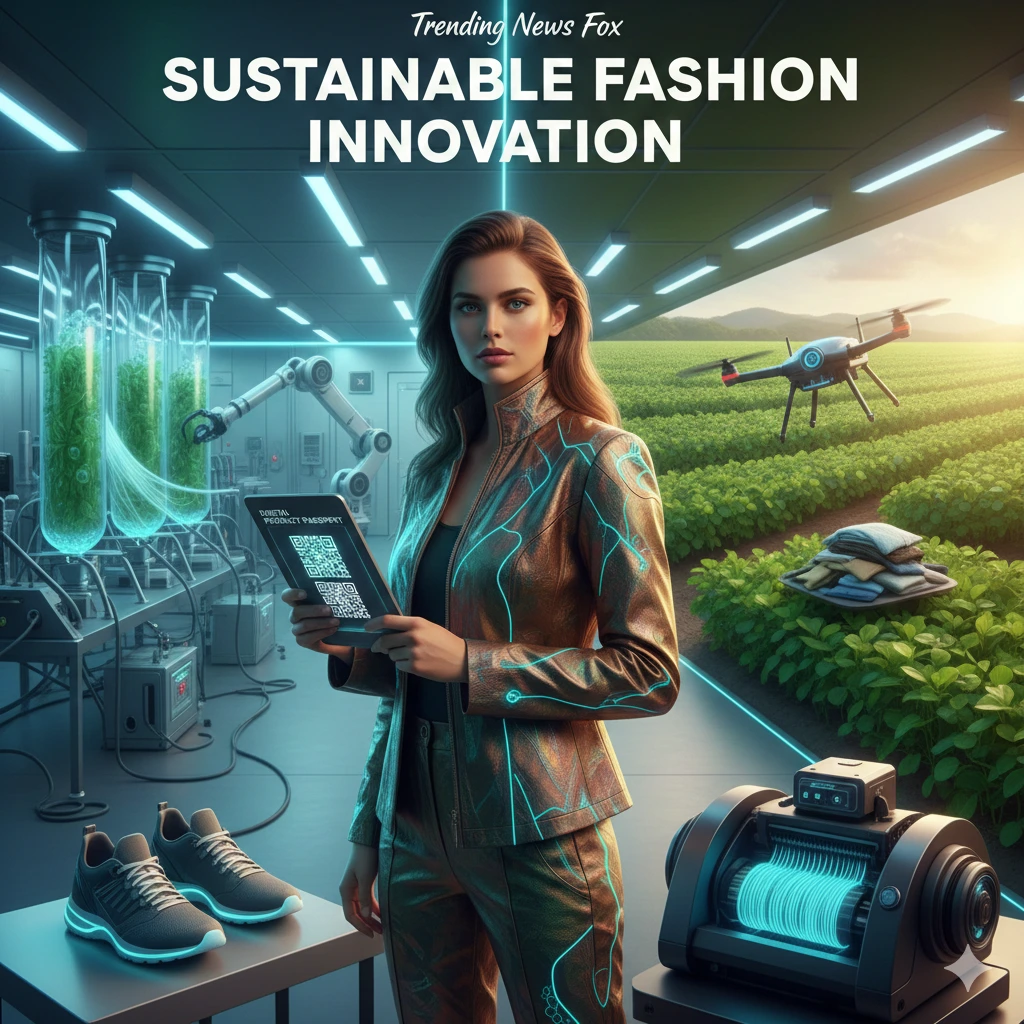
Discover how AI, mycelium leather, and waterless dyeing are revolutionizing the industry. Explore the top sustainable fashion innovation of 2026 that are making “fast fashion” obsolete.
By Trending News Fox, Web News & Media Team, Tuesday 20th January, 2026
What Are the Latest Trends in Sustainable Fashion Innovation?
In 2026, the global fashion industry is no longer just “going green”—it is undergoing a radical technological and biological overhaul. What was once a niche movement defined by organic cotton tote bags has transformed into a high-tech frontier where mycelium leather, AI-driven supply chains, and circular design are the new gold standards.
For Trending News Fox, we dive deep into the breakthroughs redefining our wardrobes. From lab-grown textiles to the death of the “take-make-waste” model, here is how innovation is finally making sustainable fashion profitable, scalable, and incredibly stylish.
1. The Rise of Bio-Fabrication: Lab-Grown Luxury
The most significant shift in 2026 is the transition from “extracted” materials to “grown” ones. Bio-fabrication—the use of living organisms like bacteria, yeast, and fungi to create textiles—is moving from experimental runways to mass-market availability.
Sustainable Fashion Innovation: Mycelium and Beyond
Mushroom leather, or Mycelium, has officially scaled. Unlike traditional leather, which requires years of land use and heavy chemical tanning, mycelium can be grown in weeks using agricultural waste. Brands like Stella McCartney and Adidas have pioneered this, but in 2026, we are seeing the “industrialization” of these labs, bringing costs down to rival high-end bovine leather.
Sustainable Fashion Innovation: Seaweed and Algae Fibers
Beyond the forest floor, the ocean is providing the next wave of innovation. Algae-based fibers are gaining traction because they are carbon-negative—they actually sequester carbon dioxide during their growth phase. These fabrics are naturally biodegradable and often infused with skin-nourishing nutrients, blurring the line between fashion and wellness.
2. Artificial Intelligence: The Sustainability Secret Weapon
While textiles capture the headlines, Artificial Intelligence (AI) is the invisible engine driving efficiency. In an industry notorious for overproduction—where an estimated 30% of manufactured clothes are never even sold—AI is the “cure” for waste.
- Precision Demand Forecasting: AI algorithms now analyze real-time social data and micro-trends to predict exactly what consumers want. This allows brands to shift to “small-batch” production, virtually eliminating the “deadstock” that usually ends up in landfills.
- Virtual Sampling: By using 3D design tools like CLO3D and Browzwear, designers can create perfect digital prototypes. This reduces the need for physical samples by up to 50%, saving thousands of gallons of water and reducing the carbon footprint of global shipping.
- AI Sorting for Recycling: One of the biggest hurdles to recycling has always been identifying fiber blends. New AI-powered optical sorting machines can now scan a garment and instantly identify its chemical makeup, allowing for “fiber-to-fiber” recycling that maintains the quality of the new yarn.
3. The Circular Economy: Designing for “End-of-Life”
In 2026, the concept of “trash” is being designed out of the fashion cycle. The Circular Economy focuses on keeping garments in use for as long as possible and ensuring they can be safely returned to the earth or the factory at the end.
Sustainable Fashion Innovation: Digital Product Passports (DPP)
The European Union’s 2026 mandate for Digital Product Passports has changed the game globally. Most new garments now come with a scannable QR code that tells the item’s entire life story: where the cotton was grown, who sewed it, and—most importantly—how to repair or recycle it. This transparency is forcing brands to move away from “planned obsolescence.”
Sustainable Fashion Innovation: Resale-as-a-Service (RaaS)
Resale is no longer just for Poshmark or Depop. Major retailers have integrated “Buy Back” programs directly into their apps. By owning the secondary market for their own goods, brands are incentivized to make higher-quality clothes that retain their value over time.
4. Regenerative Agriculture: Fashion as a Climate Solution
Sustainability used to mean “doing less harm.” In 2026, the goal is Regenerative, meaning fashion actually helps restore the planet.
Fashion’s biggest players are now investing directly in the soil. Regenerative farming practices—such as no-till planting, cover cropping, and rotational grazing—turn cotton fields and sheep pastures into “carbon sinks.”
Industry Insight: Brands like Patagonia and the Kering Group (Gucci, Saint Laurent) are now sourcing “Regenerative Organic Certified” (ROC) cotton, which ensures that for every t-shirt produced, a measurable amount of carbon is pulled out of the atmosphere and stored in the soil.
5. Waterless Dyeing: Solving Fashion’s “Blue River” Problem
Traditional textile dyeing is the second-largest polluter of water globally. In 2026, “waterless” technology is finally hitting the mainstream.
Innovative companies are using supercritical CO2 instead of water to apply pigment to fabric. In this closed-loop system, the CO2 is pressurized until it acts like a liquid, carrying the dye deep into the fibers without a single drop of water or the need for toxic “fixing” chemicals. The CO2 is then captured and reused, leaving the fabric dry and the local rivers clean.
6. The “Slow Fashion” Tech: 3D Weaving and On-Demand
The ultimate innovation in 2026 is the marriage of ancient “slow fashion” ideals with futuristic “fast tech.”
- 3D Knitting: Companies like Uniqlo and Ministry of Supply are using “Wholegarment” 3D knitting machines. These robots knit an entire sweater in one piece, meaning there are no seams and zero fabric waste.
- On-Demand Micro-Factories: We are seeing the rise of local micro-factories in cities like New York, London, and Mumbai. Instead of shipping clothes across the ocean, a customer orders a dress online, and it is printed, cut, and sewn locally within 24 hours. This eliminates the massive carbon cost of international logistics.
Overview: Why This Matters for 2026
For readers of Trending News Fox, these innovations represent a shift in consumer power. The “Greenwashing” era is over because data-driven transparency makes it impossible for brands to hide.
Key Sustainable Fashion Terms to Watch:
| Term | Meaning | Impact |
| Fiber-to-Fiber | Turning old clothes into new high-quality yarn. | Eliminates the need for virgin polyester/cotton. |
| Deadstock | Unsold inventory that usually gets burned. | AI is reducing this to near-zero levels. |
| Monomaterial | Garments made of 100% of one fiber. | Makes the item 100% recyclable. |
| Bio-Dyeing | Using bacteria to “grow” colors. | Replaces toxic heavy metals in dyes. |
The Verdict: Is Fashion Finally Sustainable?
While the industry still faces challenges—specifically the sheer volume of consumption—2026 marks the year that the infrastructure for a sustainable future was finally laid. Innovation has moved from the laboratory to the closet.
Today’s fashion icons aren’t just those who wear the best clothes, but those who understand the technology behind them. As we look toward 2030, the “trend” isn’t a specific color or silhouette; it’s the integrity of the thread itself.
Stay Ahead of the Trend
The world of sustainable innovation moves fast. Whether you’re a designer, a tech enthusiast, or a conscious consumer, staying informed is your best tool for navigating the new “Green Frontier” of fashion.
As the fashion world shifts from traditional manufacturing to a high-tech, bio-based future, consumers and industry insiders have plenty of questions. This FAQ addresses the most pressing concerns about the innovations shaping our wardrobes in 2026.
Sustainable Fashion Innovation: Frequently Asked Questions
1. What is “Bio-Fabrication” and why is it trending in 2026?
Bio-fabrication is the process of “growing” textiles from living organisms like fungi (mycelium), bacteria, and algae. Unlike traditional fabrics that require vast amounts of land and water, bio-fabrics are grown in controlled laboratory environments, often using agricultural waste as a nutrient source. In 2026, this has moved from the experimental stage to mainstream retail, offering a plastic-free, carbon-negative alternative to synthetic fibers.
2. How is AI actually helping the environment in fashion?
AI is the industry’s most powerful tool for ending overproduction. By using hyper-accurate demand forecasting, brands no longer have to “guess” how many units to make, which prevents millions of tons of unsold “deadstock” from entering landfills. Additionally, AI-powered sorting technology has finally made “fiber-to-fiber” recycling possible by instantly identifying complex fabric blends that were previously unrecyclable.
3. What is a “Digital Product Passport” (DPP)?
A Digital Product Passport is a scannable tag (usually a QR code or NFC chip) embedded in a garment. Mandated by new 2026 regulations, it provides a transparent record of the item’s lifecycle, including:
- Where the raw materials were sourced.
- The carbon footprint of its production.
- Instructions for repair, resale, and end-of-life recycling.
4. Is “Mushroom Leather” as durable as real leather?
Yes. 2026-grade Mycelium leather has been engineered to match the tensile strength and durability of traditional bovine leather. Because it is grown in a lab, it also lacks the natural imperfections found in animal hides, leading to significantly less material waste during the cutting process.
5. What does “Circular Fashion” mean in practice?
Circular fashion is a model where clothes are designed to never become waste. In practice, this means:
- Design for Disassembly: Clothes are made with “monomaterials” (100% of one fiber) so they can be easily recycled.
- Resale & Rental: Brands offer built-in platforms for you to sell back or rent your clothes.
- Biodegradability: If a garment is discarded, it is designed to compost safely back into the soil without releasing microplastics.
6. Why is “Waterless Dyeing” such a big deal?
Traditional textile dyeing is one of the world’s largest polluters of fresh water. Innovation in Supercritical CO2 dyeing eliminates the need for water entirely. By using CO2 as a solvent to carry pigment into the fibers, the process saves billions of gallons of water and removes toxic chemical runoff from the manufacturing cycle.
7. Does “Sustainable” always mean “Expensive”?
While high-tech sustainable items often have a higher upfront cost due to R&D, 2026 has seen a shift toward Long-Term Value. Innovations like 3D-knitting and “Self-Healing” fabrics make clothes last much longer, reducing the “cost-per-wear.” Additionally, the rise of the resale market allows consumers to buy high-quality sustainable pieces at a fraction of the original price.
Key Takeaway
Sustainability in 2026 is no longer about doing “less bad”—it’s about using technology to do “more good.” From the soil to the software, innovation is making it possible to love fashion without compromising the planet.
saibal.bose.how36@gmail.com. (2026ad, January 20). Sustainable Fashion Innovation 2026: The Tech Redefining Style. Trending News Fox. https://trendingnewsfox.com/sustainable-fashion-innovation-2026-the-tech-redefining-style/