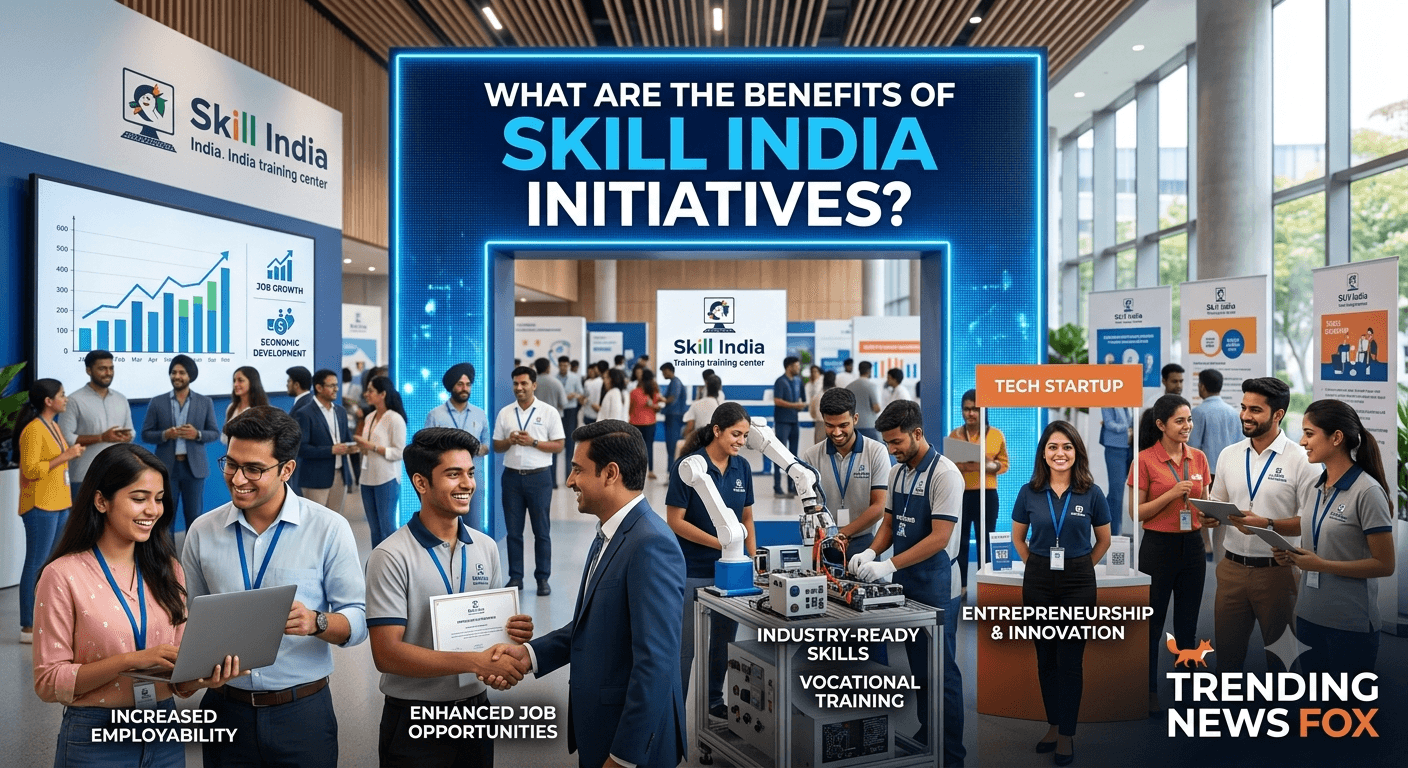
Explore Skill India, a transformative program focused on equipping the workforce with essential skills, fostering entrepreneurship, and driving national development.
TRENDING NEWS FOX
Business & Economy | Policy Pulse
Empowering the Youth: How the Skill India Initiative is Reshaping the Nation’s Economy
By News Desk
Published: June 2026
With over 65% of its population under the age of 35, India holds a unique global asset: a massive, youthful demographic. However, converting this statistical advantage into actual economic power requires more than just numbers—it requires industry-ready capability. This is precisely where the Skill India Mission, heavily expanded under its current Skill India 4.0 phase, comes into play.
Launched to bridge the persistent gap between traditional academic degrees and practical factory-floor requirements, the initiative has transformed the country’s employment landscape. Backed by an ₹8,800 crore central allocation for its continuing structural phases, the Skill India initiatives are delivering quantifiable economic, social, and global benefits.
Here is a comprehensive breakdown of the core benefits driving India’s workforce revolution.
1. Drastic Boost in Graduate Employability
Historically, India faced a unique paradox: high unemployment alongside major talent shortages reported by corporations. Academic curricula simply weren’t keeping pace with market developments.
Through the Pradhan Mantri Kaushal Vikas Yojana (PMKVY 4.0), the flagship short-term training scheme under the Ministry of Skill Development and Entrepreneurship (MSDE), training has shifted completely to a demand-driven model. By integrating over 7,000 “Skill Hubs” directly into schools, ITIs, and higher education institutes, youth are learning market-ready vocations. National employability metrics among graduates have notably surged from a meager 34% a decade ago to over 51%.
2. Fast-Tracking “Industry 4.0” and Future Skills
The modern economy moves faster than a traditional textbook can be printed. To counter this, Skill India has introduced over 100 future-skill job roles to keep pace with the era of automation.
Rather than focusing solely on traditional trades, local youth are being trained in high-tech, cutting-edge domains:
- Artificial Intelligence (AI) & Cyber Security
- Drone Technology & Robotics
- Green Hydrogen and Renewable Energy systems
- Semiconductor manufacturing pipelines
3. Fostering Financial Transparency via Direct Benefit Transfers (DBT)
One of the most notable administrative victories of the modernized ecosystem is the elimination of middleman leakages. Under the National Apprenticeship Promotion Scheme (NAPS), the stipend support provided by the government to train young workers on-the-job goes directly to the bank accounts of the apprentices via Direct Benefit Transfers. Millions of transactions have skipped third-party processing entirely, incentivizing corporate establishments to sign up and safely scale their apprentice hiring.
4. Driving Gender Inclusivity and Rural Empowerment
Skill India initiatives have played a pioneering role in pulling rural women out of unpaid informal labor and putting them into the formal economy. Schemes like the Jan Shikshan Sansthan (JSS) focus specifically on non-literates and neo-literates in deep rural zones.
Female participation in flagship short-term skilling programs has skyrocketed, comfortably crossing 52%. In long-term vocational programs like those hosted by Industrial Training Institutes (ITIs), female enrollment has grown significantly, fostering true financial independence at the grassroots level.
Core Pillars: How the Skill India Ecosystem Delivers Impact
To see how these benefits are structurally organized, look at the core sub-programs functioning under the umbrella framework:
| Initiative / Pillar | Primary Focus Area | Key Socio-Economic Benefit |
| PMKVY 4.0 | Short-term institutional & localized training | Rapid market entry for dropouts and unemployed youth. |
| NAPS | Industry-linked on-the-job apprenticeships | Bridges the gap between classroom theory and real factory floor work. |
| Recognition of Prior Learning (RPL) | Formal certification for informal workers | Provides formal titles and wage bargaining power to self-taught artisans. |
| Skill India Digital Hub (SIDH) | Unified Digital Public Infrastructure | Offers QR-coded, Aadhaar-linked verifiable certificates and job discovery. |
Going Global: India as the “Skill Capital of the World”
The domestic market isn’t the final boundary line. Facing rapidly aging populations, major advanced economies—ranging from Japan to European nations and the UAE—are dealing with severe localized labor shortages.
Through the establishment of dedicated Skill India International Centres (SIICs) and global talent mobility partnerships (like the Technical Intern Training Program), India is actively aligning its certification standards with international requirements. By offering language training and globally verified digital credentials via the Skill India Digital Hub, the nation is successfully positioning its youth to secure high-value international placements, dramatically boosting future remittance inflows.
The Bottom Line
While structural challenges like local skill mismatches and regional placement variables still require proactive policy adjustments, the benefits of the Skill India initiative are undeniable. It has successfully shifted the national narrative from merely creating “graduates” to explicitly engineering “employable, future-ready professionals.” For an economy aiming for sustained high-tier growth, this skilling framework is proving to be the ultimate backbone.
Stay tuned to Trending News Fox for the latest updates on policy, business trends, and national developments.