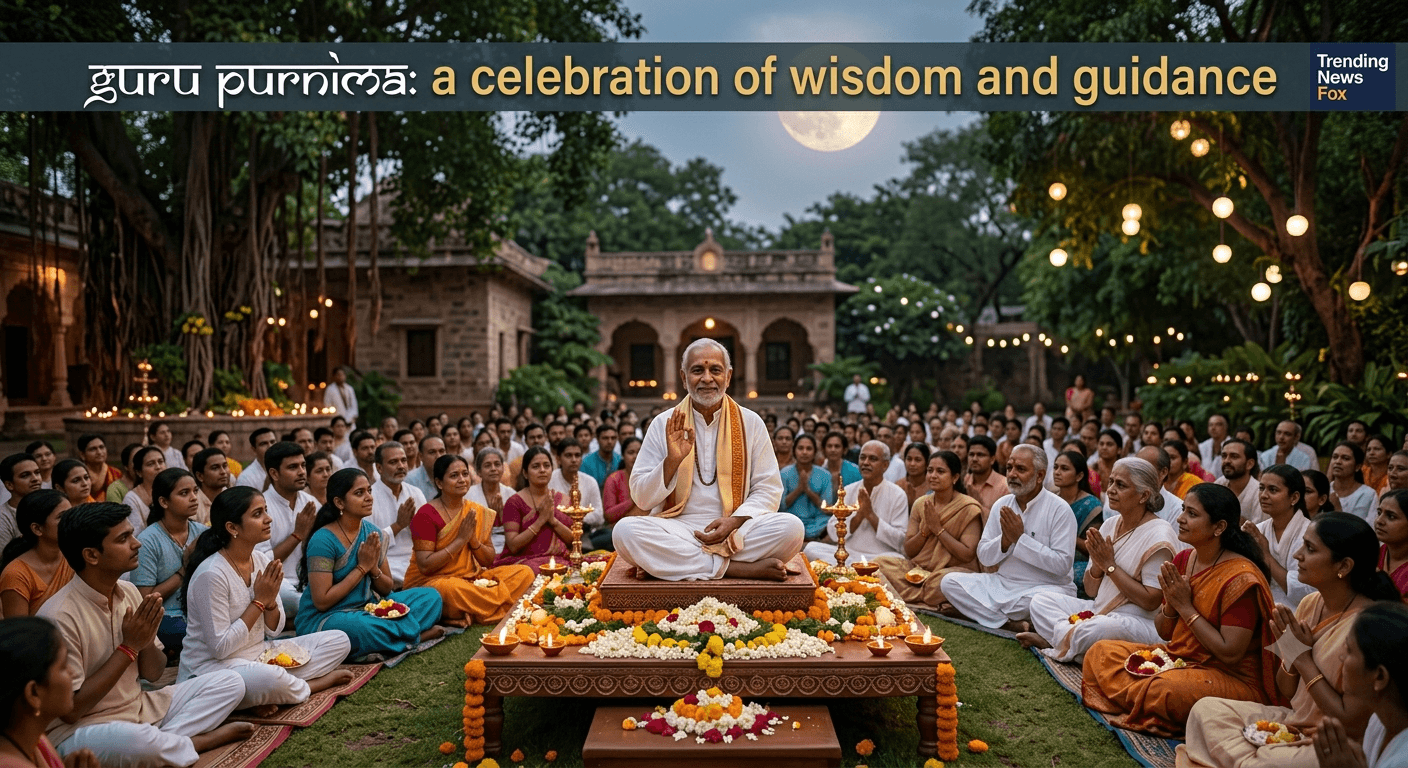
Explore the essence of Guru Purnima, a festival that pays tribute to the wisdom of teachers. Learn about its rituals and cultural importance in various traditions.
By Trending News Fox, News & Media Team, Kolkata
What is the Significance of Guru Purnima? Unpacking the History, Spiritual Meaning, and Modern Traditions
Across the globe, millions of people come together during the full moon day of the Hindu month of Ashadha (June–July) to observe Guru Purnima. While many traditional holidays focus on seasonal harvests or historical victories, Guru Purnima stands out for its deep focus on knowledge, mentorship, and spiritual evolution.
From ancient Vedic rituals to modern corporate offices and classrooms, Guru Purnima is a time to pause and pay tribute to those who guide us out of darkness and into enlightenment.

What Does “Guru Purnima” Mean?
To understand the day’s true significance, it helps to look at the Sanskrit root of the term:
- Gu (गु): Refers to darkness or ignorance.
- Ru (रु): Refers to the dispeller or remover.
- Purnima (पूर्णिमा): Means the full moon day.
Therefore, a Guru is literally “one who dispels the darkness of ignorance,” and Guru Purnima is the full moon dedicated to honoring these light-bearers in our lives.
“Guru Brahma, Guru Vishnu, Guru Devo Maheshwara; Guru Sakshat Parabrahma, Tasmai Shree Gurave Namaha.”
— A ancient Sanskrit mantra signifying that the mentor embodies the ultimate guiding forces of creation, sustenance, and transformation.
Historical and Mythological Origins
Guru Purnima is uniquely celebrated across multiple traditions, including Hinduism, Buddhism, and Jainism, each attaching its own historical milestone to this sacred day.
┌─────────────────────────────────────────────────────────────────┐
│                    TRADITIONAL ORIGINS                          │
├─────────────────┬───────────────┬───────────────────────────────┤
│ Tradition       │ Key Figure    │ Historical Milestone          │
├─────────────────┼───────────────┼───────────────────────────────┤
│ Hinduism        │ Sage Vyasa    │ Birthday & Compilation of     │
│                 │               │ the Four Vedas                │
├─────────────────┼───────────────┼───────────────────────────────┤
│ Buddhism        │ Lord Buddha   │ First Sermon at Sarnath       │
│                 │               │ (Dhammacakkappavattana Sutta) │
├─────────────────┼───────────────┼───────────────────────────────┤
│ Jainism         │ Lord Mahavira │ First disciple (Gautam Swami) │
│                 │               │ accepted                      │
└─────────────────┴───────────────┴───────────────────────────────┤
1. Vyasa Purnima (Hinduism)
In Hindu tradition, Guru Purnima is widely celebrated as Vyasa Purnima to mark the birth anniversary of Maharishi Ved Vyasa. Sage Vyasa is regarded as the primordial Guru because he organized the single, vast Veda into four distinct texts—Rigveda, Samaveda, Yajurveda, and Atharvaveda—and authored the Mahabharata and the Puranas.
2. Buddha’s First Sermon (Buddhism)
For Buddhists, this day marks the momentous occasion when Gautama Buddha, after attaining enlightenment under the Bodhi tree in Bodh Gaya, traveled to Sarnath. There, on the full moon night of Ashadha, he delivered his first sermon to his five former companions, setting in motion the Wheel of Dharma (Dhammacakkappavattana Sutta).
3. The Beginning of Tirthankara Discipleship (Jainism)
In Jain tradition, Guru Purnima marks the day Lord Mahavira, the 24th Tirthankara, made Indraformation (Gautam Swami) his first direct disciple (Ganadhara), thereby establishing the formal teacher-disciple lineage in Jainism.
Key Cultural and Spiritual Traditions
Across regions and communities, several core rituals define how Guru Purnima is observed:
- Guru Puja & Vandana: Disciples pay direct respect to their spiritual teachers, academic professors, or life mentors through prayers, offering flowers, and seeking blessings.
- Offering Gurudakshina: A traditional practice where students offer a token of gratitude—which can range from gifts and dakshina (contributions) to promises of selfless service (seva).
- Recitation and Satsang: Devotees gather to chant sacred texts, study scriptures like the Bhagavad Gita or Upanishads, and meditate.
- Fasting and Sattvic Diet: Many observe a day-long fast or consume light, wholesome (sattvic) meals to detoxify both body and mind under the peak lunar energy.
Why Guru Purnima Matters in the Modern Era
In today’s fast-paced, tech-driven world, knowledge is accessible with a single click or prompt. However, knowledge without wisdom can lead to confusion. This is where the significance of a Guru or mentor remains invaluable:
- Transforming Information into Wisdom: While search engines provide facts, a mentor provides perspective, context, and ethics.
- Cultivating Humility and Gratitude: Celebrating Guru Purnima reminds us that no success is entirely self-made; we stand on the shoulders of teachers, parents, coaches, and seniors.
- Emotional and Spiritual Grounding: The full moon’s gravitational pull has long been associated with heightened mental energy. Dedicating this night to reflection helps channel that energy into clarity, calm, and focus.
Quick Reference Summary
| Feature | Details |
| Timing | Full Moon (Purnima) of Ashadha Month (July/August) |
| Core Theme | Gratitude, Mentorship, Knowledge, Spiritual Awakening |
| Alternate Name | Vyasa Purnima |
| Observed By | Hindus, Buddhists, Jains, and spiritual seekers worldwide |
| Primary Act | Expressing reverence to teachers, academic mentors, and spiritual leaders |
Final Thoughts for Trending News Fox Readers
Guru Purnima is ultimately more than an ancient calendar date—it is a timeless reminder of human connection and lifelong learning. Whether your “Guru” is a spiritual master, an academic teacher, a workplace mentor, or a parent, taking a moment on this full moon day to express genuine gratitude can transform relationships and bring deep personal fulfillment.
What is the Significance of Guru Purnima? Everything You Need to Know
Trending News Fox | News Desk
Guru Purnima is one of the most revered dates on the Indian cultural and spiritual calendar. Falling on the full moon day (Purnima) of the Hindu month of Ashadha (June–July), it is a day dedicated to honoring teachers, mentors, and spiritual guides who illuminate our path and remove the darkness of ignorance.
Unlike many traditional Indian festivals centered on worshipping deities, Guru Purnima centers on human connection—specifically, gratitude for the transmission of wisdom.
Frequently Asked Questions (FAQs)
1. What is the main significance of Guru Purnima?
Guru Purnima is celebrated to express deep gratitude to gurus, spiritual masters, academic teachers, and personal mentors. In Indian tradition, a teacher is considered the bridge between an individual and higher consciousness. The festival highlights the sacred bond between a teacher (Guru) and a disciple (Shishya), acknowledging that true growth is impossible without guidance.
2. When is Guru Purnima celebrated in 2026?
In 2026, Guru Purnima falls on Wednesday, July 29. According to the Panchang, the Purnima Tithi begins on the evening of July 28 and concludes on the evening of July 29. Since the full moon is present at sunrise on July 29, the auspicious rituals and observances take place throughout that day.
3. What does the word “Guru” literally mean?
The word Guru comes from two Sanskrit roots:
- Gu: Means darkness or ignorance.
- Ru: Means remover or dispeller.
Together, a Guru is “the dispeller of darkness”—someone who transforms ignorance into awareness and clarity.
4. Why is Guru Purnima also called Vyasa Purnima?
Guru Purnima marks the birth anniversary of Maharishi Ved Vyasa, one of the greatest sages in Sanatana Dharma.
| Contribution of Ved Vyasa | Significance |
| Compilation of Vedas | Organized the vast oral knowledge of the ancient world into four distinct Vedas (Rig, Sama, Yajur, and Atharva). |
| Authoring Epics & Texts | Composed the Mahabharata, the 18 Puranas, and the Brahma Sutras. |
| Symbol of the First Guru | Honored as the Guru of Gurus (Adi Guru) for making ancient spiritual wisdom accessible. |
Because Vyasa laid the foundation for systematic learning, the day is widely celebrated as Vyasa Purnima or Vyasa Puja.
5. How is Guru Purnima celebrated across different religions?
Guru Purnima holds profound historical and spiritual significance in multiple faith traditions:
- Hinduism: Honors Ved Vyasa, spiritual lineage (Parampara), and current spiritual masters.
- Buddhism: Commemorates the day Lord Buddha delivered his first sermon at Sarnath to his first five disciples, five weeks after attaining enlightenment beneath the Bodhi tree.
- Jainism: Marks the day Lord Mahavira, the 24th Tirthankara, accepted his chief disciple Gautam Swami, making Mahavira a Guru for the first time.
- Yogic Tradition: Celebrates Adiyogi (Lord Shiva) transforming into the first Guru by imparting the science of yoga to the Saptarishis (the seven ancient sages).
6. What are the traditional rituals performed on Guru Purnima?
Devotees and students observe the day through several traditional practices:
- Guru Puja: Performing prayers, lighting lamps, and offering flowers, sweets, or fruits to one’s spiritual guide or teachers.
- Guru Dakshina: Offering a token of gratitude, respect, or voluntary service to the mentor.
- Paduka Puja: In traditional ashrams, worshipping the sacred footwear (Padukas) of the guru to symbolize walking in their footsteps.
- Fasting & Meditation: Observing a light sattvic fast and dedicating time to reflection, chanting, or studying sacred texts.
7. How can you observe Guru Purnima if you don’t have a formal spiritual Guru?
You do not need an ashram or a formal master to observe Guru Purnima. The essence of the day is recognizing who helped you grow:
3 Meaningful Ways to Celebrate:
- Express Personal Gratitude: Call, write, or visit school teachers, university professors, career mentors, or parents who guided your path.
- Honor Maharishi Vyasa or Nature: Set up a clean space at home, light a diya, and offer a quiet moment of gratitude to universal teachers like nature or classic books.
- Support Education: Donate books, sponsor a student’s fees, or volunteer to teach someone a practical skill.
8. How does Guru Purnima differ from Modern Teachers’ Day?
While modern Teachers’ Day (observed on September 5 in India) focuses primarily on academic educators in formal schooling, Guru Purnima is an ancient, holistic celebration. It encompasses spiritual guides, life mentors, parents, and cosmic knowledge, focusing deeply on character transformation and internal awakening rather than formal academic learning alone.