Discover robust trading infrastructure solutions designed to enhance your trading efficiency and performance. Optimize your strategies with our advanced technology.
By Trending News Fox, News & Media Team, Kolkata
The Invisible Engine: What Is Trading Infrastructure and Why It Matters in 2026
When we think of modern financial markets, our minds usually gravitate toward complex charts, fluctuating tickers, and high-stakes split-second decisions. But behind every flashing price quote and executed order lies a massive, highly sophisticated, and invisible digital universe: trading infrastructure.



In an era dominated by algorithmic models, artificial intelligence, and high-frequency trading (HFT), the competitive landscape is no longer shaped purely by what you trade, but how your technology executes it. For financial institutions, hedge funds, and retail platforms alike, trading infrastructure is the definitive line between multi-million dollar profits and devastating slippage.
Here is an investigative look by Trending News Fox into what trading infrastructure actually is, how it operates under the hood, and why it has become the most critical asset in global finance.
Defining Trading Infrastructure: The Modern Highway of Wealth
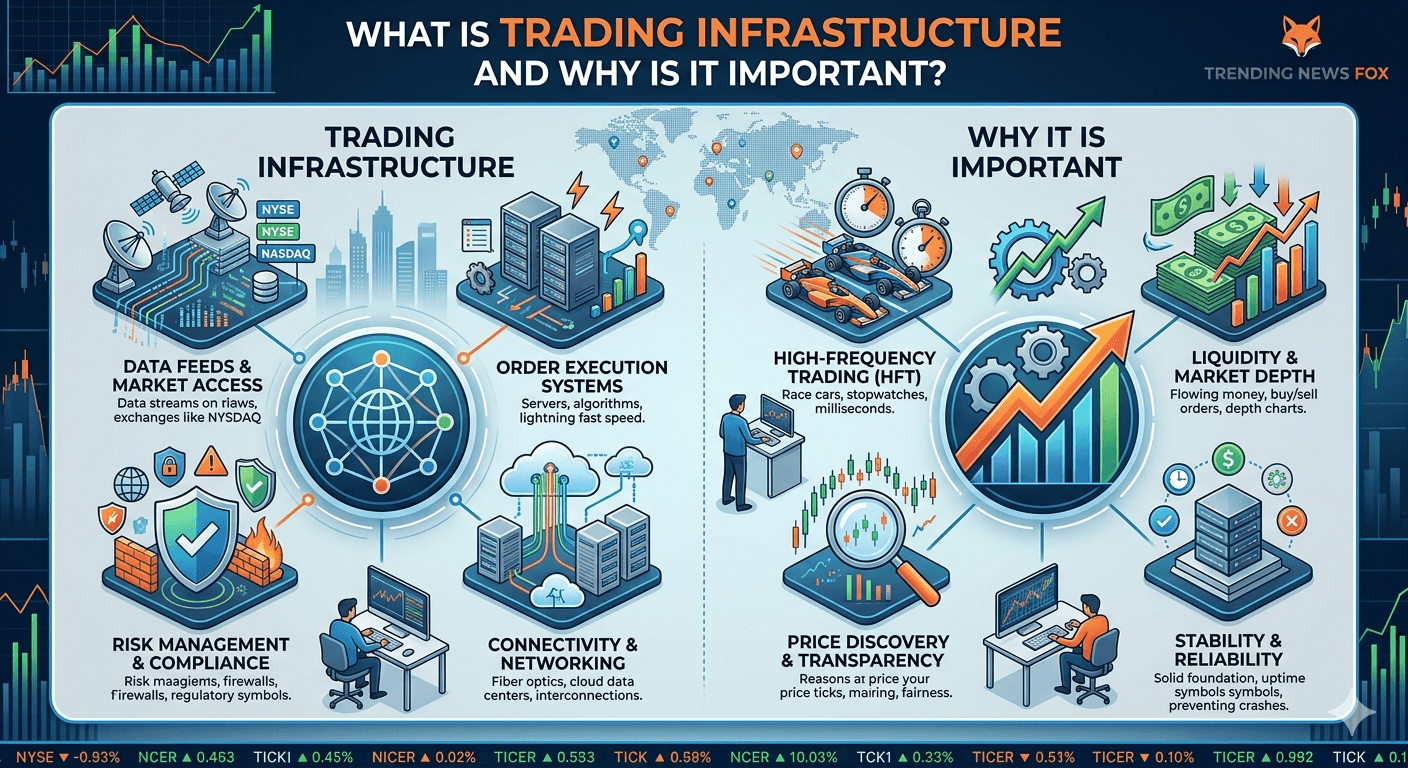
At its core, trading infrastructure is the comprehensive network of hardware, software, telecommunications, data frameworks, and protocols that allow a trade to be initiated, verified, routed, executed, and settled.
Think of it as the ultimate financial highway system. A trader’s decision to buy or sell is the vehicle, but trading infrastructure comprises the roads, traffic lights, toll booths, and GPS tracking that ensure the vehicle reaches its destination safely and ahead of the competition.
Importantly, infrastructure itself does not make investment decisions or predict stock trends. Instead, it serves as the neutral, mission-critical foundation that allows the global economy’s blood—liquidity—to flow continuously without clotting.
The Core Blueprint: Anatomy of a High-Performance Trading Stack
To understand why this technology is so vital, we have to look at the specialized layers that form a modern institutional trading stack. Today’s infrastructure combines cutting-edge physical engineering with complex software design.
+-------------------------------------------------------------+
|                     APPLICATION LAYER                       |
|         (Algorithmic Models, AI & Execution Logic)          |
+-------------------------------------------------------------+
                              │
                              ▼
+-------------------------------------------------------------+
|                       SOFTWARE STACK                        |
|        (Rust / C++ Engines, Lock-Free Ring Buffers)         |
+-------------------------------------------------------------+
                              │
                              ▼
+-------------------------------------------------------------+
|                      HARDWARE SPEEDWAY                      |
|       (FPGA Acceleration, SmartNICs, Low-Latency ASICs)     |
+-------------------------------------------------------------+
                              │
                              ▼
+-------------------------------------------------------------+
|                   PHYSICAL NETWORK COLO                     |
|    (Hollow-Core Fiber, Microwave Links, Exchange Racks)     |
+-------------------------------------------------------------+
1. Ultra-Low Latency Connectivity (The Physical Layer)
In the trading world, the speed of light through regular glass fiber-optic cables is often deemed “too slow.” Glass slows light down by roughly 33% compared to a vacuum. To bypass this, leading firms rely on Hollow-Core Fiber (HCF) cables—which pass light through air pockets to achieve near-vacuum speeds—alongside terrestrial microwave towers that slice over mountains and plains in straight lines to connect major financial hubs like Chicago and New York.
2. Colocation and Racking
Physical distance equals time delay. Trading infrastructure heavily relies on colocation, where firms pay premium real estate fees to house their servers within the exact same data centers that contain the exchange’s matching engines. To maintain strict fairness, clearing regulators ensure that every single participant’s server rack uses exactly identical lengths of yellow fiber cable so that no single rack gets a nanosecond advantage based on physical proximity.
3. Hardware Acceleration (ASICs and FPGAs)
Traditional operating systems and CPUs introduce unpredictable processing delays known as jitter. Modern trading infrastructure circumvents this by embedding execution logic directly onto silicon using Field Programmable Gate Arrays (FPGAs) and application-specific integrated circuit (ASIC) network cards. These custom microchips process incoming market data packets and route orders at the hardware level in mere nanoseconds, bypassing the time-consuming software operating system altogether.
4. High-Performance Software Architecture
When software is required for heavy algorithmic processing, the infrastructure must be written in low-level languages like C++ or Rust. These frameworks give engineers precise control over memory management, avoiding “garbage collection” pauses common in languages like Java or Python that can stall a system mid-trade.
Why Trading Infrastructure Is Critically Important
Without a robust infrastructure, the global financial machine would grind to a halt. While retail investors rarely see it, institutional players spend billions annually optimizing their infrastructure for several foundational reasons:
Trading Infrastructure: Eliminating Price Slippage
Slippage occurs when a trader executes an order at a different price than what was originally quoted. In volatile markets, a delay of just 5 milliseconds can cause a stock price to tick upward, costing a fund thousands of dollars on a single block order. High-quality trading infrastructure ensures a highly reliable tick-to-trade timeline, maximizing the probability that the price you see is the exact price you get.
Trading Infrastructure: Managing Toxic “Data Bursts”
Financial markets do not move in smooth, predictable flows; they hit systems in explosive, unpredictable waves following major macroeconomic announcements or black swan events. A robust infrastructure possesses the internal bandwidth to process millions of messages per second without dropping packets or crashing under sudden stress.
Trading Infrastructure: Preserving Financial Stability & Compliance
Trading systems must adhere to strict international regulatory frameworks, such as Europe’s Digital Operational Resilience Act (DORA). The infrastructure must automatically implement automated pre-trade risk checks to block erratic, erroneous algorithms before they trigger catastrophic events like a “flash crash.”
The Big Split: Private Infrastructure vs. The Public Cloud
A massive debate is currently playing out across Wall Street and global tech hubs regarding where this infrastructure should live.
According to market research from Coalition Greenwich, despite the massive enterprise push toward public cloud platforms like AWS and Google Cloud, 53% of financial firms strictly maintain on-premise, private infrastructure for their front-office operations.
| Infrastructure Type | Primary Workloads | Key Advantages | The Trade-off |
| Private On-Premise / Colocation | Front-Office, Live Order Execution, High-Frequency Trading | Predictable nanosecond latency, full physical control, custom hardware tuning | Exponentially higher capital expenditure (CapEx) |
| Public Cloud Ecosystems | Post-Trade Settlement, Quantitative Backtesting, Compliance Auditing | Limitless elastic storage, rapid scalability, lower maintenance overhead | Unpredictable network hops and microsecond delays |
While the public cloud is perfect for analyzing historical data or handling back-office accounting, it cannot yet match the hyper-deterministic, ultra-low latency requirements needed to instantly fight for order fills at the exchange matching engines. Consequently, a hybrid architecture remains the gold standard for top-tier firms.
The New Frontier: Artificial Intelligence and Liquid-Cooled Futures
As we navigate through the year, the demands on trading infrastructure are mutating rapidly due to the explosive integration of generative AI and machine-learning models into trade execution.
Audio Podcast Below:-
Traditional servers are ill-equipped to handle the massive mathematical computation required by live AI models evaluating sentiment analysis and market order books simultaneously. This shift is forcing data centers to reinvent themselves. Modern trading infrastructure is rapidly shifting toward specialized AI clusters packed with massive graphic processing units (GPUs) that require complex liquid-cooling setups and ultra-fast optical switching networks to operate without melting under the processing strain.
Trading Infrastructure: Final Thoughts from Trending News Fox
Ultimately, trading infrastructure is the great equalizer and divider of modern finance. It represents the quiet convergence of quantum physics, advanced software engineering, and global economics.
Video Podcast Below:-
For the average retail investor using a smartphone app, trading infrastructure ensures that your market orders are filled safely and accurately within the blink of an eye. For the global institution, it is a relentless, nanosecond-by-nanosecond arms race where having the second-fastest infrastructure is just an expensive way to lose. As markets grow more automated, the entities that invest in building the fastest, most resilient digital highways will continue to dominate the financial landscape.