Enhance your business with our expert supply logistics strategies, focusing on cost reduction, timely delivery, and seamless supply chain management.
TRENDING NEWS FOX
Special Business Report | Deep Dive
Navigating the Grid: What Are the Key Components of Supply Logistics?
By Trending News Fox Editorial Team
Published: June 16, 2026
Mastering Supply Logistics: A Step-by-Step Guide
In an era defined by rapid technological shifts, geopolitical instability, and surging e-commerce demands, the phrase “supply chain breakdown” has transitioned from a boardroom headache to a household concern. Global networks have shifted permanently into an era where disruption is the rule rather than the exception. More than 80% of global companies now expect recurring impacts on their operations due to climate volatility and trade complications.

For businesses fighting to maintain a competitive edge, understanding the mechanics of supply logistics—the systemized planning, execution, and control of the movement of goods and information—is no longer just about cutting costs. It is about survival.
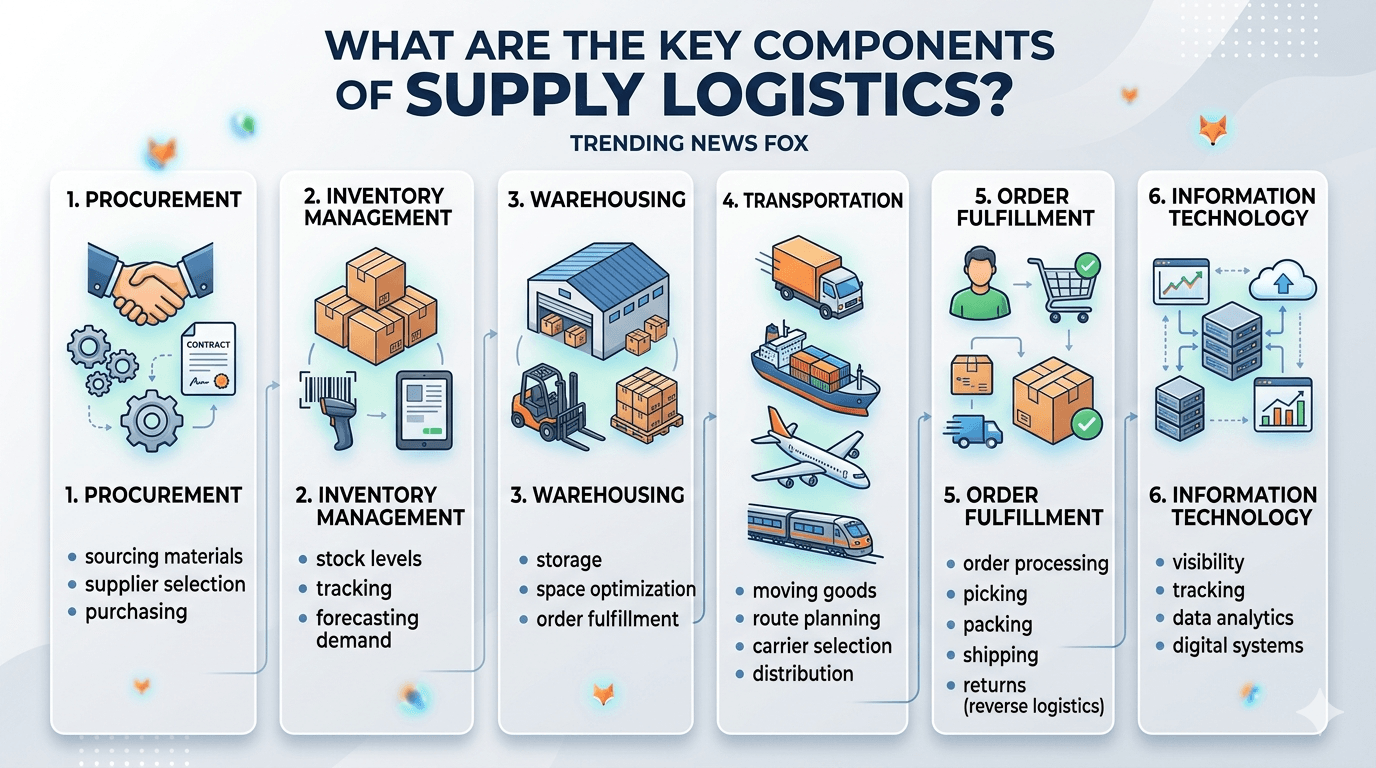
What keeps these networks fluid when the world around them is volatile? The answer lies in the flawless integration of several foundational pillars. The following core components dictate whether a product successfully makes the journey from a raw concept into the consumer’s hands.
Unlocking the Secrets of Efficient Supply Logistics
1. Demand Sifting and Inventory Optimization
At the heart of any logistics network sits a foundational question: How much product do we actually need, and where should it sit?
Historically, companies relied on periodic historical averages to guess future sales. In today’s volatile climate, that model has crumbled. Logistics leaders are pivoting to continuous planning models, leaning heavily on artificial intelligence and machine learning to sense real-time market shifts.
Inventory management acts as the balancing weight in this equation. Holding too much product locks up cash flow and escalates storage fees; holding too little leads to stockouts, delayed shipments, and alienated customers. Modern logistics leverages dynamic analytics to determine precise safety stock levels, absorbing sudden demand spikes or transport delays without overwhelming the warehouse.
2. Warehousing and Intelligent Material Handling
Warehouses are no longer static storage hubs filled with dusty boxes. They have evolved into highly automated fulfillment nodes designed for rapid, precise execution.
The physical layout of these spaces, known as slotting optimization, ensures that high-velocity items are staged near loading docks to slash picking times. Within these walls, several critical sub-components keep goods moving:
- Receiving and Put-Away: Validating arriving freight against digital purchase orders and assigning them to precise, retrievable rack positions.
- Order Picking and Sorting: Deploying advanced systems like autonomous guided vehicles (AGVs) and sorting machines to collect products for specific orders rapidly.
- Packaging and Staging: Boxing goods securely to minimize damage during transit while standardizing dimensions to optimize the utilization of cargo space.
[Inbound Freight] ➔ [Automated Put-Away] ➔ [Intelligent Slotting] ➔ [AGV Picking] ➔ [Outbound Staging]
3. Multimodal Transportation and Fleet Management
Transportation is frequently the most visible—and most expensive—component of supply logistics. It represents the physical threads connecting suppliers, manufacturers, distribution centers, and end users.
As global transport markets experience severe carrier consolidations and unpredictable fuel volatility, the most resilient strategies utilize an intermodal approach. This means seamlessly blending multiple modes of transport to bypass bottlenecks and lower carbon footprints.
| Transport Mode | Primary Advantage | Typical Strategic Use Case |
| Ocean Freight | Unmatched capacity, low relative cost | Bulk raw materials, non-urgent consumer goods |
| Air Freight | Maximum speed, high reliability | High-value electronics, pharmaceuticals, critical replacement parts |
| Rail Freight | High overland fuel efficiency | Heavy industrial goods, cross-continental lanes |
| Motor Freight (Trucking) | Absolute flexibility, door-to-door access | First-mile collections, middle-mile transfers, and retail fulfillment |
Managing these moving parts relies heavily on a Transportation Management System (TMS). This software acts as a digital traffic controller, routing shipments along optimal paths, consolidating loads to avoid empty trailers, and tracking carrier performance metrics in real time.
4. Packaging and Unitization
Often overlooked, packaging is a critical link between manufacturing and transport. If a product is poorly packaged, it can break during transport, ruin warehouse storage space, or fail to fit neatly on standard shipping pallets.
Logistics focuses heavily on unitization—the practice of grouping individual items into a single, standard unit (like a shrink-wrapped pallet or a shipping container). This standardization allows forklifts, cranes, and automated conveyor systems to move massive volumes of diverse goods without constantly resetting their equipment. Furthermore, industrial trends heavily favor reusable, standardized transport packaging, which dramatically reduces product damage while meeting strict environmental, social, and governance (ESG) metrics.
5. End-to-End Visibility and Information Flow
A physical item cannot move efficiently if the data surrounding it is laggy or fragmented. In modern logistics, reliable data is the most valuable asset a company can possess. Information flow dictates every single physical action: tracking customs clearances, sharing electronic bills of lading, issuing automated warehouse receipts, and analyzing real-time GPS coordinates.
To eliminate blind spots, enterprises are moving away from tracking only their direct, “Tier 1” partners. True resilience requires visibility deep into Tier 2 and Tier 3 suppliers to catch material shortages before they trigger a domino effect downstream.
This transparency is anchored by Logistics Control Towers—centralized data hubs fueled by Internet of Things (IoT) sensors, cloud computing, and automated workflows. These platforms don’t just show where a truck is on a map; they use predictive analytics to warn managers about incoming storms or port strikes, allowing teams to recalculate routes before the delay even occurs.
6. Reverse Logistics and Returns Architecture
Logistics doesn’t end when a package hits the customer’s doorstep. Driven by the explosion of e-commerce and a rising consumer demand for circular economies, reverse logistics—the flow of surplus, damaged, or returned goods back through the system—has become a make-or-break business function.
An efficient reverse logistics framework must handle:
- Gatekeeping and Inspection: Rapidly assessing returned items to determine if they can be repackaged and resold, refurbished, or completely recycled.
- Asset Recovery: Reclaiming financial value from returned goods through secondary outlet markets or salvage.
- Sustainable Disposal: Ensuring that unsalvageable materials are recycled or disposed of in strict accordance with environmental regulations, minimizing waste footprint.
The Next Horizon: Moving from Crisis Management to Automation
As we navigate the landscape of 2026, the traditional boundaries separating procurement, warehousing, and transportation are dissolving. The top-performing supply operations have transitioned from reactive “firefighting” to active, unified orchestration.
This transition is being accelerated by the rise of autonomous digital agents. Instead of merely generating dashboards for humans to review, embedded AI systems can now autonomously cross-reference regional demand spikes with real-time inventory shortages, query alternative suppliers, negotiate spot-freight pricing, and issue purchase orders within preset corporate guardrails.
Ultimately, supply logistics is no longer a back-office utility focused exclusively on shipping boxes at the lowest cost. It is a highly strategic, hyper-connected network. By mastering these key components—optimizing inventory through predictive intelligence, modernizing warehouse automation, leveraging flexible transport modes, and maintaining total data visibility—modern enterprises can transform their logistical networks from a point of vulnerability into an enduring competitive advantage.
Stay tuned to Trending News Fox for continued coverage on global economic trends, supply chain innovations, and deep-dive industry analyses.