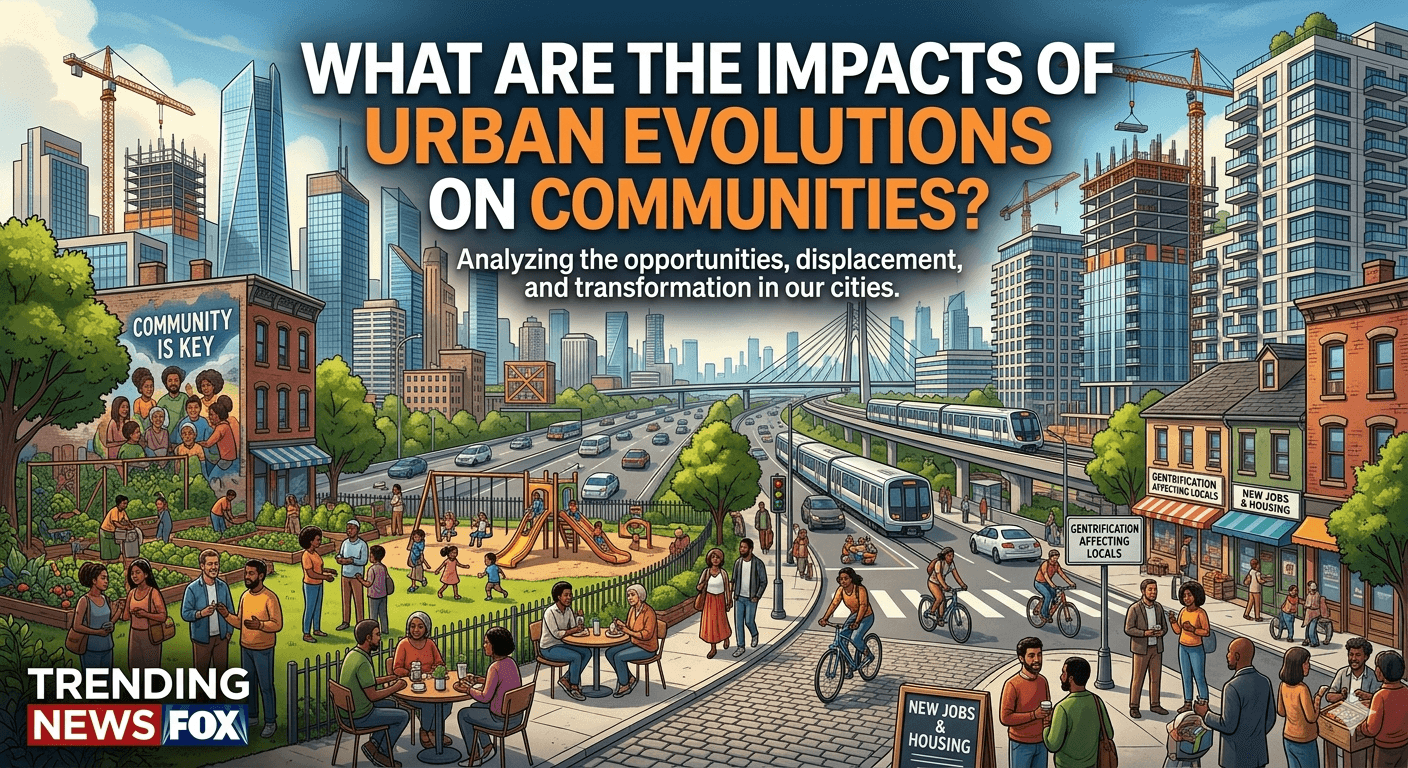
Discover Urban Evolutions, where innovative design meets sustainable living. Explore our projects that transform urban spaces into vibrant communities.
By Trending News Fox, News & Media Team, Kolkata
Concrete Jungle or Connected Communities? How Urban Evolution is Rewriting the Rules of Local Life
The global landscape is undergoing a massive facelift. For the first time in human history, more people live in urban areas than rural ones, and by the coming decades, the United Nations projects that nearly 70% of the world’s population will call a city home.


But this shift isn’t just about pouring more concrete or erecting taller glass towers. It is an era of radical urban evolution—a profound transformation in how cities are designed, wired, governed, and lived in. From the expansion of “smart city” grids and hyper-dense architectural concepts to climate-resilient engineering, the way our metropolitan spaces change directly dictates how we behave, work, and connect.
5 Key Trends in Urban Evolutions You Should Know
For Trending News Fox, we dive deep into the central question of modern civic life: What are the actual, ground-level impacts of urban evolution on our local communities?
1. The 15-Minute City: Reclaiming Time or Segmenting Society?
One of the most defining urban planning trends is the rise of human-centric design, epitomized by the 15-Minute City framework. Popularized in Paris and quickly adopted across European and North American metros, this model dictates that a resident’s daily necessities—work, groceries, education, healthcare, and leisure—should be accessible within a 15-minute walk or bike ride from their front door.
+-------------------------------------------------------------+
|                     THE 15-MINUTE CIRCLE                    |
|                                                             |
|          [Workplace]                  [Grocery Market]      |
|               \                             /               |
|                \                           /                |
|                 \                         /                 |
|   [Healthcare] --- ( YOUR FRONT DOOR ) --- [Public Park]    |
|                 /                         \                 |
|                /                           \                |
|               /                             \               |
|         [Schools]                         [Cafes & Culture] |
+-------------------------------------------------------------+
The Bright Side: Stronger Local Bonds
When cities scale down to a neighborhood level, the social fabric strengthens. Commute times drop dramatically, directly lowering carbon emissions and reducing individual stress levels. Residents spend more time in their immediate surroundings, patronizing local independent businesses and interacting with neighbors. This physical proximity fosters what sociologists call social capital—the networks of trust and mutual support that keep communities resilient during crises.
The Dark Side: The Risk of Enclaving
However, urban critics warn of a subtle danger: structural isolation. If neighborhoods become entirely self-contained, cities risk fracturing into socio-economic enclaves. Wealthier districts enjoy high-end amenities and green spaces, while historically underfunded sectors risk becoming isolated food deserts with poor infrastructure, trapping lower-income populations within a 15-minute radius lacking upward mobility.
2. The High Cost of Renewal: Gentrification and Cultural Displacement
Urban evolution frequently arrives disguised as “urban regeneration” or “neighborhood revitalization.” While the influx of capital into decaying industrial yards or neglected historic districts sounds universally positive, its shadow side—gentrification—remains one of the most disruptive forces facing urban communities today.
Urban Evolutions: The Inversion of Affordability
When developers transform historic brick factories into tech innovation hubs or trendy luxury lofts, property values and municipal taxes skyrocket. Data from long-term urban studies reveals a striking trend across major global metros: areas undergoing rapid physical upgrades witness a dramatic compositional shift in demographics.
Audio Podcast Below:-
According to census tracking data in historically marginalized urban centers, neighborhoods undergoing aggressive revitalization projects frequently see substantial drops in their long-standing minority and working-class populations over a single decade.
Urban Evolutions: The Psychological and Cultural Toll
The impact isn’t merely financial; it’s deeply psychological. Long-time residents who manage to absorb rising rents often experience displacement anxiety and cultural alienation. Mom-and-pop convenience stores, multi-generational community halls, and traditional cultural landmarks are progressively replaced by uniform, upscale retail chains. When the physical anchors of a community’s heritage are erased, the historical identity of the neighborhood is stripped away, leaving behind a sterile environment that prioritizes incoming wealth over existing culture.
3. Tech-Driven Living: The Era of Intelligent Infrastructure
Cities are no longer static blocks of stone and steel; they are becoming living, sensing data ecosystems. The emergence of intelligent infrastructure—the convergence of the Internet of Things (IoT), artificial intelligence, and physical assets—is radically changing how communities interface with their surroundings.
| Smart System component | Practical Urban Function | Real-World Community Impact |
| Hyper-Adaptive Mobility | Real-time traffic sensors & autonomous mass transit routing. | Drastically reduces transit wait times and cuts down urban gridlock. |
| Grid-Level AI Management | Smart building sensors that adjust power consumption dynamically. | Decreases a neighborhood’s aggregate carbon footprint and lowers utility strains. |
| Geospatial AI (GeoAI) | Interactive mapping of permits, zoning, and infrastructure health. | Streamlines municipal compliance and allows planners to deploy emergency services faster. |
While these advancements optimize municipal efficiency, they introduce a distinct societal challenge: the digital divide. Low-income neighborhoods frequently lack the underlying high-speed fiber infrastructure or digital literacy programs required to leverage these smart services. If a city’s transport, emergency alerts, and public services migrate entirely to a smartphone-dependent “Mobility-as-a-Service” (MaaS) interface, vulnerable populations risk being locked out of essential municipal systems entirely.
4. Designing for Survival: Climate Resilience and “Sponge Cities”
As extreme weather patterns escalate into an undeniable global reality, urban evolution has shifted from an aesthetic pursuit to a strategy for pure survival. Modern architecture and civil engineering are increasingly prioritizing ecological preservation and climate defense over unbridled expansion.
Video Podcast Below:-
The concept of Sponge Cities—pioneered in flood-prone Asian and northern European metropolises—is a prime example. Rather than funneling stormwater exclusively through rigid concrete pipe networks, cities are being refitted with permeable asphalt, urban wetlands, rain gardens, and floodable public parks.
[ Heavy Rain Influx ]
         │
         ▼
 ┌──────────────┐      ┌─────────────────┐      ┌─────────────────┐
 │ Permeable    │ ───► │ Urban Wetlands  │ ───► │ Underground     │
 │ Streets      │      │ & Rain Gardens  │      │ Reservoir Parks │
 └──────────────┘      └─────────────────┘      └─────────────────┘
         │                      │                        │
         └──────────────────────┴────────────────────────┴───► [ Natural, Gradual
                                                                Drainage into Aquifers ]
During dry spells, these areas serve as standard basketball courts, community plazas, and recreational green spaces. During flash storms, they intentionally submerge, absorbing millions of gallons of water to safeguard surrounding residential structures.
Urban Evolutions: The Environmental Justice Gap
However, environmental stressors are rarely distributed equally. Dense, low-income districts typically suffer from the urban heat island effect—where vast swathes of asphalt and a lack of tree cover cause local temperatures to climb significantly higher than neighboring, affluent suburban areas.
When city governments invest heavily in green walls, urban forests, and climate-resilient architecture, prioritizing these premium features in financial and tourist districts while ignoring informal settlements or working-class quarters turns environmental sustainability into a tool of economic exclusion rather than collective protection.
5. The Democratic Shift: Participatory Urban Planning
Perhaps the most encouraging impact of modern urban evolution is the democratization of city planning itself. Historically, cities were designed from the top down by master builders and bureaucratic committees, leaving local communities completely detached from the choices shaping their horizons.
Today, advanced digital planning tools and interactive geographic information software (GIS) allow citizens to preview proposed neighborhood developments in real-time. Communities can actively participate in:
- Participatory Budgeting: Allocating a direct percentage of municipal tax revenue to localized, grassroots projects chosen by neighborhood vote.
- Co-Design Workshops: Partnering with architectural firms via digital simulation tools to dictate where new public parks, affordable housing complexes, or bike lines belong.
When municipal authorities actively empower long-standing residents to influence the development roadmap, the negative side effects of urban evolution—like cultural alienation and infrastructure disparity—are severely mitigated.
The Trending News Fox Takeaway: Balance is the Ultimate Blueprint
The evolution of the modern city is inevitable, but its final destination remains unwritten. Urban evolution can either act as an equalizer—providing cleaner air, resilient infrastructure, and vibrant local economies through human-scale design—or it can act as an engine of division, accelerating displacement and isolating those who cannot afford the price of admission to a “smart” neighborhood.
The ultimate benchmark of a successful city is not the height of its skyline or the complexity of its digital network. It is how safely, equitably, and comfortably it supports the community living on its streets. As we navigate this era of radical urban reinvention, balancing commercial progress with cultural preservation is the only sustainable blueprint forward.