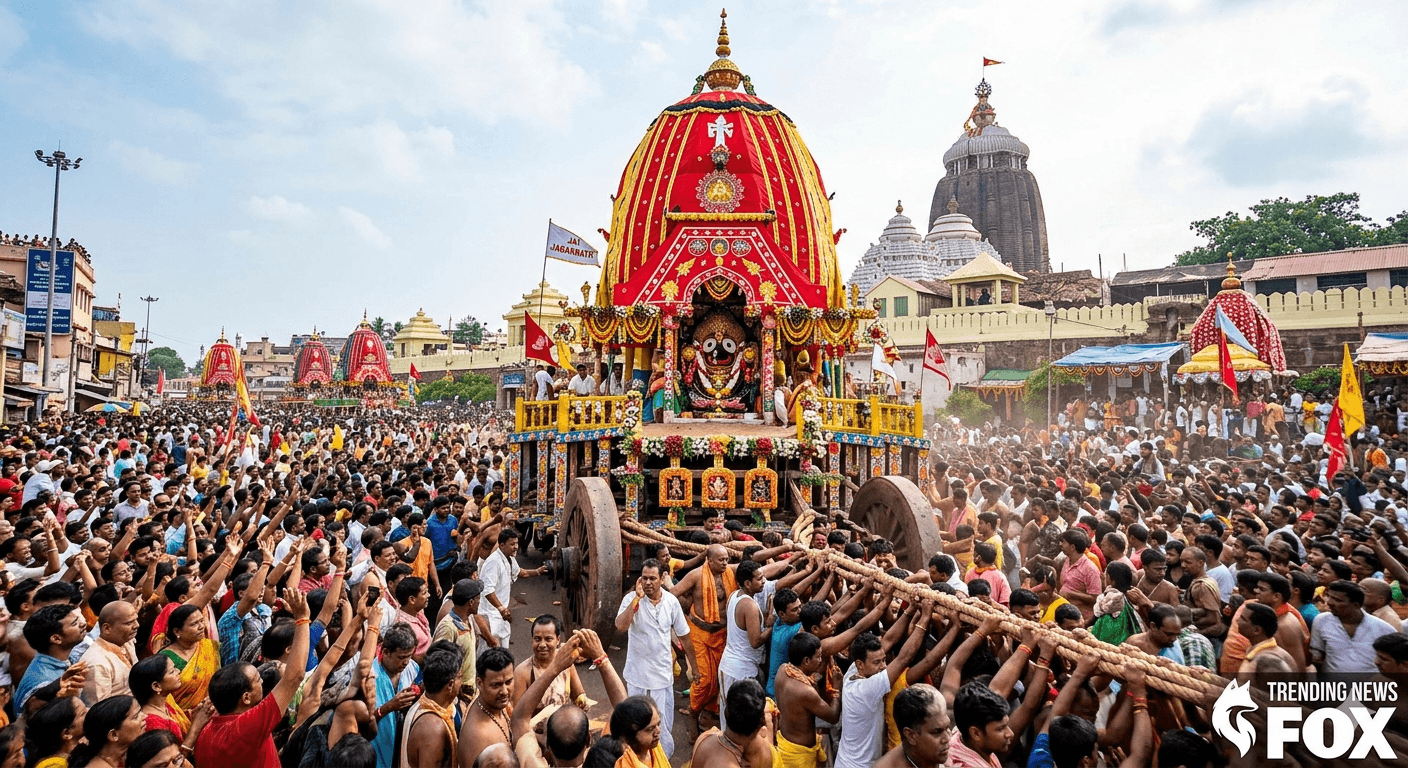
Experience the rich traditions of Ratha Jatra, where devotees gather to celebrate Lord Jagannath’s journey in magnificent chariots filled with joy and devotion.
Chariots of Devotion: Inside the Global Phenomenon of Puri Ratha Jatra
By Trending News Fox Culture Desk
The air in the coastal town of Puri, Odisha, carries a weight that is both literal and spiritual. Underneath the blazing mid-summer sky, the salty tang of the Bay of Bengal mixes with the sharp, earthy scent of fresh neem wood, crushed marigolds, and burning camphor. But the true defining characteristic of this landscape is the sound—a deafening, rhythmic wall of noise composed of crashing cymbals (manjira), deep-throated blowing of conch shells, and the ecstatic chants of “Jai Jagannath!” rising from a crowd of over a million people.
This is the Ratha Jatra (often spelled Ratha Yatra), the world’s oldest and largest annual chariot festival. While India is home to countless religious gatherings, the Rath Jatra of Puri stands entirely distinct. It is a spectacle of massive architectural undertaking, centuries-old ritual precision, and a profound philosophical inversion: the Lord of the Universe leaving his cloistered temple sanctum to walk—and roll—among the common people.
For our readers at Trending News Fox, we dive deep into the multi-layered world of this ancient celebration, exploring its historical roots, its breathtaking engineering, and why it continues to capture global attention.
The Divine Outing: Breaking the Temple Barriers
At the heart of the Ratha Jatra is a surprisingly intimate, emotional narrative. In mainstream Hindu practice, deities reside deep within the inner sanctum (Garbhagriha) of a temple. Devotees must travel to them, waiting in long lines for a fleeting glimpse, known as darshan.
However, Lord Jagannath (a vibrant, localized manifestation of Lord Vishnu/Krishna), alongside his elder brother Balabhadra and younger sister Subhadra, upends this tradition entirely once a year.
The festival commemorates the deities’ annual journey to their birthplace and maternal aunt’s home, the Gundicha Temple, located roughly three kilometers down the Bada Danda (the Grand Avenue) of Puri. Historically, this procession holds massive social egalitarian significance. For centuries, various marginalized groups, non-Hindus, and foreigners were barred from entering the main 12th-century Jagannath Temple due to strict orthodox rules.
By stepping out onto the public streets, Jagannath becomes available to all. The deity steps down from his throne so that any human being, regardless of caste, creed, or nationality, can look him in the eyes and pull his chariot. It is a profound theological statement wrapped in a public carnival.
The Architecture of Faith: Engineering Three Titanic Chariots
One of the most mind-boggling aspects of the Ratha Jatra is that its colossal wooden chariots are built entirely from scratch every single year—and they are constructed without a single metal nail, screw, or modern structural blueprint.
The construction begins months earlier on the auspicious day of Akshaya Tritiya. A specialized guild of carpenters (Maharanas), who hold hereditary rights to this sacred task, rely entirely on memory, traditional geometric measuring strings, and hand tools passed down through generations. The timber—historically gifted by local royalty and now provided by the state government—is floated down the Mahanadi River in massive rafts before being hauled to Puri by road.
Each of the three deities has a unique chariot tailored to their specific spiritual iconography:
1. Nandighosha (The Chariot of Lord Jagannath)
- Height: 44 feet, 2 inches
- Wheels: 16 massive wooden wheels
- Colors: Draped in vibrant yellow and red cloth, matching the colors associated with Lord Krishna.
- Guardians: Guarded by the bird-deity Garuda.
2. Taladhwaja (The Chariot of Lord Balabhadra)
- Height: 43 feet, 3 inches
- Wheels: 14 wheels
- Colors: Wrapped in green and red cloth. Balabhadra is associated with agriculture and primal strength, symbolized by the palm tree motif on his flag.
3. Darpadalana (The Chariot of Devi Subhadra)
- Height: 42 feet, 3 inches
- Wheels: 12 wheels
- Colors: Covered in black and red cloth. It carries the fierce yet protective energy of the sister goddess.
The sheer size of these structures is what gave birth to the English word “juggernaut.” When 14th-century European travelers, such as the Franciscan friar Odoric of Pordenone, first witnessed these unyielding, titanic wooden structures rolling down the streets pushed by thousands of frantic worshippers, they struggled to describe it. Over time, the mispronounced name of the deity, Jagannath, morphed into the term used to describe an unstoppable, crushing force.
Chronology of the Festival: A Nine-Day Divine Drama
The Ratha Jatra is not a single-day event; it is a highly choreographed, nine-day mythological drama that progresses through precise, unyielding phases.
Snana Purnima
15 Days Before Jatra
The deities are taken to a high bathing platform and washed with 108 pitchers of ritually purified water. According to legend, this heavy bath causes the deities to catch a fever. They are placed in isolation (Anasara) for a fortnight, during which the temple doors remain closed to the public.
Sri Gundicha Jatra (The Grand Procession)
Day 1
The festival officially begins. The deities are brought out of the temple in a wild, rhythmic movement called Pahandi—where massive crowds sway as the heavy wooden idols are carried to their chariots. After the King of Puri sweeps the platforms, the massive ropes are pulled, and the chariots roll toward the Gundicha Temple.
Hera Panchami
Day 5
A dramatic ritual illustrating divine marital discord. Goddess Lakshmi, left behind in the main temple, grows angry at her husband, Lord Jagannath, for going on a vacation without her. She travels in secret to the Gundicha Temple, orders her followers to break a piece of Jagannath’s chariot as a warning, and escapes back via a side alley.
Bahuda Jatra (The Return Journey)
Day 9
After a week-long stay at their aunt’s house, the deities begin their return journey back to the Shree Mandir. On the way back, the chariots stop briefly at the Mausi Maa (Aunt’s) Temple, where the deities are offered Poda Pitha, a traditional baked rice cake.
Suna Besha & Adhara Pana
Day 10 – 11
Once back outside the main temple, the deities remain on their chariots for a public viewing. In an astonishing display of wealth and artistry, they are dressed in Suna Besha—adorned with over 200 kilograms of pure gold ornaments. The next day, they are offered Adhara Pana, a sweet, nutritious drink served in massive earthenware pots that are broken intentionally on the chariot floor to liberate lingering spirits.
The Royal Sweeper: A Lesson in Equality
Among the tapestry of rituals that define the festival, none captures the socio-political imagination quite like the Chhera Pahanra.
Before the chariots can move an inch, the titular Gajapati King of Puri arrives in a grand palanquin. However, he does not come to conquer or command. Instead, dressed in humble white attire, he takes a gold-handled broom and sweeps the dust and sandalwood water from the wooden decks of all three chariots.
The Power of Symbolism: The Chhera Pahanra is a powerful historical equalizer. It sends a clear message to society: before the eyes of the divine, there is no hierarchy. The highest earthly monarch is nothing more than a humble street sweeper when it comes to serving the universe.
Ratha Jatra: A Global Juggernaut in the Digital Age
While the heart of the festival remains firmly rooted in the soil of Odisha, the modern era has transformed the Ratha Jatra into a highly globalized phenomenon. Through the efforts of spiritual movements like ISKCON (International Society for Krishna Consciousness), sister chariot festivals are now celebrated on the exact same day in hundreds of cities worldwide, from London’s Trafalgar Square and New York’s Fifth Avenue to the streets of Moscow, Sydney, and Buenos Aires.
Furthermore, digital broadcasting has changed how millions interact with the deity. The Odia diaspora and global spiritual enthusiasts track the construction of the chariots weeks in advance via YouTube livestreams, while state-of-the-art drone cameras capture the massive “sea of humanity” moving down the Grand Avenue for television screens across the globe.
Yet, despite the high-definition cameras and global satellite feeds, the raw, ancient pulse of the Ratha Jatra remains unchanged. It is a living, breathing testament to human faith, community engineering, and the enduring power of a tradition that refuses to be diluted by time. For those looking down from the rooftops of Puri, watching three massive, bright canopies slice through a million upraised hands, it is clear that this ancient juggernaut isn’t stopping anytime soon.
Ratha Jatra (also known as the Chariot Festival) is one of the world’s oldest and grandest religious processions. Celebrated primarily in Puri, Odisha, this massive event draws millions of devotees who gather to pull the magnificent chariots of Lord Jagannath and his siblings.
Ratha Jatra: FAQ
🏛️ Core Concepts & Significance
What is Ratha Jatra?
Ratha Jatra is an annual Hindu festival where the presiding deities of the Puri Jagannath Temple—Lord Jagannath (a form of Vishnu/Krishna), his elder brother Lord Balabhadra, and his younger sister Goddess Subhadra—leave their main temple sanctum to visit their aunt’s house at the Gundicha Temple.
Why is this festival unique compared to other Hindu rituals?
In most traditional Hindu temples, the main idols (mula vigraha) are permanently fixed inside the inner sanctum and never leave. Ratha Jatra is a rare exception where the deities actively step out into the public space. This allows people of all castes, creeds, and nationalities—including non-Hindus who are traditionally not permitted inside the main Puri temple—to see and serve the deities.
What is the spiritual meaning behind pulling the chariots?
Devotees believe that getting a glimpse (darshan) of Lord Jagannath on his chariot cleanses one of all sins. Actively pulling the heavy ropes of the chariots is considered an immense act of devotion that can break the cycle of rebirth (moksha).
🪵 The Chariots & Construction
Are the same chariots used every year?
No. Brand new chariots are built from scratch every single year. The construction begins months in advance on the auspicious day of Akshaya Tritiya using specific types of holy timber supplied by the state government.
What are the names and features of the three chariots?
Each deity has a distinct chariot with its own specific name, color scheme, and number of wheels:
| Attribute | Lord Jagannath | Lord Balabhadra | Goddess Subhadra |
| Chariot Name | Nandighosha | Taladhwaja | Darpadaliana (or Debadalana) |
| Canopy Colors | Red and Yellow | Red and Bluish-Green | Red and Black |
| Number of Wheels | 16 | 14 | 12 |
| Chariot Height | ~45 feet | ~44 feet | ~43 feet |
🔄 Rituals & Timeline
What is the Chhera Pahanra ritual?
This is one of the most famous and symbolic rituals of the festival, highlighting the concept of humility and equality before God. The Gajapati King of Puri (the spiritual head and first servant of the Lord) arrives in a palanquin and sweeps the platforms of all three chariots with a golden broom, spraying them with fragrant water and sandalwood paste before the procession begins.
How long does the festival last?
The entire festival spans roughly 9 to 10 days.
- The Journey Out: The deities travel from the Jagannath Temple to the Gundicha Temple (a distance of about 3 km) and stay there for seven days.
- The Return Journey (Bahuda Jatra): On the ninth day, the deities begin their journey back to their main home.
What happens when the deities return?
Before entering the main temple, two major rituals take place while the deities are still on their chariots:
- Suna Besha: The deities are adorned with massive, breathtaking amounts of solid gold jewelry weighing hundreds of kilograms.
- Adhara Pana: A holy, sweet drink made of milk, cheese, sugar, and spices is offered to the deities in tall earthen pots, which are then broken on the chariots so the guardian spirits of the chariots can consume it.
💡 Fascinating Trivia
🌍 Origin of the word “Juggernaut”: The English word juggernaut (an unstoppable, massive force) originates directly from Jagannath. When early British travelers witnessed the colossal chariots moving through unstoppable, roaring crowds of millions of people in Puri, they adapted the name into the English language to describe anything massive and unstoppable.
What is Anavasara?
Right before Ratha Jatra, the deities are given a ritualistic bath with 108 pitchers of water during Snana Yatra. According to tradition, the deities fall ill with a high fever from the cold bath and are kept in isolation (Anavasara) for 15 days, away from public view, where they are treated with secret herbal medicines before emerging healthy for the grand chariot procession.